
Crossroads
2/17/2026 | 52m 55sVideo has Closed Captions
Episode Four of BLACK AND JEWISH AMERICA traces the Black - Jewish alliance since the 1970s.
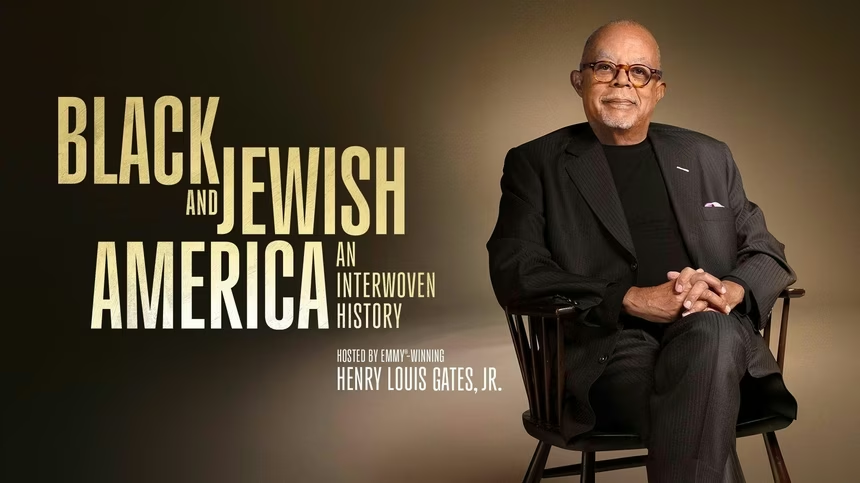
Episode four of BLACK AND JEWISH AMERICA: AN INTERWOVEN HISTORY explores the evolving Black and Jewish alliance from the 1970s onward. From affirmative action and political milestones to Middle East tensions and rising hate, it examines challenges, shared struggles, and the lessons of solidarity in a divided America.
From
Problems playing video? | Closed Captioning Feedback
Problems playing video? | Closed Captioning Feedback
Corporate support for BLACK AND JEWISH AMERICA: AN INTERWOVEN HISTORY was provided by Bank of America and Johnson & Johnson. Major support was provided by the Corporation for Public Broadcasting....
Crossroads
2/17/2026 | 52m 55sVideo has Closed Captions
Episode four of BLACK AND JEWISH AMERICA: AN INTERWOVEN HISTORY explores the evolving Black and Jewish alliance from the 1970s onward. From affirmative action and political milestones to Middle East tensions and rising hate, it examines challenges, shared struggles, and the lessons of solidarity in a divided America.
From
Problems playing video? | Closed Captioning Feedback
How to Watch Black and Jewish America: An Interwoven History
Black and Jewish America: An Interwoven History is available to stream on pbs.org and the free PBS App, available on iPhone, Apple TV, Android TV, Android smartphones, Amazon Fire TV, Amazon Fire Tablet, Roku, Samsung Smart TV, and Vizio.
Community Engagement & Discussion Guide
This guide will point you to resources, partners and suggestions that allow you to create the engagement opportunities that truly connect, invigorate and inspire your communities.Providing Support for PBS.org
Learn Moreabout PBS online sponsorship[ Dramatic music plays ] -By the end of the 20th century, relations between Black and Jewish Americans had grown deeply complicated.
-Nothing has separated the Jewish and the Black community more than affirmative action.
-Andrew Young secretly has a meeting with members of the PLO.
-The issue right now is not Jews and Blacks.
The issue really is the Middle East.
-Black men stormed through the street.
-To kill an innocent young man... -The alliance that once sprang from shared oppression had been tested by politics, by foreign conflicts, and by the passage of time.
-Tensions began simmering last night.
-If you want any more evidence that racism and anti-Semitism are linked, think about Charlottesville.
-You!
Will not!
Replace us!
-We must not allow the relationship between Jews and African Americans to suffer.
-During this time, Blacks and Jews have been pulled together and pushed apart.
-The alleged gunman's social media filled with hate against Jews, immigrants.
-We're at a moment where all sorts of malevolent forces are at work.
-Still, I think the story of that relationship has something to teach us about difference, about division, and about the hard work of coalition building.
♪♪ [ Down-tempo music plays ] -Dr.
King referred to himself as a drum major.
With his death, the drums are louder still.
We do not yet know whether they are a summons to battle or to the meeting of reconciliation and peace.
That choice, it seems to me, is largely up to us.
[ Siren wailing ] ♪♪ -1968 would see widespread student protests and massive social upheaval.
Both Martin Luther King Jr.
and Robert Kennedy would be assassinated within a few short months of each other.
That was also the year I graduated from high school in Piedmont, West Virginia.
And after a year at the local junior college, in the fall of 1969, I would transfer into the sophomore class at Yale as one among the largest number of Black students ever to matriculate at the university, reflecting Yale's effort to diversify its student body.
-During the Kennedy and especially the Johnson administrations, there was a heady rush of legislation to expiate the 300 years of what came to be known as racism and sexism.
-Affirmative action dismantled a racist quota.
There always was a specified number of Black people, and so affirmative action blew that up.
The class of '66 at Yale had six Black guys to graduate.
The class that hit campus in September of '69, three years later, had 96 Black kids -- the largest presence of Black people in the history of Yale.
I was one of them.
-The university says it will have a new program to guarantee minority admissions.
-Affirmative action, designed to benefit women as well as people of color, would come to be a defining issue of my generation.
Some institutions initially sought to increase racial diversity through quotas, a policy that became a bone of contention between Blacks and Jews.
Jewish organizations, long committed to the civil rights struggle, found themselves aligned with conservatives in opposition to racial quotas in college admissions.
-Whether you discriminate in favor of somebody or against somebody, it eventually means the same thing.
You're working against that concept of the society of equals all being treated equally.
-Just a generation earlier, quotas had been used to cap the number of Jewish students on campus.
And in the eyes of many Jews, any quota system threatened to erase their hard-won gains.
♪♪ -What some people call affirmative action others call reverse discrimination.
-Increasing the number of Black students through quotas would by definition reduce the number of white students, including Jews.
-Nothing has separated the Jewish and the Black community more in the last generation than this issue of affirmative action.
-For much of the 20th century, Black and Jewish Americans had stood shoulder to shoulder on many social and political issues.
That seemed to be changing as the fight over racial quotas escalated.
But when affirmative action shifted from strict quotas to diversity goals, Jewish opinion also changed.
[ Crowd cheering ] With quotas off the table, many Jewish organizations aligned with defenders of affirmative action in cases before the Supreme Court.
Differences between the two groups on issues like racial quotas would soon move beyond college campuses into politics more broadly -- and ultimately onto the world stage.
[ Group singing ] Traditionally, Israel was seen by Jewish people as a safe haven from persecution and a core part of their identity.
But to some Black activists, Israel increasingly was viewed as a colonial power.
[ Down-tempo music plays ] -The normative practice among American Jews from the 1960s on became one of very deep connection with the state of Israel -- precisely when Israel became more and more criticized by many people within the American Black community.
-We are moral messengers, and we believe and support the human rights of all Palestinians, including the right to be self-determinant.
-As the '70s progressed, the Palestinian cause began to gain traction globally.
In 1975, the United Nations, over the objections of many Western countries, including the United States, passed a resolution declaring Zionism to be a form of racism.
-United Republic of Tanzania.
-Yes.
-United States.
-No!
-La présente résolution est adoptée.
-The 1975 resolution had widespread support, and it really shocked the Jewish world.
-This resolution, based on hatred, falsehood, and arrogance, is devoid of any moral or legal value.
-The Zionism-as-racism resolution led to the consolidation of a new coalition of non-Western actors, a raid against Western powers who considered Israel to be part of the Western camp.
That coalition sought to bring an end to all remaining forms of colonialism in the world.
They saw Zionism as a particularly live form of colonialism.
At the same time, Jews, especially in the United States, came to regard that equation of Zionism and racism or Zionism as colonialism as the new anti-Semitism.
[ Down-tempo music plays ] -As the opponents dug in, many veterans of the civil rights struggle, well aware of the critical role the Black-Jewish alliance had played in its success, refused to abandon their Jewish allies.
And in November 1975, they took out a full-page ad in The New York Times to reaffirm their commitment to Israel.
-BASIC, the Black Americans in Support of Israel Committee, was formed by a bunch of the old-guard civil rights leaders as SNCC and these other groups become more and more anti-Israel, questioning whether Israel should exist at all.
-They would make the two people who were Jewish who helped found the NAACP racist!
They would make thousands of Jews who gave Martin Luther King over $2 million racist!
Shame upon them!
[ Applause ] -These other Black leaders say, "No, no.
That's not how we feel about Israel.
The Black community is with you.
We stand for Israel.
Stay with us."
-These leaders were determined to emphasize the importance of keeping the alliance intact.
And while support for Israel in the Black community remained strong... [ Explosion echoing ] ...the efforts of some Black leaders to engage in the politics of the Middle East would strain that alliance, as violent acts of terrorism carried out in the name of the Palestinian cause began to reshape the political climate.
-The Israeli sportsmen were taken hostage in their living quarters in the Olympic Village at Munich.
Some were murdered on the spot.
-Palestinian guerrillas who have seized an Italian cruise ship are now demanding that Egypt give them time on radio and television to broadcast their demands.
If they don't get that, they say, they will begin killing the passengers.
-The Palestinian Liberation Organization, or the PLO, was the main group that people identify as commandeering the Palestinian issues.
Yasser Arafat becomes this archetype of the PLO.
[ Cheers and applause ] -I have come bearing an olive branch and a freedom fighter's gun.
Do not let the olive branch fall from my hand.
-Arafat had always presented himself as a freedom fighter, but in the context of the U.S., Arafat was a terrorist.
-The American Jewish community regarded Yasser Arafat as someone with whom one could not enter into any legitimate form of political discourse.
-Martin Luther King's chief lieutenant and basic signatory, Andrew Young, now ambassador to the United Nations, found himself caught in a Black-Jewish quagmire.
-President Carter led the prolonged applause for the swearing in of Andrew Young.
-As the first African American ambassador to the United Nations, Young was an important historical symbol to the Black community.
-This is one of the highest offices that a person can hold, and the fact that Carter would appoint him as the kind of symbol of America at the United Nations meant something.
-Hoping to forestall the introduction of a U.N.
resolution about Palestinian statehood, Ambassador Young engaged in an unauthorized meeting with the PLO's U.N.
observer.
-Andy, who had been on the front lines of civil rights struggles across the South, believed that the only way to bring about an effective change was through dialogue and communication and conversation.
-Andrew Young secretly has a meeting with members of the PLO because he's trying to find out ways to kind of broker a peace.
-To be in conversations with the PLO, it was taboo for any American politician.
And so he did it quietly.
-Word of this leaks, and the Jewish community erupts in outrage.
-After less than two years on the job, Ambassador Young was forced to resign because of the tempest that arose from his clandestine meeting with PLO leadership.
-The Black community and the Jewish community have traditionally worked together, will continue to work together in spite of differences.
The issue right now is not Jews and Blacks.
The issue really is the Middle East.
-Even though it was President Jimmy Carter who had reluctantly demanded Young's resignation, some Black activists claimed that his hasty exit had been orchestrated by powerful Jewish elites.
-Andrew Young is forced to resign, and Blacks are very angry.
And this is not just a street reaction.
These are the people who speak for the center of Black life and Black politics.
And here they are feeling that Jews, essentially, have driven Andy Young out of office.
-Many of us felt that that was a bridge too far, to go after the first Black U.N.
ambassador, who clearly had a record of working for reconciliation with everybody.
Isn't that what diplomats are supposed to do is meet with both sides and see if they can find some common ground?
Isn't that what Dr.
King did?
That was one of the rifts in the Black and Jewish community.
♪♪ -In the weeks that followed, a second diplomatic controversy involving another prominent Black leader would sow more seeds of mistrust between Blacks and Jews.
-We are concerned about the plight of Palestinian people.
Each of us knows the history of terror in this region too well.
-September of 1979, the Reverend Jesse Jackson met with the PLO.
-Jesse was looking at the PLO as an integral part of a human-rights solution to what was going on in Israel and Palestine.
-And he meets with Yasser Arafat, the head of the PLO, and he hugs him.
[ Down-tempo music plays ] -I remember the photo.
I remember how it violated a sense of propriety and legitimacy for a major American religious and political figure to grant credibility to a person who was deemed, in the American-Jewish imagination, to be nothing other than a terrorist and, in fact, the chief terrorist.
-That picture of him embracing Arafat goes viral, and Jews are very suspicious of him.
And many Blacks are suspicious of him too, frankly.
-Jackson lost some Jewish support for his actions, but not all.
Many liberal Jews committed to social justice at home continued to support him as his political star continued to rise.
-I announce to you this day my decision to seek the nomination of the Democratic Party for the presidency of the United States of America.
[ Cheers and applause ] -Just four years later, Jackson announced his bid for the presidency.
As the charismatic leader of a multiracial coalition, Jackson positioned himself as the champion of the oppressed.
-The Rainbow Coalition was a very savvy way of reaching beyond Black and brown people and getting white liberals and progressives on his side.
And that would include a great deal of progressive Jews.
-But during his 1984 campaign, he made some off-color remarks to a Black journalist, which would harm his coalition and cripple his candidacy.
-Milton Coleman, who was a Black reporter for the Post, was talking to Jesse Jackson after a campaign event, and Jackson said to him, "Let's talk Black talk," which Jackson took to mean off the record.
In the conversation, Jackson said, "All the Hymies want to talk about is Israel.
"When I got to Hymietown, that's all they want to talk about," Hymietown being New York.
And all hell breaks loose.
-Hey, Jesse, you anti-Semite, get out of L.A.!
-Down with!
-Jesse Jackson!
-Jackson and the Jews has become an issue in this campaign.
-We just doesn't want to see Jackson come in there.
-The press seized upon this, and it really endangered Jesse Jackson's campaign at a moment where it had been really building up steam.
-For many Jews, this is confirmation that Jackson is anti-Semitic and he's fanning these flames.
-It was not in the spirit of meanness but an off-color remark having no bearing on religion or politics.
However innocent and unintended, it was insensitive and wrong.
-At the Democratic Convention, he tries to make amends, but it's something that he'll never be able to live down or to get rid of.
-When he said the Hymietown remark, obviously an anti-Semitic slur, that becomes another controversial moment that Jackson has to apologize for and that "Saturday Night Live" memorably lampoons.
[ Laughter ] -And this is a very special message to all you chosen people out there.
-♪ Ooh, ooh, ooh ♪ -♪ Don't let me down ♪ -♪ Down, down ♪ -♪ Don't let me down ♪ -♪ No, no, no, no ♪ -♪ Don't let me down ♪ -♪ Hymietown ♪ -♪ Hymietown ♪ [ Laughter ] -While Jackson would make another bid for the presidency in 1988, the damage had been done.
For many Jews, it seemed like the boundaries had shifted, as open expressions of anti-Jewish hostility increasingly appeared to be fair game.
[ Cheers and applause ] This feeling only hardened when one Black leader decided to make hate part of his appeal to the wider Black community.
-We have to follow our self-interest even if our self-interest causes us to be at variance with the interests of the Jewish community.
-And unlike Jackson, he was completely unapologetic about his attacks on Jews.
-The Jews don't like Farrakhan.
So they call me Hitler.
Well, that's a good name.
Hitler was a very great man.
[ Down-tempo music plays ] -Louis Farrakhan's blatantly anti-Semitic views were widely attacked in the mainstream media But that was only one source of his platform.
As a leader of the Nation of Islam, a 20th-century faith tradition that uses Islamic idioms to advance Black nationalist ideals, Farrakhan directed his message to a growing number of young Black males who felt increasingly dispossessed.
-If we start dotting the Black community with businesses, challenging ourselves to be better than we are, white folk, instead of driving by using the N word, they'll say, "Look.
Look at them."
♪♪ -While we knew Farrakhan was problematic, you have to understand the dire conditions that Black people were in.
There was so much that Farrakhan was doing that was tangible for Black people alongside a nation that was actually often doing the opposite.
-God is blessing me to raise up a nation of Black people who are considered spiritually, politically, and economically dead.
-While his platform of Black pride and economic self-reliance resonated with some segments of the Black community, Farrakhan also used his broad reach to spread dangerous falsehoods.
I was in a class one day, and a student was talking about slaveholders in the South.
And he turned to one of the Jewish kids, and he said, "Yeah.
One of your ancestors, Joseph."
I was shocked, you know?
And I realized he was basing this slur on misinformation, and that was this crazy book called "The Secret Relationship Between Blacks and Jews."
-In the South, 75% of Jews owned slaves... while 36% of the gentiles owned slaves.
-Published by the historical research department of the Nation of Islam, this three-volume work claimed to expose the long-hidden secret of the pivotal role Jews had played in the transatlantic slave trade.
Farrakhan argued with much fanfare that all along it had been the Jews who were responsible for the original sin of slavery, the source of so much Black misery.
-How are Jewish people in America responsible for the plight of Black people?
-Well, unfortunately, sir, it's come to light that the Jewish people were significantly involved in the slave trade.
-It was just total rubbish.
Somebody had to speak up, so I did.
My motivation was simple.
I wanted to set the historical record straight.
Jewish involvement was not at all the driving force in the history of the slave trade, and to suggest otherwise was an attempt to scapegoat Jews and exacerbate tensions that could undermine the historic alliance between Blacks and Jews.
It received a lot of attention, a lot of hatred, death threats.
You know, "Why'd you do it, brother?"
[ Laughs ] "Them Jews paying you?"
You know.
I'm a scholar.
It was important to say that it was false because it was false!
-Jews saw in Farrakhan a real danger.
He put a match to this kind of underground feeling that Blacks and Jews had that they could not really trust each other.
[ Mid-tempo music plays ] Economic and cultural tensions between Blacks and Jews always had the potential of surfacing in communities where they were living side by side.
And in the summer of 1991, in one Brooklyn, New York, neighborhood, those very tensions exploded -- with fatal consequences.
-What is unique about Brooklyn is somewhat unique to New York, in that it holds this inherent contradiction.
It's a very diverse borough, and it's deeply segregated.
So while these people live among one another, they don't really live with each other.
And in Crown Heights in particular, there is a sort of hyperextended version of that.
♪♪ -The Black and Jewish populations of Crown Heights, Brooklyn, were a unique mix.
Black residents were mostly immigrants from the Caribbean rather than migrants from the American South, while their Hasidic neighbors were part of an orthodox Jewish community known for its uniquely conservative interpretation of Jewish law.
Their black hats and long black coats were signs of difference as indelible as the black skin of their neighbors.
Hasidic Jews had never been part of the civil rights movement.
They had never been part of Jewish liberalism.
They were a very insular community.
They were literally living cheek by jowl with a working-class Black community that saw these Jews expanding, because the Hasidic Jews wanted to live together.
-There is inequality which is rampant in housing, in access to places of public accommodation, in social services.
And because of the way these communities are constructed, these obstacles are seen in Black and Jewish terms.
It is the Jews are the haves.
The Blacks are the have-nots.
-In Crown Heights, the Lubavitcher faction of the Jewish community maintain their own private schools, ambulances, and security patrols.
Their Black neighbors, however, were reliant on public resources, often lacking by comparison.
Resentments over these disparities would boil over after one tragic incident.
-Black residents are demanding justice after a motorist, a Hasidic man, ran a red light, jumped a curb, and hit two Black children, killing one and critically injuring the other.
[ Siren wailing ] -The violence erupted shortly after a Jewish-owned ambulance whisked away the Jewish driver.
-The issue is that there must be justice if you ever want real peace.
We lost a 7-year-old kid.
Who was the driver, and how does he end up going on the curb?
They would never produce the driver.
-Throwing rocks, carrying bats.
and overturning police cars, an angry crowd roamed through the Crown Heights section of Brooklyn.
-Rioting breaks out, and an Australian exchange student who's Jewish is walking along.
A group of Blacks set upon him and kill him.
-To kill an innocent young man on the street, to burn cars of innocent people... -For many Jewish residents, the beatings, the violence resembled what their ancestors had faced in Eastern Europe and immediately taps into that longer history of oppression.
-New York Mayor David Dinkins came to calm the crowd but could do little about it.
-We've got to increase the peace.
-David Dinkins, the Black mayor of New York at the time, who had been elected with Jewish support, couldn't figure out what to do.
-Police in New York City are hoping to prevent a fourth day of trouble.
-Many criticized Dinkins for not kind of cracking down enough, and as a result, the riot was a real stain on the first Black mayor of New York City's legacy.
-Once the violence was quelled, sadly, neither side would feel that justice had been served, leaving open wounds to fester.
In the Crown Heights aftermath, Black and Jewish residents seemed unable and unwilling to hear one another.
Just when it felt like the situation was hopeless, one courageous artist decided to plunge into an arena where others feared to tread.
[ Dramatic music plays ] -Anna Deavere Smith interviewed Blacks and Jews.
-Sometimes... I think there's no justice... because the Jewish people, they are very high up.
-In 1992, playwright and actor Anna Deavere Smith interviewed over 100 people from every side of the Crown Heights conflict and brilliantly performed their words verbatim.
-I understood a function of art was to break down divisions among people not only by listening to them, but then by becoming them.
-[ Australian accent ] My brother was the only victim who paid for being Jewish with his life!
-What in the world drew you to the events of Crown Heights?
Were you trying to bring the communities together?
-I wasn't trying to bring the community together.
I was trying to give the community an opportunity to talk about why they weren't together.
-Do you think that being aware of the specificity of our experiences, our commonalities can serve as a basis for coalition politics between Blacks and Jews?
-I'm not interested in commonality.
-Mm.
-I'm interested in particularness.
I'm more interested in the tragic separation.
The thing it offers me is a desire to know about that which is very different than me.
-It's always dangerous to compare, like, one group's suffering for -- You know.
I mean, Jews have a lot that we've suffered.
I mean, the trauma of the Holocaust is still very much with us.
And, I mean, there was a unique horror to slavery.
It's a very different thing.
[ Mid-tempo music plays ] -Like Anna, Pulitzer Prize- and Oscar-winning writer Tony Kushner seeks to explore America's cultural diversity and celebrate its differences.
Raised in the American South, Kushner's semi-autobiographical musical, "Caroline, or Change," tells a story of a Black maid working for a Jewish family in Lake Charles, Louisiana, during the civil rights movement.
-The woman who worked for my family as a maid, Maudie Lee Davis, who is the -- "Caroline, or Change" is based on her, It's dedicated to her.
-Was focusing on these two families, one Black, one Jewish, meant to be a metaphor for the larger relationship between Blacks and Jews in the United States?
-Well, I don't know if it was a metaphor.
I mean, it was... it was my first lived experience of this incredibly complicated relationship.
I mean, the Black-Jewish relationship has suffered a lot in the last 30 or 40 years.
It suggests, in so many ways, how hard and complicated the things that have torn us apart as communities are and how complicated the process of bringing them back together is going to be.
-After Crown Heights, the Black-Jewish relationship here at home seemed to have reached a low point.
But half a world away, another drama was playing out, one that offered a promise of renewal.
-Israel has more than 15,000 brand-new immigrants tonight.
They're the Black Jews of Ethiopia.
Just a day and a half ago, they were caught in that country's escalating civil war.
-They fled because of famine, and there was another wave of oppression of Jews in Ethiopia.
Many of them were trying to escape.
It's a powerful story of perseverance and of faith.
-After centuries of persecution, with civil war and famine ravaging the country, Jews in Ethiopia were offered a means of escape.
In a covert operation that would unfold between 1984 and 1991, Israel would provide a safe haven.
-There's a kind of groundswell of political momentum that leads to the famous airlifts.
-The first airlifts were organized in 1984.
Twelve thousand people were flown to safety in a secret Israeli operation, code name Moses.
-When the airlifts started, the group is referred to as the Beta Israel, and they're seen as Jews within an Ethiopian context.
-At the same time, the rabbis in Israel insist that they go through a conversion ceremony, even though they are Jewish, because they're not Jewish in the "European" sense of the word.
They have different practices.
-Although the Torah was at the heart of Jewish life in Ethiopia, centuries of isolation, marked by adherence to their own ancient religious traditions, meant that holidays like Hanukkah were unfamiliar to them until they reached Israel.
-It wasn't that people said they weren't Jews.
The Beta Israel were seen as eastern, backwards, primitive, and so they had a need to go through a formal conversion.
[ Down-tempo music plays ] Now, for many, particularly the elders of the Beta Israel, this was an offense.
-You have this Israeli embrace of "We are all children of Israel" and at the same time, racism.
That also helps bring the issue of Black Jews everywhere in the world.
-Suddenly people are talking about these Black Jews who've been airlifted by the thousands into Israel, and they become catapulted into the spotlight as the quintessential representation of Black Jews in the world.
-I believe that with our story, we can strengthen the relationship between the Jews and the Blacks in America.
-The rise of visibility and the rise in the numbers of Jews of color have created really interesting questions about what it means to be Jewish in the United States.
In a way, it's holding up a mirror about the Jewish experience and how Jewish identity has become merged over many decades with being white.
-I don't consider myself white.
And when I once told our class that, they laughed in my face.
You laughed in my face.
-I did.
-Many white American Jews are absolutely stunned to learn that there are so many Jews of color.
-There's an assumption that all Jews are white, that all Jews are powerful.
And we're not examining the ways in which Black Jews deal with their own double consciousness.
-It was kind of like this watershed moment for interracial kids.
I felt like it was a recognition that you can be biracial but also that if you are Black and white, being Jewish means something kind of different.
And...I really appreciated that.
-...five, four, three, two, one!
-Happy New Year!
-Happy New Year!
-As the 20th century drew to a close, being Black and Jewish no longer had to be considered an either-or proposition.
In fact, for the first time in American history, the 2000 census allowed people to choose more than one ethnic or racial identity.
It seems fitting, then, that when a new-generation Black leader emerged, his own multiracial background would both challenge and broaden the view of what was possible.
-I stand before you today to announce my candidacy for president of the United States of America.
-Barack Obama's arrival on the national political scene appeared destined.
-When Barack Obama decides to run, it's completely perfect.
-[ Chanting ] Obama!
-He is a candidate that all unite around.
He is totally pro-Jewish.
He runs ads in Hebrew.
He declares the Black-Jewish alliance is alive.
-We must not allow the relationship between Jews and African Americans to suffer.
This is a bond that must be strengthened.
-Obama not only understood the importance of the historical alliance between Blacks and Jews, but he frequently referenced the Old Testament Exodus story in campaign stump speeches.
-I stand on the shoulders of giants.
I thank the Moses generation.
-Yes.
Yes.
[ Audience murmuring ] -We got to remember, now, that Joshua still had a job to do.
-By accepting the torch from the old-guard elders of the movement, whom he called the Moses generation, Obama sounded a hopeful note by declaring himself the leader of the Joshua generation, the broad-based coalition that had worked to get him elected.
-We're gonna leave it to the Joshua generation... [ Audience murmuring ] ...to make sure it happens.
There are still some battles that need to be fought, some rivers that need to be crossed.
-There's this hunger for this kind of throwback to coalition politics and alliance politics where you'd have this leader, you know, this kind of transformational Black leader who could see because of that shared experience and who could drive an agenda that would be beneficial to all.
-The next first family of the United States of America.
[ Crowd cheering ] -Perhaps the fairy tale was that you could move on and resuscitate this without dealing with the deep insecurity, anxiety, and wounds that had been left by earlier, unresolved fractures.
[ Dramatic music plays ] -This is an ABC News special report.
-One of the deadliest attacks on a place of worship in United States history.
-Twenty-one-year-old Dylann Roof opened fire on one of the most famous Black churches in the South.
-Mother Emanuel is, in fact, more than a church.
This is a place of worship that was founded by African Americans seeking liberty.
-The shooting at Mother Emanuel AME church in June 2015 was a wake-up call to anyone who thought electing a Black president meant that the concept of race and anti-Black racism were things of the past.
-The election of Barack Obama immediately exposes how deeply ingrained white supremacy is in the fabric of American society and culture.
-And although the massacre at Mother Emanuel was aimed at Black worshippers, rising ethnic hatred would prove to be colorblind.
-If you look at the manifesto of the shooter, he wasn't just railing against Black people.
He was also talking about Jews.
-I've found, in my own experience, that most people that are anti-Semites are also racist.
-The Charleston shooter's words were part of a larger pattern, a resurgence of white nationalism targeting both Blacks and Jews, reminding them that they faced a common enemy.
Hate.
In the years that followed, the pace of these attacks accelerated as racism and anti-Semitism were amplified by the social-media echo chamber.
And nowhere was that more apparent than in Charlottlesville, Virginia.
-Tensions began simmering last night, when white nationalists carried torches in the city, eerily reminiscent of Nazi-party propaganda events in the '20s and '30s.
If you want any more evidence that racism and anti-Semitism are linked, think about Charlottesville.
What were those people chanting?
"Jews shall not replace us."
-Saturday's rally was sponsored by white nationalists, who showed up in force.
-When you see Charlottesville, they're marching, saying, "Jews will not replace us," and they were defending the statue of a Confederate general to enslave us.
-Charlottesville had sounded an alarm, and no one could have anticipated the horror to come.
[ Down-tempo music plays ] Just a year later, a gunman stormed the Tree of Life synagogue in Pittsburgh in the deadliest anti-Semitic attack in the history of the United States.
-They came together to worship and were brutally murdered.
The alleged gunman's social media -- filled with hate against Jews, immigrants.
-In the end, 11 worshippers from three different congregations were killed, all because of their faith.
-In the wake of the Tree of Life shooting, Black and Jewish faith leaders and their congregants linked arms in mourning and in solidarity.
[ Down-tempo music playing ] -♪ We shall overcome ♪ ♪ Some day ♪ [ Applause ] -Of course we welcome my dear brother and my friend Rabbi Jeffrey Myers and his congregation, Tree of Life.
-Rabbi Myers lost seven members of his own synagogue in the massacre.
-I reached out, pastor to rabbi, just to say, "Hey, I'm here, man, and I care."
If it helps him to know that someone cares, that someone's thinking about what he must be going through... ♪♪ -For far too long, we've had a vast silent majority in America.
We need that silent majority to become vocal, to say, "This is not okay."
...that says enough is enough.
-Amen!
[ Applause ] -After years of strain, the Black-Jewish alliance, frayed but resilient, began to regain momentum, united against the growing wave of hate.
[ Down-tempo music plays ] Then came October 7, 2023.
Hamas terrorists invaded Israel and brutally murdered more than 1,000 Israeli Jews and took more than 250 hostages.
-Jews were absolutely horrified.
This is not just two sides fighting.
This is Israel facing a group that wants it annihilated.
♪♪ -The terrible, brutal massacre by Hamas occurs on October 7th, and the set of responses, either justifying or calling attention to the loss of life on both sides, was met with anger and resentment on the part of many Jews.
I must confess that I myself would've wished that more of my friends and allies on the left would have been able to condemn what occurred on October 7th as a kind of searing of the human soul.
♪♪ -I think if you go back and look at social-media comments, there was condemnation of Hamas.
♪♪ [ Explosions echoing ] But fast-forward six, 12, 18 days later, and the Israeli onslaught on Gaza and the devastation.
The sentiment had changed.
-After October 7th, whatever strides forward the Black-Jewish coalition had built became very shaky, because now the sympathy in the United States was with the Palestinians.
-The horrendous attack on October 7th, with the callous murders and taking of hostages that accompanied it, was followed by a brutal war that brought widespread devastation and a tremendous loss of life in Gaza, setting in motion passionate and bitter debate.
And nowhere was the atmosphere more charged than on college campuses.
♪♪ -Shame!
Shame!
Shame on you!
-The protest movement begins in the fall of 2023, and it creates very deep battle lines, which seem to be unbridgeable.
-Free, free Palestine!
-What you have in campus after campus is a standoff between the pro-Palestinian group, which is made up of Jews and non-Jews, and the pro-Israel group.
[ Group chanting indistinctly ] -For a lot of the students that I've talked to, Black and Jewish students, the distinction between punishing Hamas and punishing Palestinians has led to divides on college campuses.
-The political climate on campus was fraught.
The number of pro-Palestinian Black students rose sharply, while Jewish students themselves often seemed bitterly divided between those who strongly defended Israel's retaliatory war against Hamas and those who vehemently condemned it.
-Many of the pro-Palestinian protests are filled with people who are from many different racial groups, including a number of Jewish Americans.
And I think our inability to talk about the complexity of even that sort of division has created far more discord.
-As the war continued, online misinformation and deep differences of opinion often made conversations volatile, even impossible, sometimes dividing families, straining friendships and, more broadly, pulling the Jewish and Black communities even further apart.
-The United States over the last decade has become increasingly politically polarized, and it's become harder and harder to have difficult conversations about pretty much any subject.
And we've really seen in the last year, then, a profound difference between the way the Israel-Palestine issue is talked about on campus and the way it was discussed in previous years.
-From the river to the sea... -At UCLA, a small number of us gathered and said, "How can we make clear that we value all human life, that it's necessary to condemn what occurred on October 7th and it's necessary to condemn this massive assault by Israel?"
A number of us continued to try to find ways to at least be able to hold conversations across this divide.
It was clear that something needed to be done.
-David Myers leads an initiative at UCLA called Dialogue Across Difference, which, as the name suggests, promotes open discourse and debate, training students how to engage in honest, if difficult, conversations.
[ Down-tempo music plays ] -I came to see, even before October 7th, that something was not right in our culture at the university.
We were in silos in which we felt very comfortable.
We had lost the muscle to engage one another.
When the opportunity came along to get involved in the Dialogue Across Difference initiative, I jumped at the chance.
-So, it's been over a year since the protests took place here at UCLA.
What was that experience like personally?
-I remember the protest being a very scary time for everyone.
The campus became divided, and a lot of friendships were broken.
-Mikey, as an Israeli, did you want revenge?
Did that occur to you?
-A hundred percent no.
-No?
-That's not where my heart was at.
I felt a lot of anger.
Not revenge, though.
What I was thinking is we're grieving right now.
The same time, the assault on Gaza began.
It was a very complicated time.
-When the encampment did happen and everything just kind of blew up on campus, Dialogue Across Differences was the first space that I actually had to talk about what had happened.
-Has it been effective?
-I think the initiative is really important to bring people that are on different parts of the identity and the political spectrum, bring them in the same space.
-The role of dialogue is to create a framework to have a conversation, to say, "Let's get to know each other," and actually spend that time asking, "What do you think?"
or, "What do you feel?"
Those conversations have to be built intentionally.
-Are there lessons that you've learned from your experience that can be upscaled to other situations, like, for instance, the relationship between Blacks and Jews, do you think?
-Yes.
And not just Blacks and Jews, but also, I'm Latino, and so I think there's a great many communities that can be aided by having your pain acknowledged and seen.
And I think that's a really important first step.
-You sound like my couple therapist.
-You're welcome.
[ Laughter ] -Black people and Jewish people have always been looking for spaces for representation.
If we are able to come together and have discussions and understand that our struggles are intertwined, I think we can make progress together in that way.
-Blacks and Jews can agree that there are other issues, apart from Israel-Palestine, that bring us together.
There are other shared interests that really run deep, from the complicated and interwoven histories of both those peoples.
[ Mid-tempo music plays ] ♪♪ As I always say of myself, I'm a situational pessimist and a congenital optimist.
So today is bad, but tomorrow is gonna be a better day.
I love that.
♪♪ -Across this series, we've revisited stories of triumph and heartbreak... alliances forged and tested.
Blacks and Jews, two peoples shaped by exile and resilience, know what it means to be cast out and what it takes to build beauty from pain.
At our best, we've stood shoulder to shoulder in marches and protests, in courtrooms, in classrooms, in churches and synagogues, not just for ourselves but for each other.
History reminds us that freedom is fragile, democracy a work in progress, and that no one is safe until everyone is safe.
In the end, it's about finding common ground and imagining a future neither of us can build alone.
♪♪ [music plays through credits] ♪ ♪ ♪ ♪ ♪ ♪ ♪ ♪ ♪ ♪ ♪ ♪ [music continues through credits]

- History
Great Migrations: A People on The Move
Great Migrations explores how a series of Black migrations have shaped America.

Support for PBS provided by:
Corporate support for BLACK AND JEWISH AMERICA: AN INTERWOVEN HISTORY was provided by Bank of America and Johnson & Johnson. Major support was provided by the Corporation for Public Broadcasting....