
Several More Lives to Live
Episode 3 | 1h 1m 51sVideo has Audio Description
After Walden, Thoreau takes on new roles and adventures as an illness catches up with him.
After completing his two-year experiment at Walden Pond, Thoreau returns to society to test what he has learned about living responsibly. He undertakes new “experiments” as a surveyor, scientist, and abolitionist, and takes two more trips to Maine — uncovering even deeper truths about life and the world. He writes with a new urgency as a lifelong illness begins to catch up with him.
From
Problems playing video? | Closed Captioning Feedback
Problems playing video? | Closed Captioning Feedback
Episodes presented in 4K UHD on supported devices. Major funding for HENRY DAVID THOREAU was provided by The Better Angels Society and its members: The Keith Campbell Foundation for the...
Several More Lives to Live
Episode 3 | 1h 1m 51sVideo has Audio Description
After completing his two-year experiment at Walden Pond, Thoreau returns to society to test what he has learned about living responsibly. He undertakes new “experiments” as a surveyor, scientist, and abolitionist, and takes two more trips to Maine — uncovering even deeper truths about life and the world. He writes with a new urgency as a lifelong illness begins to catch up with him.
From
Problems playing video? | Closed Captioning Feedback
How to Watch Henry David Thoreau
Henry David Thoreau is available to stream on pbs.org and the free PBS App, available on iPhone, Apple TV, Android TV, Android smartphones, Amazon Fire TV, Amazon Fire Tablet, Roku, Samsung Smart TV, and Vizio.
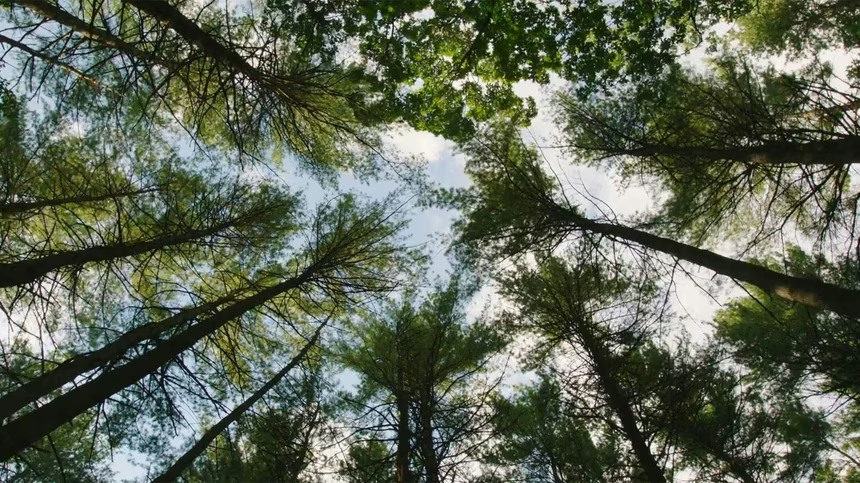
Share Meditative Moments from the Film
Explore the PBS Giphy collection for Henry David Thoreau.Providing Support for PBS.org
Learn Moreabout PBS online sponsorshipAnnouncer: Major funding for "Henry David Thoreau" was provided by... The Better Angels Society, Jeff Skoll, the Mansueto Foundation, Tyson Foods, and The Arthur Vining Davis Foundations.
Funding was also provided by the Tyson Family Foundation, The Neil and Anna Rasmussen Foundation, and by The Better Angels Society members: The Keith Campbell Foundation for the Environment and Mark A. Tracy.
Additional funding was provided by Roxanne Quimby Foundation, Jim and Mona Mylen through The HeartSpace Fund, and Elizabeth Kenny.
[Cricket chirping] ♪ Henry David Thoreau: It seemed to me that I had several more lives to live, and could not spare any more time for that one.
Henry David Thoreau.
♪ Laura Dassow Walls: If one says that he went to Walden to find the secret of life, and if one says he did, the point was to take it back out into the world, to move to town and see, "Well, can I bring this with me?
Can I meet new challenges in a new environment?"
So the experiments continue.
[Birds calling] ♪ Narrator: When Henry David Thoreau left Walden Pond, he was 30 years old.
[Horse neighs] For two years, he had lived simply and deliberately, broadening his own transcendent view of life, based on the revelation that all things-- rocks, plants, animals, and people--are interconnected.
His writing there provided the foundations for his two most famous works: "Walden," about what he had learned from his two years at the pond... [Jail cell door shuts] and "Civil Disobedience," about why he spent a night in jail to protest a government that still allowed slavery to exist.
Pico Iyer: It's so unlikely that Henry David Thoreau would suddenly be making his own "Declaration of Independence" and "Bill of Rights" in this little town next to a pond.
There were no search engines then; there was no easy way for accessing the wisdom of the world.
But such was his curiosity that he found it.
Narrator: Now Henry would live "other lives" as a surveyor, scientist, explorer, and abolitionist-- all of which gave him new insights into nature, society, and himself.
He would make a discovery about the evolution of species that had eluded even Charles Darwin.
He would write an essay that explored the connections between the wildness of nature and a human's desire to be free.
He would take a second and third expedition to Maine, where he experienced the Penobscot tribe's intimate relationship with the land, which was even deeper than he imagined possible.
And he would support new strategies to try to abolish slavery, even at the risk of compromising his own convictions.
Cristie Ellis: The thing he models for us the best is a life committed to ongoing investigation.
He talks about always wanting to get two views of the same truth.
Because the truth will change when you get another view of it.
Henry David Thoreau: I fear chiefly lest my expression may not be extravagant enough, may not wander far enough beyond the narrow limits of my daily experience, so as to be adequate to the truth of which I have been convinced.
As if Nature could support but one order of understandings.
The universe is wider than our views of it.
♪ [Bell ringing] Narrator: After he left Walden Pond, Henry spent ten months living at the home of his friend and mentor, Ralph Waldo Emerson, while the famous transcendentalist was traveling abroad.
He soon became part of the family.
He referred to Emerson's wife Lidian as a "dear sister."
Their 3-year-old son Edward asked Henry to be his father.
Sandra Harbert Petrulionis: The children talk about the things he made for them-- a dollhouse, toys.
And in one case, he made little mittens for the cats because Lidian Emerson complained that their feet were cold.
Thoreau had quite a social, sociable side in the right company.
Every year he threw a melon party, which the neighbors all looked forward to.
So there's a liveliness and a cheerfulness and a connectedness to people.
Narrator: By February of 1849, Thoreau completed his final draft of "A Week on the Concord and Merrimack Rivers," about the trip he took with his late brother John.
In it, Thoreau transformed their adventure into a mythic voyage by interweaving their experiences with deep references to history, classical Eastern literature, and religion.
Rochelle L. Johnson: It was a travel log of the experience and the landscape at that time, but it was a new thing, filled with philosophy, with Thoreau's poetry, with his thinking and speculating about history and meaning.
Narrator: A Boston publisher agreed to print 1,000 copies of the book but only if Henry agreed to buy back any that didn't sell.
On May 30th, his book was released.
The "Boston Evening Transcript" praised its "finely descriptive prose."
But some critics were disturbed by Thoreau's suggestion that there was as much wisdom in Eastern religions as in Christianity.
His "treatment of this subject," the "New York Tribune" declared, "seems revolting to good sense and good taste."
Clay Jenkinson: Thoreau is saying, "Yeah, I'm willing "to maybe offend you a little here because I want you "to see what I'm saying-- "that there are other paths, and maybe some of them are equally interesting or superior to our own."
Narrator: Even members of his own family were upset.
Maria Thoreau: There were parts of it that sounded to me very much like blasphemy.
Sophia told me, Helen made the same remark, and coming from her, Henry was much surprised.
Maria Thoreau.
Rochelle L. Johnson: Some people saw it as the first work of great American literature, reflecting American landscapes and American experience, but it wasn't received that way.
Narrator: Henry would eventually have to buy back 706 of the 1,000 books printed, which cost him $300-- an entire year's income for the average American.
He carried all of them up to his attic room in the Thoreau family home, later joking that he now had a library of nearly 900 volumes, over 700 of which he wrote himself.
It would take him four years to repay his debt.
♪ On June 14, 1849, Henry's older sister Helen died of tuberculosis, the same sickness that had plagued one of Henry's uncles, his late brother John, and his father, John Senior.
Henry himself had experienced symptoms as far back as his college years at Harvard.
Rochelle L. Johnson: Thoreau was always aware of the brevity of human life, partly because of the disease that he likely knew he bore.
So Thoreau's deep commitment to getting out and exploring must have been tied to his understanding that those lungs were only gonna hold out for so long.
[Train whistle blowing] Henry David Thoreau: Wishing to get a better view than I had yet of the ocean, which, we are told, covers more than 2/3 of the globe but of which a man who lives a few miles inland may never see any trace.
I made a visit to Cape Cod in October 1849.
Narrator: After traveling to Orleans on the elbow of the Cape, Henry and his frequent traveling companion Ellery Channing walked 25 miles along the Atlantic Coast to Provincetown.
♪ Henry David Thoreau: All the morning we had heard the sea roar on the eastern shore.
It was a very inspiriting sound to walk by.
Instead of having a dog to growl before your door, to have an Atlantic Ocean to growl for a whole Cape!
♪ Narrator: They observed an ecological system entirely different from the landscape of Concord.
Henry took copious notes of what he saw, reveling in the endless cycles of life and death.
Henry David Thoreau: The sea-shore is a most advantageous point from which to contemplate this world.
It is a wild, rank place, and there is no flattery in it.
Strewn with whatever the sea casts up-- a vast morgue rotting and bleaching in the sun and waves, and each tide turns them in their beds, and tucks fresh sand under them.
There is naked Nature, inhumanly sincere, wasting no thought on man, nibbling at the cliffy shore where gulls wheel amid the spray.
♪ Narrator: He heard stories of storms and shipwrecks from locals, spent time with an oysterman, and a night in a lighthouse, where its bright lamp kept Henry awake.
"How many sleepless eyes from far out on the Ocean," he wondered, "were directed toward my couch."
He would travel to the Cape four times in all.
Thoreau wrote two lectures about his excursions, which were published in "Putnam's Magazine."
Toward the end of his life, he would work closely with his sister Sophia to expand them into a book that she arranged to have published after his death.
[Sea gulls calling, child laughing] Henry David Thoreau: The time must come when this coast will be a place of resort for those New-Englanders who really wish to visit the sea-side.
If the visitor thinks more of the wine than the brine, as I suspect some do at Newport, I trust that for a long time he will be disappointed here.
A storm in the fall or winter is the time to visit it; a light-house or a fisherman's hut, the true hotel.
A man may stand there and put all America behind him.
♪ Henrik Otterberg: He lost his older sister Helen, his father was periodically ill, so Henry's responsibilities for the family economy increased.
[Train whistle blows] Narrator: At the time, there was a growing need for surveyors.
Henry had been practicing the craft for years.
After assembling a set of surveying tools and passing out flyers, he got to work.
Robert Thorson: He loved measurement.
Surveying allowed him to make measurements and earn money with the most important piece-- he could do this outdoors.
As knowledgeable as he was about the natural world, there are some contradictions in his ideas.
Narrator: The forest-land he surveyed was often clear-cut for raw materials, to set boundaries for new farmland, or to build mills and factories, which also required the damming of rivers to run them.
Lawrence Buell: He's working for hire, mostly for people who are trying to maximize their profits.
He knows what he's doing.
At the same time, he's proud of his track record.
He becomes famous for precision.
Narrator: He scorned society's dependence on new technologies, like the telegraph and the mass printing of newspapers, yet he enjoyed them himself.
He complained that the train sped up daily life, but it made his lecturing career possible.
He traveled by rail more than 70 times.
Rochelle L. Johnson: I'm not sure how contradictory Henry was so much as willing to see things in multiple ways, which, sure, may seem contradictory.
Lawrence Buell: If there was some tension between the two, and there was, then I think that's human.
All of us are bundles of contradictions.
♪ Narrator: On September 18, 1850, the U.S.
Congress passed the Fugitive Slave Act.
The new law made it legal for slave owners to reclaim any runaway-- man, woman, or child--even those who had managed to escape to the free states in the North.
In April 1851, Thomas Sims, who had escaped from a Georgia rice plantation, was arrested in Boston and sent south to be reenslaved.
Henry David Thoreau: The authorities of Boston sent back a perfectly innocent man into slavery.
I wish my townsmen to consider that, whatever the human law may be, a government which deliberately enacts injustice, and persists in it, will become the laughing-stock of the world.
Cristie Ellis: The average white American, north and south, knew slavery was wrong, but it was really inconvenient to have to get rid of it.
Laura Dassow Walls: Where does the sugar to sweeten your coffee come from?
Where does the rice that you eat come from?
Narrator: The new law also mandated that helping an escaped slave was now a crime.
Lois Brown: At the time of the 1850s, the fine was up to a thousand dollars, which in our day and time is about $40,000.
40,000, and then up to six months in jail.
So, you begin to understand the incredible high stakes of continuing to assist.
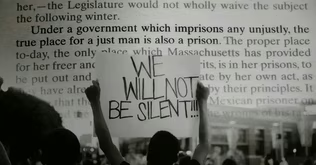
Henry David Thoreau: I say break the law.
Let your life be a counter friction to stop the machine.
Narrator: The women of the Thoreau household had already been active in the Underground Railroad-- a secret network of safe houses, which abolitionists used to help slaves escape to freedom.
Henry began to work alongside them.
He escorted a fugitive named Henry Williams from the Thoreau home to the train station in Concord.
But after seeing a policeman, he put Williams on a later train to Burlington, Vermont.
Williams went on to freedom in Canada-- one of several human beings that Henry helped escape.
On April 23rd, Henry arrived at the Concord Lyceum to give a lecture called "Walking, or The Wild."
♪ Henry David Thoreau: I wish to speak a word for Nature, for absolute Freedom and Wildness, as contrasted with a freedom and culture merely civil, to regard man as an inhabitant, or a part and parcel of Nature, rather than a member of society.
I wish to make an extreme statement, if so I may make an emphatic one.
In Wildness is the preservation of the World.
♪ Clay Jenkinson: It's not really about walking.
I think that he's talking about what it is to be completely free.
He's a white, privileged writer who can walk anywhere he wants.
A fugitive slave doesn't have time to think about nature.
Rochelle L. Johnson: So when Thoreau writes in "Walking" that the freedom to walk is essential, he's certainly pointing to-- to the freedom that all human beings deserved.
In a natural world that is flourishing, regenerative, inexhaustible, the freedom that the natural world allows can teach us ideas, hopes, thoughts we didn't know we had.
J. Drew Lanham: Wildness, it's freedom.
Sometimes it's the breeze blowing through the trees or the call of a bird.
And so wildness is--I mean, it's over my shoulder, it's underfoot, it's always in my heart in a way that allows me to access it, even when I can't get to it.
Narrator: Thoreau called his lecture "Walking" "an introduction to all I may write hereafter."
Douglas Brinkley: "Walking," I think, is the birth of the modern environmental thinking.
It's one of those things that has grown over time.
It's the idea of wild and wilderness can be loved and protected and cared about.
It becomes a part of us.
[Activists chanting] ♪ Rochelle L. Johnson: In "Walden," Thoreau writes, "Why do precisely these objects, which we behold, make a world?"
And in the time after Walden, he turns to science to find the answer to that question.
What are these objects?
How do they interact with one another?
How do they make seasonal change?
How do they shape a soul?
Narrator: Endlessly curious, Thoreau began reading zoological and botanical texts, looked at Saturn's rings through his neighbor's telescope, and studied the findings of scientists who had traveled the world.
After reading Charles Darwin's "Voyages of the Beagle", Henry began seeing his own walks as miniature expeditions in their own right.
♪ Henry David Thoreau: June 7th.
I wonder that I even get 5 miles on my way-- the walk is so crowded with events and phenomena.
How many questions there are which I have not put to the inhabitants!
Henrik Otterberg: He could sit watching a vernal pool for frogs and tadpoles for hours on end.
He was willing to invest his time and attention, and the dividends paid out in his prose.
And then the next thing you know, he's drawing inductions and generalizations.
He might do 20 of these a day.
J. Drew Lanham: Maybe it's one of these things that's feeding on itself, and that the more you know and the more detail, the closer you look, the more worlds you see.
Michael Pollan: Just as an observer of nature, he's incredibly acute, and when he's doing that, he's not being romantic.
He's being precise and empirical.
Cristie Ellis: But he'll veer from talking about some really technical aspect of a flower that he's noticing to something huge, you know, like his relationship to the stars.
From the minute to the majestic.
Look at anything around you and you can probably find the universe.
Henry David Thoreau: Time is but the stream I go a-fishing in.
I drink at it; but while I drink, I see the sandy bottom and detect how shallow it is.
Its thin current slides away, but eternity remains.
Narrator: Like Darwin, Thoreau began discovering and identifying species of trees, plants, and flowers in the greater Concord area-- more than 800 in all.
His attic room became filled with notebooks, journals, books, maps, charts, tables, as well as collections of rocks, pressed plants, and birds' nests.
Cristie Ellis: He wasn't comfortable calling himself a scientist, because the scientist is someone who looks at the world objectively.
For Thoreau, when you're looking at something, the thing you're seeing is being filtered through your own experience.
Narrator: Henry called 1852 a "year of observation."
Lawrence Buell: He was extremely patient as an observer of nature but much less patient in tolerating what he thought were the shortcomings of his neighbors.
Laura Dassow Walls: And there was a bit of a lordliness to Emerson that Henry started to resent.
He was always the teacher, and Henry would always be the student.
And as Henry started to feel that he wasn't just Emerson's student but his equal, tension started to grow.
Narrator: "My friend invites me to read my papers to him," Thoreau wrote in his journal.
"Gladly I would read, if he would hear.
There is no intellectual communion."
Emerson confided in his journal that Henry was always stubborn and contradictory, writing dismissively, "If I knew only Thoreau, I should think cooperation of good men impossible."
Thoreau imagined telling Emerson what he really thought: "I am offended by your pride, "your sometime assumption of dignity, and your manners, which come over me like waves," adding, "I am wiser than you think."
Michael Pollan: Thoreau was the prodigal son to Emerson.
And Emerson had ideas about, you know, what kind of career Thoreau should have.
He never became the writer Emerson hoped he would become, because Thoreau was pursuing something else.
Thoreau and Emerson were something like father and son.
But we see in Thoreau's writings his doubts about whether his relationship with Emerson is good for him.
Michael Pollan: And at a certain point, you have to carve out your own space, and that is gonna involve pushing against this formative influence.
Kristen Case: When he fell out with Emerson, he turned to the natural world to reconnect him.
[Boat's horn blows] Henry David Thoreau: At 5 P.M., September 13, 1853, I left Boston in the steamer for Bangor.
When I arrived, my companion that was to be had gone up river, and engaged an Indian.
Narrator: In September of 1853, Henry's cousin, George Thatcher, invited him on a moose hunting expedition to Chesuncook Lake, deep in the Penobscot ancestral lands of Maine.
Ever since he was a boy, Henry had been fascinated by Indigenous cultures.
For years, he had been reading about the history and customs of Native Peoples, and had compiled what he called his "Indian Books."
They eventually grew to thousands of pages.
John J. Kucich: He's trying to find someone who can bring to life and test what he's been reading about all these years.
Narrator: They hired a Penobscot tribal leader named Joseph Attean.
James Eric Francis Senior: Joseph Attean was the son of the chief of the tribe, and Attean was considered the best boatman on the river.
Narrator: At first glance, Henry was disappointed.
John J. Kucich: Thoreau is surprised by how acculturated Attean is to white norms.
He wears white clothing, he speaks English, he travels in the woods with Western gear, a rifle, and salt pork.
He wanted somebody who more matched his idea of what an Indian should be.
Narrator: But as they canoed up the Penobscot River, Henry began to change his mind.
He was impressed by Attean's knowledge of the wilderness and his skills at tracking moose.
Thatcher eventually shot one... [Rifle fires] but it disappeared into the woods.
Attean found the moose, skinned it, and carved off a portion of the meat, taking as much of it as he could carry.
Thatcher was only interested in the antlers... and the bullet.
James Eric Francis Senior: It's a sport, and they're slaying these animals, and you can't possibly eat that much meat, so they're leaving the carcasses to rot, which is totally outside our cultural beliefs.
Narrator: Thoreau was appalled.
"This hunting of the moose merely for the satisfaction of killing him," he wrote, "is too much like going out to some wood-side pasture and shooting your neighbor's horses."
Toward the end of the trip, Attean invited him and Thatcher to camp with some local Indians.
[Indistinct conversation] Henry David Thoreau: We lay on our backs, talking with them till midnight.
There can be no more startling evidence of their being a distinct and comparatively aboriginal race than to hear this unaltered Indian language.
It took me by surprise.
These were the sounds that issued from the wigwams of this country before Columbus was born; they have not yet died away.
James Eric Francis Senior: He realizes that there are parts of this culture that are still vibrant and are gonna live on despite colonization.
♪ Carol Dana: We've survived by remaining invisible.
It's still with us, that feeling.
People don't understand.
There's things about our culture there's no words for.
Narrator: On their way home, Henry and George Thatcher stopped at Indian Island, the same Penobscot settlement Henry had considered forlorn and dreary on his first trip to Maine seven years before.
♪ John J. Kucich: It's the same village, but he's able to see it differently.
He can see the village for what it is, which is a community of people who are making do in the present.
[Excited chatter] Henry David Thoreau: The Boston Court-House is full of armed men, holding prisoner, and trying a MAN, to find out if he is not really a SLAVE.
It was really the trial of Massachusetts.
Every moment that she now hesitates to atone for her crime, she is convicted.
Narrator: In late May 1854, an escaped slave named Anthony Burns was arrested in Boston by Federal marshals.
His Southern enslaver came up from Virginia and took his "property" back.
A week later, Congress passed the Kansas-Nebraska Act, which empowered newly-formed states in America's Western territories to decide for themselves whether to permit slavery.
Thoreau was enraged.
On July 4th, a protest rally was held in South Framingham, Massachusetts, with speeches by abolitionists William Lloyd Garrison, Wendell Phillips, Sojourner Truth, and Henry David Thoreau.
Sandra Harbert Petrulionis: Thoreau spoke in the afternoon.
The lecture podium itself had the American flag turned upside down to indicate the danger to the country.
It was a very, very hot July 4th, and the day's incendiary nature matched the heat.
Henry David Thoreau: I feel that my investment in life here is worth many percent less since Massachusetts last deliberately sent back an innocent man, Anthony Burns, to slavery.
[Applause] Man's influence and authority were on the side of the slaveholder and not of the slave, of the guilty and not of the innocent, of injustice, and not of justice.
Nowadays, men wear a fool's-cap, and call it a liberty-cap.
[Applause] J. Drew Lanham: I love the way that Thoreau called out everybody.
He didn't just call out the Southerners... [Laughs] he was calling out people in Massachusetts.
And he wasn't shy about that.
Henry David Thoreau: Show me a free state and a court truly of justice, and I will fight for them, if need be; but show me Massachusetts, and I refuse her my allegiance, and express contempt for her courts.
[Cheering and applause] Cristie Ellis: He says, "Laws will not make men free.
Men must make the laws free."
So, to be a good citizen of the government, you have to be willing to argue with it.
You have to be willing to disobey it.
This is the way to express your love and patriotism.
Henry David Thoreau: I walk toward one of our ponds, but what signifies the beauty of nature when men are base?
Who can be serene in a country where both the rulers and the ruled are without principle?
The remembrance of my country spoils my walk.
♪ Alone in the distant woods or fields, even in a bleak and, to most, cheerless day like this, cold and solitude are friends of mine.
I wish to get the Concord, the Massachusetts, the America, out of my head and be sane a part of every day.
I wish to be made better.
I wish to forget.
Narrator: Thoreau now began to feel a weakness in his legs-- another symptom of tuberculosis-- that left him, he wrote, "sick and good for nothing, but to lie on my back."
Rebecca Solnit: Thoreau had tuberculosis most of his adult life.
And it's a wasting disease that makes you weak and exhausted.
He had a terminal disease, and he knew it, Rebecca Kneale Gould: When he's talking about driving life into a corner, not getting to the end of his life and saying he has not lived, he means that.
He's saying, "I don't know when my time's gonna be up.
I'm not gonna waste a minute."
Narrator: He kept active, traveling to visit friends, making trips to do research at the Harvard Library, and continuing to work as a surveyor.
He even took two lengthy walking excursions to Cape Cod.
In July of 1857, he left on his third and most ambitious trip to Maine, this time with his friend Edward Hoar.
[Oars splashing] The first stop--once again-- was on Indian Island to find a guide.
John J. Kucich: So in his third journey, the Indian guide becomes the whole point.
I think there's a very clear sense that he wants to find someone who can bring to life and test what he's been reading about all these years in Indian notebooks.
James Eric Francis Senior: And I think he really wanted to have a more immersive experience and really get to know what it means to be in this nature.
Narrator: They hired Joe Polis, a Penobscot spiritual and political leader.
James Eric Francis Senior: Polis is in his yard.
He's skinning a deer hide against a slanted log, but he's amongst these manicured gardens.
There's some sophistication to Polis.
He's articulate.
He's very knowledgeable, but he also is very Indigenous.
And Thoreau's trying to grapple with those two pieces of Polis.
♪ Narrator: Together, they would travel more than 300 miles up the Allagash Lakes, and then down the east branch of the Penobscot River by canoe and on foot, including portages around waterfalls and river rapids.
They carried the canoe and their supplies-- hundreds of pounds in all-- through mosquito-infested, muddy swamps and dense forests.
The trip gave Henry another opportunity to learn about how Natives negotiated the Maine wilderness.
♪ John J. Kucich: Thoreau is watching a Penobscot person living with incredibly intricate knowledge of the land as part of who they are.
Carol Dana: When we say "gu-dowl-nuh-bem-na-wuk," all our relations, we mean everything.
Minerals, trees, rocks.
Those are our relations.
Because without them, we know we'd be nothing, right?
James Eric Francis Senior: Thoreau thinks, "I can never have that other half of what Polis has, that Indigenous half."
Narrator: Polis taught Henry the words his people used for plants and herbs, leaves and roots.
Carol Dana: It's a dynamic, verb-oriented language.
A "je-sah-ti-gwah" is one who's painted many colors.
That's a dragonfly.
James Eric Francis Senior: The word for a birch bark canoe is "aw-gwee-den."
And it means "that which floats lightly."
You get this characteristic that is embedded within the meaning of that word.
The more he asks Polis about what each word is, the closer he is getting to understand that Indigenous worldview of the nature around him.
And what a gift!
John J. Kucich: Thoreau instantly grasps that mainstream American white culture has a lot to learn from Native people-- a very different way of being in the world, and language is one of the key entry points into it.
James Eric Francis Senior: For Thoreau, going from calling the tribe on its way to extinction to a point where Polis is a person who he admires the most.
He sees these men beyond the color of their skin, and he grows as a human being in relationship to this Indigenous culture.
But his goal is never really to use that to politically help Native communities.
[Horse neighs, horses clopping] His goal was really to reform white society to make it more responsive to the environment, to make it less immersed in this really rapacious, capitalist world he can see coming.
And he comes back from Maine with a deeper appreciation for what it means to live in your native ground.
And he eventually starts to go over his journals and gather the notes of his own place and to track much more carefully the phenomenon of Concord that will become the Kalendar project-- his great final project, which is this grand account of the Concord ecosystem.
[Bird chirps] Henry David Thoreau: Why should just these sights and sounds accompany our life?
I would fain explore the mysterious relation between myself and these things.
Make a chart of our life, know how its shores trend-- that butterflies reappear... and when-- know why just this circle of creatures completes the world.
Kristen Case: The depth of what he included in his records is pretty unique.
He cared enough about it to want to be present at the opening of every wild flower in the spring.
♪ The Kalendar charts are the study of the climate as it changes through the seasons.
And he always was moving toward this kind of greater and greater fullness of vision-- to bring many perspectives, many temporal points together into a kind of symphony.
Narrator: Thoreau pored through decades of his seasonal observations, and combined them with new ones, creating records so precise, they have proven to be invaluable for scientists measuring the effects of climate change almost 200 years later.
Robert Thorson: You can't see climate.
But you can see the manifestation of a climate change in the phenomenon around you.
So if you can have measurements from the 1850s, people can really understand things have changed.
Beth Witherell: He wrote, "Don't underrate the value of a fact.
One day, a fact will flower into a truth."
♪ Narrator: In the summer of 1859, Henry also began collecting data about the ever-changing Concord River.
Henry began to see the river as a whole entity, with its own unique history, culture, and laws.
The data he collected was, for him, further proof of what he had seen in Maine, Cape Cod, and elsewhere-- the signs of inevitable decline caused by human efforts to tame nature's "wildness."
He began to imagine natural places that humankind might, one day, simply leave alone, "where a stick should never be cut for fuel-- a common possession forever."
Robert Thorson: He spent 18 months with the river project, and he was still on it hardcore until the John Brown affair kicked in.
And when that kicked in, he dropped it because that's the higher calling.
Narrator: In his essay "Civil Disobedience," Thoreau had asserted that each citizen should resist a government that supported slavery.
A militant abolitionist named John Brown had a more aggressive strategy: armed resistance.
Back in 1856, after a series of clashes between pro- and anti-slavery militia, Brown had killed five unarmed pro-slavery settlers in Kansas.
Brown traveled to Concord in 1857, looking for support for his cause, and went there again in May of 1859.
During that visit, Henry met with Brown, and would later describe him as a meteor "flashing through the darkness in which we live."
That fall, John Brown and his men raided the federal armory at Harpers Ferry, Virginia, hoping to arm a slave uprising with the weapons there.
[Rifles firing] They failed, and Brown was captured.
Douglas Brinkley: John Brown is a conundrum.
You can look at him very clearly and make an argument that he is a terrorist, and you can also call him a liberator.
But it became a tipping point, John Brown.
He became a symbol for anti-slavery.
Henry David Thoreau: It galls me to listen to the remarks of craven-hearted neighbors, who speak disparagingly of Brown because he resorted to violence, resisted the government, threw his life away!
What way have they thrown their lives, pray?
Such minds are not equal to the occasion.
Beth Witherell: He sits down and he writes and he writes and he writes, assuming that Brown will be executed.
He wants to get the word out before a judgment is made.
Narrator: On October 30th, Thoreau gave a fiery speech in Concord, the first person to publicly defend Brown's actions.
"I do not wish to kill or be killed," he asserted, "but I can foresee circumstances in which both these things would be by me unavoidable."
Douglas Brinkley: He's saying forget the law, forget what the federal government says.
You know what's right and wrong.
And if people have to die to do away with slavery, we have an obligation to do it.
Narrator: John Brown was hanged on December 2nd.
Thoreau wrote a new speech called "The Last Days of John Brown."
It was read aloud six months later at Brown's gravesite.
"He is the clearest light that shines on this land," he wrote.
"He is an Angel of Light."
Lois Brown: What is it about John Brown that so shifts?
Like, it's a seismic shift in Henry David's life.
He realized what it takes to achieve change.
Narrator: The issue of slavery would be decided on the battlefield.
[Fife and drum music] [Indistinct chatter, glasses clink, cutlery clanks] Robert Thorson: January 1, 1860, a friend of Thoreau's invited him to a dinner party, because they had just got a copy of a new book by Charles Darwin, "Origin of Species."
Thoreau quickly got a hold of that book and read it voraciously.
Narrator: Darwin's "Origin of Species" introduced natural selection, the idea that the most adaptable members of a species pass on their traits to the next generation instead of the long-established belief that all species had been created by God.
Thoreau was so excited by what he read in Darwin because Thoreau, too, saw a world that was dynamic, constantly undergoing transformation.
He was puzzled by why you'd cut down pines, and oaks would spring up and why you would cut down oaks and pines would spring up.
So he pursues his own idiosyncratic form of science.
Narrator: One day in June of 1860, he threw a stick of wood against a pine tree in bloom.
As the pollen floated away in a cloud, he realized just how far it could travel.
♪ Laura Dassow Walls: Charles Darwin said there's something that we don't understand, which is how it is that the succession of forest trees works in North America.
And it must have astonished Thoreau because he had been working on precisely that scientific question intensively for three or four years.
♪ Narrator: In September, Thoreau delivered a lecture called "Succession of Forest Trees," in which he answered the question that had puzzled Darwin.
The key to the mystery of how different species of trees grew where they hadn't before, Thoreau argued, was seeds.
♪ Henry David Thoreau: A beautiful thin sack is woven around the seed, with a handle to it such as the wind can take hold of, and it is then committed to the wind, expressly that it may transport the seed and extend the range of the species.
Cristie Ellis: This is new knowledge.
Because seeds travel, he could prove that species were moving often great distances across landscapes.
Henry David Thoreau: I have great faith in a seed.
Convince me you have a seed there, and I am prepared to expect wonders.
Narrator: Thoreau's literary agent in New York, Horace Greeley, published the essay, and it was picked up by newspapers nationwide.
Laura Dassow Walls: He'd worked out the complete theory.
It turned him into our first pioneering plant ecologist.
He literally invented an entire science.
♪ [Grandfather clock chiming] Henry David Thoreau: August 15, 1861.
My cold turned to bronchitis, which made me a close prisoner.
My ordinary pursuits, both indoor and out, have been for the most part omitted.
Indeed I have been sick so long that I have almost forgotten what it is to be well.
Narrator: In early spring, Henry had begun having more serious symptoms of the illness that had plagued him off and on for most of his life.
Rochelle L. Johnson: Henry contracted what he hoped was a cold, and then perhaps hoped was bronchitis, but indeed was tuberculosis in 1860.
He would've known the signs.
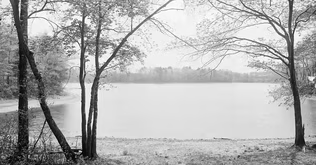
Narrator: In September, he managed to visit Walden Pond.
Sophia was with him.
It would be his last trip there.
♪ His illness steadily worsened, and eventually confined him to his bed in the family home.
He could write only intermittently.
When Henry could no longer hold a pen, Sophia served as his scribe.
Together, they collected, edited, and revised essays that would become "The Maine Woods" and "Cape Cod."
And he always was moving toward this kind of greater and greater fullness of vision.
But he knows he doesn't have long.
He couldn't walk outside anymore.
So his own journal becomes his representation of nature that he could then walk into.
♪ Henry David Thoreau: It is pleasant to walk over the beds of these fresh, crisp, and rustling leaves.
They that soared so loftily and are laid low, resigned to lie and decay at the foot of the tree, and afford nourishment to new generations of their kind, as well as to flutter on high!
They teach us how to die.
Narrator: Surrounded by his family, Henry David Thoreau died at 9:00 in the morning on May 6, 1862.
He was just 44 years old.
His passing was so peaceful that Sophia wrote, "I feel as if something very beautiful has happened."
Some say the last words of the naturalist, who had so many transcendent experiences, were simply, "Moose.
Indian."
Sophia, who was reading to him about his river trip with John, said that his last words were: "Now comes good sailing."
♪ Henry David Thoreau: We found our boat in the dawn just as we had left it-- as if waiting for us, there on the shore, all cool and dripping with dew... We two, brothers, and natives of Concord, with a vigorous shove, we launched our boat from the bank and dropped silently down the stream.
We bade adieu to familiar outlines, and addressed ourselves to new scenes and adventures.
Naught was familiar but the heavens... [Horses clopping, bell ringing] Narrator: Three days later, after the church bell tolled 44 times, Concord gathered for his funeral.
School had been dismissed early so that the students--more than 300 in all--could attend.
Ralph Waldo Emerson delivered the eulogy.
♪ Ralph Waldo Emerson: He was bred to no profession; he never married; he lived alone; He chose, wisely no doubt for himself, to be the bachelor of thought and Nature.
Mr.
Thoreau dedicated his genius with such entire love to the fields, hills, and waters of his native town.
He knew the country like a fox or a bird, and passed through it as freely by paths of his own.
I cannot help counting it a fault in him that he had no ambition.
Wanting this, instead of engineering for all America, he was the captain of a huckleberry party.
But these foibles, real or apparent, were fast vanishing in the incessant growth of a spirit so robust and wise, so noble a soul that he should depart out of Nature before yet he has been really shown to his peers for what he is.
But he, at least, is content.
Clay Jenkinson: The last sentence in Walden is "The sun is but a morning star."
What does he mean?
It means "you've just begun to think "through the meaning and the significance of what I've produced here."
♪ [Cricket chirping] [Airplane whooshing] [Vehicle horns honking] Sandra Harbert Petrulionis: As Thoreau said, "Don't, when you come to die, discover that you have not lived."
He died young, but he didn't end his life realizing he had not lived.
Clay Jenkinson: It happens to millions of people today and then to realize: "I just existed.
I just lived.
I don't know what it meant.
I never really figured it out."
Michael Pollan: He was arguing for being aware at all times, to waking up to the facts of your life, to being conscious, being aware, being present.
♪ Henry David Thoreau: The mass of men lead lives of quiet desperation.
They honestly think there is no choice left.
Most of the luxuries, and many of the so-called comforts of life, are not only not indispensable, but positive hindrances to the elevation of mankind.
Bill McKibben: We built the world that Thoreau feared, a world that's so noisy and crowded that we don't have any time to think for ourselves anymore.
Douglas Brinkley: Most people are hostage to their upbringing, their economic status, and they don't get excited about the adventure of being alive.
And it's like watching an incredible birthright being extinguished because we're muddling through life.
And that's the death of freedom.
[Typing on keyboard, cellphone ringing] Henrik Otterberg: Many of the decisions that pertain to our lives have been made by others, have been made by circumstances that have been beyond our control.
Bill McKibben: A very human-centered view of the world has now raised the temperature to the point where our great forests catch on fire, where already hundreds of millions of people can no longer live in the places where they were born.
Thoreau intuits that if we're going to make it, we're going to have to turn to the natural world for help.
In wildness is the preservation of the world.
Robin Wall Kimmerer: It feels as if the whole living world is calling out to us to pay attention.
Lois Brown: But he says, you know, "Even in the muck of all this, "I encountered a white water lily, "and lilies like that grow in slime, and grow in spite of it."
He was open always to accepting signs from nature that all was not lost.
Thoreau was saying, if you're beginning to die within, take measures right now.
There must be some cabin in the woods within you.
There must be some space where you can regenerate yourself and remember what is most essential to you.
J. Drew Lanham: I think Thoreau gives us the bridge to do that.
If we would just open up our heads and hearts to those lessons, I think it can take us a long way on that path.
And here he is still offering these messages.
It's up to us to open the book and read.
♪ Henry David Thoreau: There is a season for everything.
You must live in the present, launch yourself on every wave, find your eternity in each moment.
Fools stand on their island of opportunities and look toward another land.
There is no other land; there is no other life but this.
Henry David Thoreau.
♪ ♪ ♪ ♪ ♪ ♪ ♪ Announcer: Scan this QR code with your smart device to watch the whole series and learn more about Henry David Thoreau.
Announcer: The "Henry David Thoreau" DVD is available online and in stores.
The series is also available with PBS Passport and on Amazon Prime Video.
The digital companion soundtrack is also available online.
♪ ♪ ♪ ♪ ♪ ♪ ♪ ♪ ♪ Announcer: Major funding for "Henry David Thoreau" was provided by... The Better Angels Society, Jeff Skoll, the Mansueto Foundation, Tyson Foods, and The Arthur Vining Davis Foundations.
Funding was also provided by the Tyson Family Foundation, The Neil and Anna Rasmussen Foundation, and by The Better Angels Society members: The Keith Campbell Foundation for the Environment and Mark A. Tracy.
Additional funding was provided by Roxanne Quimby Foundation, Jim and Mona Mylen through The HeartSpace Fund, and Elizabeth Kenny.
 New
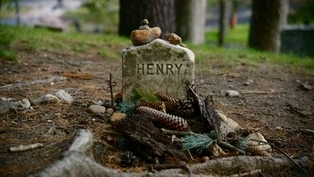
NewHenry David Thoreau Asks Us to Live in the Present
Video has Closed Captions
Clip: Ep3 | 8m 19s | Henry David Thoreau dies at 44, but his message lives on and encourages us to read. (8m 19s)
 New
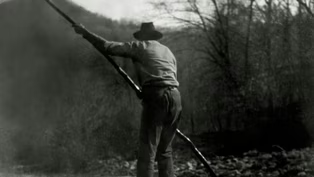
NewJoe Polis Teaches Thoreau the Penobscot View of Nature
Video has Closed Captions
Clip: Ep3 | 9m 45s | On an excursion, a Penobscot leader teaches Thoreau about the Penobscot culture and language. (9m 45s)
 New
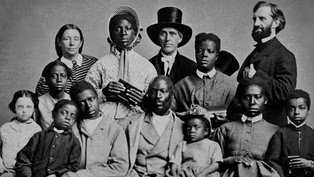
NewThoreau Begins to Work with the Underground Railroad
Video has Closed Captions
Clip: Ep3 | 5m 3s | Thoreau participates in the Underground Railroad and gives a speech on what it means to be free. (5m 3s)
Providing Support for PBS.org
Learn Moreabout PBS online sponsorship









Support for PBS provided by:
Episodes presented in 4K UHD on supported devices. Major funding for HENRY DAVID THOREAU was provided by The Better Angels Society and its members: The Keith Campbell Foundation for the...