
Police Dive
Season 11 Episode 1105 | 9m 46sVideo has Closed Captions
An underwater detective searches for truth and faith in Virginia.
On the muddy edge of Lake Chesdin, Sgt. Mike Berry prepares to dive for a murder weapon. As he descends, memories of faith, service, and the emotional toll of recovery work surface. The film blends investigation with introspection in a portrait of belief and duty.
Problems playing video? | Closed Captioning Feedback
Problems playing video? | Closed Captioning Feedback
Support for Reel South is made possible by the ETV Endowment of South Carolina, National Endowment for the Arts, and Wyncote Foundation.
Police Dive
Season 11 Episode 1105 | 9m 46sVideo has Closed Captions
On the muddy edge of Lake Chesdin, Sgt. Mike Berry prepares to dive for a murder weapon. As he descends, memories of faith, service, and the emotional toll of recovery work surface. The film blends investigation with introspection in a portrait of belief and duty.
Problems playing video? | Closed Captioning Feedback
How to Watch REEL SOUTH
REEL SOUTH is available to stream on pbs.org and the free PBS App, available on iPhone, Apple TV, Android TV, Android smartphones, Amazon Fire TV, Amazon Fire Tablet, Roku, Samsung Smart TV, LG TV, and Vizio.
Providing Support for PBS.org
Learn Moreabout PBS online sponsorshipI've been doing it so long that when it's time, I want to die wrapped up in rope, underwater, fighting for my life.
That's the way I'd like to go out.
(gentle music) (atmospheric music) (wildlife chirping) (atmospheric music continues) (atmospheric music continues) (atmospheric music continues) (atmospheric music continues) (atmospheric music continues) - I did my first police dive in 1981.
Back then, there was absolutely no method to the madness.
I decided that we needed to get serious.
If there's no methods, there's no standards, I'll write the standards.
(atmospheric music continues) (water bubbling) (atmospheric music) (atmospheric music continues) As you're going down in those depths, you have to be very, very comfortable in harsh conditions.
(atmospheric music continues) Most missions, it's total zero visibility, and you're operating on the bottom.
So whatever that bottom is, if it's vegetation, if it's muck, if it's snapping turtles, if it's trees, if it's stumps, if it's rocks, that's what you're moving in, you're crawling along that bottom, looking for bodies, murder weapons, evidence.
(atmospheric music continues) For some reason, people thought if you take a murder weapon and throw it off a bridge, all the rules of evidence change because it went in the water.
But there could be other evidence on the gun.
There could be fingerprints, there could be DNA, there could be ballistics.
And so you want to do no harm to the gun.
You have to touch it enough to know that it's a gun, but the moment your brain says, "This is the gun," you have to let go of it.
(atmospheric music continues) (atmospheric music continues) (atmospheric music continues) These standards started filtering to other countries.
These methods that I designed started going all over the place.
I became known as sort of like the godfather of police diving.
(atmospheric music continues) (atmospheric music continues) (atmospheric music continues) (atmospheric music continues) Most bodies are just simple drownings, but you really never know the truth of what's going on.
(atmospheric music continues) We did one this year.
The only children this family had, all three of 'em drowned.
You know, imagine that.
Just absolutely horrible.
We recovered all three.
All three children.
It's a horrific situation and can affect you for life.
I've seen divers after their first body recovery have nightmares.
They can't sleep at night anymore 'cause they're just having these thoughts all the time.
One of the ways I deal with it, I talk to the dead.
And I kind of think it keeps me sane.
I don't look at 'em as just a dead person.
If I'm after Joe, I'm looking for Joe.
And sometimes when I find Joe, I'll go, "Oh, there you are."
You know, "Hey, I'm here to take you back home."
Or a little child, you know?
I do cradle 'em in my arms and I say, "Hey, I'm gonna get you outta here and get you back to your mother.
You don't belong down here.
Let's get outta here."
There is no closure until they're brought up, and you can feel for the family.
Your ability and your position to try to help them ease a little bit of the grief, it's just really important.
I just look at it as a blessing that I'm able to do this, and I'm still doing it at my age.
I'm 66 and I can still suit up and dive all day.
(gentle music) I've been doing it so long that when it's time, I want to die wrapped up in rope, underwater, fighting for my life.
That's the way I'd like to go out.
When you die, you become part of God's plan, and so I don't fear it.
It's just like this blink between here and eternity.
(gentle music continues) (gentle music continues) (gentle music continues) (gentle music continues) (gentle music continues) (gentle music) (gentle music continues) ♪ I am dirt on the ground ♪ ♪ Here I lay without a sound ♪ ♪ It's my sin that holds me down ♪ ♪ I am dirt ♪ - [Narrator] Funding for "Reel South" is brought to you by ETV Endowment of South Carolina, National Endowment for the Arts, Wyncote Foundation.
(soothing music) Additional funding for this program is provided by.
A complete list is available from PBS.
Video has Closed Captions
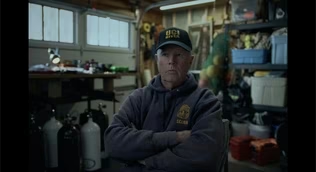
Clip: S11 Ep1105 | 1m 52s | Sgt. Mike Berry discusses how he copes with the emotions brought up by recovering corpses. (1m 52s)
Providing Support for PBS.org
Learn Moreabout PBS online sponsorship













Support for PBS provided by:
Support for Reel South is made possible by the ETV Endowment of South Carolina, National Endowment for the Arts, and Wyncote Foundation.