
Now Hear This – “Everyone Loves Joplin”
Season 53 Episode 13 | 53m 55sVideo has Closed Captions
Scott Joplin was the king of ragtime, a new kind music for the turn of the 20th century.
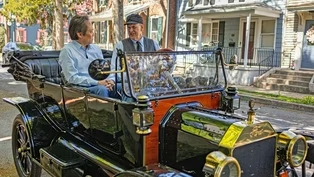
Scott Joplin was the king of ragtime, a new kind music for the turn of the 20th century. Rick Benjamin’s Paragon Ragtime Orchestra takes Scott Yoo back in time to experience the music, movies and style of that era.
Problems playing video? | Closed Captioning Feedback
Problems playing video? | Closed Captioning Feedback
Major series funding for GREAT PERFORMANCES is provided by The Joseph & Robert Cornell Memorial Foundation, the Anna-Maria and Stephen Kellen Arts Fund, the LuEsther T. Mertz Charitable Trust, Sue...
Support provided by:

Now Hear This – “Everyone Loves Joplin”
Season 53 Episode 13 | 53m 55sVideo has Closed Captions
Scott Joplin was the king of ragtime, a new kind music for the turn of the 20th century. Rick Benjamin’s Paragon Ragtime Orchestra takes Scott Yoo back in time to experience the music, movies and style of that era.
Problems playing video? | Closed Captioning Feedback
Where to Watch Great Performances
Great Performances is available to stream on pbs.org and the PBS app.
Buy Now
Great Performances Newsletter
Subscribe to the Great Performances newsletter to keep up with the latest full episodes to stream, exclusive content, and more!Providing Support for PBS.org
Learn Moreabout PBS online sponsorshipPart of These Collections
Now Hear This
Journey across Europe with Scott Yoo to discover how four composers created masterworks.
View Collection
Everything Streaming Now
See everything streaming on Great Performances in one convenient location.
View CollectionProviding Support for PBS.org
Learn Moreabout PBS online sponsorship[ Joplin's "Maple Leaf Rag" plays ] -Next on "Great Performances," I'm Scott Yoo.
Scott Joplin was the king of ragtime, a new music for the turn of the 20th Century with African-American roots.
-When you hear ragtime, it's manifesting a lot of that early tradition and going straight into the piano.
♪♪ -As he traveled the Midwest, Joplin played many instruments in many styles.
He became famous, then forgotten.
-His life in many ways was tragic.
-But he knew he was going to live on as a composer.
♪♪ -50 years ago, he was rediscovered.
-When this movie came out,' "The Sting," they used Joplin on the soundtrack, and it became a sensation.
-That began a Joplin revival that continues today.
-From that time until now, we haven't seen anything like this.
It feels quite special and quite monumental.
-He influenced so many musicians over the years, including myself.
On the next "Now Hear This," see why everyone loves Joplin.
♪♪ Major funding for "Great Performances" is provided by... ...and by contributions to your PBS station from viewers like you.
Thank you.
♪♪ -Rick Benjamin, conductor of the Paragon Ragtime Orchestra, is an expert in the music of Joplin and the turn of the 20th Century.
♪♪ And he wanted to take me for a ride in his car.
-This is the iconic 1914 Model T. It's the vehicle that put the world on wheels.
-Incredible.
-A very sharp rip-up.
[ Engine starts ] You did it!
-Alright, can we go in?
-Yeah!
Let's go!
-Alright.
♪♪ ♪♪ It's almost like you were born in the wrong century, Rick.
-That's what people seem to say.
-[ Laughs ] -Most definitely.
-How do you get into the music of that time period?
-Well, when I was a child of about 10, I found my grandmother's Victrola, wind-up phonograph, out in her garage one Sunday afternoon.
I spent the day lost out there listening to those records, bands and orchestras playing ragtime and singers -- a whole world of sound from another time period that was extremely appealing.
-Joplin wrote mostly for piano, but he and others also arranged his works, like this one, for small orchestra.
♪♪ ♪♪ -I later went to Juilliard and became a student there.
And while I was there, working on my Beethoven and Brahms, I discovered the collection of music belonging to Arthur Pryor, who was one of the Victor Talking Machine Company's conductors.
And he had saved scores from their sessions -- thousands of them!
They were being sent to a landfill.
And I managed to recover them.
I brought them all back to Juilliard and started the Paragon Ragtime Orchestra.
♪♪ ♪♪ ♪♪ Rick and his Paragon Ragtime Orchestra were on a tour through Victorian-era theaters in Pennsylvania, playing original scores written for early silent films.
♪♪ ♪♪ [ Laughter ] ♪♪ [ Laughter ] ♪♪ The 12-piece orchestra, exactly like this one, with strings, winds, brass, and percussion, was the musical ensemble of the era.
Every theater and dance hall had one.
♪♪ Early in his career, Joplin played in small orchestras across the Midwest, even leading one of his own.
♪♪ ♪♪ [ Laughter ] ♪♪ [ Laughter ] ♪♪ ♪♪ My friend John Novacek is one of Joplin's biggest fans.
He helped me understand how ragtime came to be, on the same kind of piano that it was born.
-So, Scott Joplin didn't invent ragtime.
Ragtime was something that was in the air in the late 19th Century in the Midwest of America.
And it really started in places like this -- saloons, clubs, dance halls, brothels and anywhere that they would hire African-American pianists -- which was crucial, because there was an incredible crop of African-American pianists practicing this new style, which came to be known as ragtime, which was a fusion of two different styles.
One was the European march, or a quadrille, the bass, where you have... ♪♪ A little boom-chick, boom-chick.
But, also, it had these complex, African rhythms on top of that in the treble.
If you take something like "Stars and Stripes Forever," you have this great trio melody... ♪♪ And it's very much on the beat -- ♪ Dom-ba-ba-ba ♪ And if I were to rag that, I might do something like this.
♪♪ -So you're taking the march, left hand, and you're essentially superimposing on that, like, almost like a banjo part.
-Exactly.
Almost like the banjo picking.
It gives it that sort of intoxicating swing that's just so irresistible.
-To learn about the banjo style that influenced ragtime, I met Dom Flemons, an expert in early American music, at a historic dance hall.
This is a cool place.
I don't know.
It feels very authentic.
-Yeah.
This is sort of the type of Midwestern venue that Scott Joplin would have played in those early years.
His music was rooted in string-band music.
His father, Giles, was a violinist.
He played fiddle in square dances.
And, then, his mother, Florence, was a banjo player.
His father was an ex-slave from North Carolina, and his mother was a freed woman from Kentucky.
And so they brought their musical traditions together, and Scott got to hear all that stuff growing up.
So, I'm going to show you just a little bit of the modern banjo, 'cause this is kind of what people mostly expect the banjo to sound like.
♪♪ ♪♪ -Sounds fantastic.
Lots of energy in that.
-Absolutely.
But this isn't the style of banjo that would have been reminiscent of what Scott Joplin heard growing up.
-It's too modern?
-Yeah, a little bit too modern.
You know, it has a drum sort of head on it, a lot of metal.
And this is a style of banjo called a tackhead banjo.
Then, these were made popular in the mid-19th Century.
So, you can see a skin head on here.
It has no frets, so it's similar to a violin in many ways.
-So this is harder.
-Yeah, it is.
Very much harder.
But at the same time, you can kind of slip notes in between.
And that's really a fun thing to be able to do.
So I guess if I were to play you something that was, you know, specific to the period, this is a piece called "Joe Sweeney's Jig."
He was a white banjo player, and he spent a lot of time with the different African-Americans that were around him, and he learned the banjo from them and then brought it to the world.
♪♪ ♪♪ There's something when you're playing the banjo -- and this is important with ragtime -- you have this syncopation, you have a backbeat.
So you're... [ Banjo plays ] And, so, when you hear ragtime, it's manifesting a lot of that early tradition and going straight into the piano.
And so that's something that's a part of that.
So, let me show you a little bit more of an 1880s style of banjo breakdown here.
This is a composition I put together here in that style.
♪♪ ♪♪ ♪♪ ♪♪ ♪♪ ♪♪ ♪♪ ♪♪ -It's great.
Now, what about the march influence on ragtime?
Back on his Victorian theater tour, Rick gave me some new info on the father of American march music, John Philip Sousa.
-In the 1880s, Sousa was involved in theater music.
He was a conductor of shows and small orchestras like Paragon.
And Sousa's music was just as famous for dancing in America's ballrooms as it was for marching down Main Street.
-Sousa dances?
-Sousa dances, yes.
-No kidding?
-And this is where we introduce this whole concept of the beat being so important to American popular music -- that marching beat, that 1, 2, 1, 2.
Before this time, melody was something that was sort of the focus of attention, even for dance music.
Back in the 1880s, he wrote a new piece called the "Washington Post."
It's dedicated to the newspaper.
and it became the music for a new dance step called the Two-Step, which swept the country and became a sensation.
And all of American dance music from that period forward, including the ragtime dances, all come out of this marching tradition.
♪♪ ♪♪ ♪♪ -I always thought of this famous Sousa piece as a march.
But now I could imagine couples floating across a dance floor.
♪♪ ♪♪ ♪♪ ♪♪ -Now, a watershed event in ragtime history was the Chicago World's Fair in 1893.
The Black musicians were not actually allowed on the fairgrounds, but in all the surrounding bars and clubs, ragtime was flooding these places.
About four years after that, actual written rags were starting to be published.
The first one was actually by a Chicago white bandleader named William H. Krell.
And it's quite basic in terms of the rag language, but it goes something like this.
♪♪ ♪♪ -It's nice.
-It's nice.
It's harmless [laughs] as they would say.
Two years later, Joplin himself was published.
The very first one was something called "Original Rags."
♪♪ ♪♪ -Sounds like Joplin.
-It's Joplin already.
And what came next was even a bigger deal.
That was the "Maple Leaf Rag," about six months later.
I don't think they know the exact date it was published.
But "Maple Leaf Rag," as we know, went on, and it made history.
-Sold a million copies.
-It ultimately sold a million copies -- already a half a million, I think, by 1909.
And this really made Joplin the quote-unquote "King of Ragtime Writers."
♪♪ ♪♪ ♪♪ ♪♪ ♪♪ ♪♪ ♪♪ -It's fantastic.
-For the next 18 years or so, Joplin wrote almost 50 piano pieces, and there was a real evolution in style.
Joplin was very ambitious as a composer.
He eventually wrote two operas.
But even the piano rag itself took on new dimensions.
And, then, we have this beauty, the "Gladiolus Rag."
And you can just see how rich and songlike the writing became.
♪♪ ♪♪ ♪♪ ♪♪ ♪♪ ♪♪ -Despite the enduring popularity of "Maple Leaf," many Joplin aficionados consider this his finest work and the ragtime masterpiece.
Almost nothing was written about Joplin during his lifetime.
He left few letters and only two photographs.
But I wanted to know more about the mind behind his music.
So back in Pennsylvania, on the Susquehanna University campus, I met Rick again.
-Joplin's music of course is associated with bright, happy, exciting, rhythmic things most of the time.
And so it becomes interesting to really consider some of the known facts about his life, which in many ways was tragic.
First was an unsuccessful marriage due to the death of his first child.
-Well, that's understandable.
-Terrible tragedy.
At around that time, he was working on his first opera.
He actually formed a company and put it on the road, and it seemed to be successful when the manager of the company left with the money and the production collapsed.
The return from that was a second marriage to a young lady named Freddie Alexander.
And incredibly, just days after their honeymoon, she died.
Terrible tragedy.
And it does affect Joplin's music after that deeply, including this piece I'd like to play for you.
It's a wonderful concert waltz that he named "Bethena."
It's one of his most interesting works, the depth of it, the different moods and ranges in it, the key changes.
It's experimental, too.
You can see a troubled mind here at work behind this, someone searching for something.
The continuing tragedy is that the piece wasn't a success.
It was published by a tiny company in St.
Louis.
And the output, the purchase of it was so small that there was only one surviving copy of this composition.
But it has a lot to say to us.
♪♪ ♪♪ ♪♪ ♪♪ ♪♪ ♪♪ ♪♪ For my money, this sad, beautiful waltz is Joplin's most perfect piano composition.
♪♪ ♪♪ [ Birds chirping ] It's such a cool house.
When did they build it?
-Well, thank you.
1895, actually.
Joseph Lyman Silsbee... -In Chicago again, I met graphic novelist Chris Ware.
He's meticulously restored his ragtime-era house, where he collects original Joplin recordings.
-So it sort of actually perfectly spans the ragtime era.
-Mm.
So when we go inside, am I entering a ragtime time machine a little bit?
-I don't know.
That sounds kind of insane.
But, I mean, I do very much like the architecture and the surroundings of the era.
I've tried to make it as accurate as possible.
Tried to be true to the house itself, too.
So the very first recording, actually, of "The Entertainer" was in 1928 by two guys, Nap Hayes and Matthew Prater, an African-American mandolinist and guitarist.
It's pretty clear they seem to have learned it by ear.
Interestingly, however, the piece, if you look at the original sheet music of "The Entertainer," it's dedicated on the cover to James Brown and his Mandolin Club.
A lot of music was played by mandolin orchestras, before that banjo orchestras.
So if you listen closely to this, you'll hear "The Entertainer," though played in a slightly different way.
♪♪ -Upstairs in his studio, Chris was working on a Joplin project.
-This is the second time I've tried to draw this particular photo, so... -Do you feel like you get to know him by drawing him?
-Not really.
I feel like I get to know what a terrible artist I am by trying to draw people that, you know -- I mean, you tend to think about the person as you're drawing them.
-What kind of a guy do you think Scott Joplin was?
-Judging from Ed Berlin's biography, he was a quiet person.
He I think self-consciously apparently cultivated a refined way of speaking.
By all accounts he was serious.
And I guess Brun Campbell, who was a white pianist who reportedly took lessons from him way early on in the late 19th Century, early 20th Century, said, you know, he'd have a drink occasionally and even might gamble every once in a while.
But he was very -- You know, he knew his priorities.
He knew what was important.
His whole life was put into that music.
-You know, actually, Rick was talking about how Joplin is such a uniquely American character.
And I would argue that Missouri and St.
Louis at the time -- you know, St.
Louis was kind of the nexus of the Mississippi River and people sort of trying to migrate West to find a better life.
-Mm-hmm.
-There was all of that economic activity there.
It's kind of where ragtime players went.
-I mean, I just have to assume that it was people seeking a better life of dignity and some respect, or something like that, getting out of the South.
It seems to me like just trying to find somewhere where you could be a person, you know, and be considered respected and respectable.
And that might maybe meant then going to St.
Louis, 'cause the opportunities were greater.
And, then, eventually, Joplin came to Chicago.
Joplin didn't stay here very long.
Eventually settling in New York, I think, just for the jobs, basically, for trying to get some work as a composer.
And he wasn't as much of a performer, which is one of the things I've always loved about Joplin, is that his music is not performance-based.
Even when you play it wrong, it's still good.
You can extract the happiness out of it, and then people realize, "Wait.
If you play this a little slower, there's sadness in it at the same time."
It's such a peculiar, unstable molecule.
And the fact that all of those things are in the music, it's very much like baroque music, where you could play Bach on any instrument and the emotion is still encoded into the music.
-Never thought of it that way.
That's really interesting.
♪♪ -Onstage at Fitzgerald's, pianist Reginald Robinson played a rag so inspired by banjo that Dom could play along.
♪♪ ♪♪ ♪♪ ♪♪ ♪♪ Reginald wanted to talk to me about Joplin's legacy.
Hey, that's awesome.
Yeah.
-Joplin influenced so many musicians throughout the years.
He was known not only as the king of ragtime, but the father of ragtime.
And he influenced a lot of writers.
He taught.
He was a teacher, as well.
And this is a piece that he wrote with one of his people, Arthur Marshall, "Swipesy Cakewalk."
♪♪ ♪♪ ♪♪ -Wow.
You nailed that.
That's awesome.
It's hard to know where the Joplin ends and the other composer begins, right?
I mean, it sounds like a Joplin piece.
Yeah.
Well, Arthur Marshall's style was very close to Joplin's -- [chuckles] very close.
And he also influenced people like Jelly Roll Morton, who was known as one of the very first jazz composers.
The story was told by Joplin's widow, Lottie, that Jelly Roll Morton was having some issues with a tune that he was working on called "King Porter Stomp."
So he sent a copy of it to Scott Joplin to -- -"What do I do?"
-Yeah.
To finish it.
-Nice.
-And Joplin was so influential, as I said, he influenced so many musicians over the years, including myself.
And this is one of my compositions.
I call it "Footloose."
-Okay.
♪♪ ♪♪ ♪♪ ♪♪ ♪♪ ♪♪ ♪♪ ♪♪ Joplin's influence endures today largely because of a major revival that started with another Joplin best-seller.
-Alright.
Here's my old collection.
-[ Laughs ] -Scott Joplin in the 1970s.
He passed away, sadly, in 1917.
Had syphilis and in a terrible hospital that wasn't far from here.
Came to a sad end.
But he knew he was going to live on as a composer.
But it really wasn't until the '70s that the massive Joplin revival happened.
And I feel so lucky, because that's when I caught the music-loving bug.
And that was right at the peak of the Joplin revival.
This album really started it all.
This Joshua Rifkin, "Piano Rags by Scott Joplin."
Became a best-selling album.
This sold a million copies.
And I bought one of them.
[ Chuckles ] I was just so entranced with his playing and with this music.
This really kicked me off on a musical career.
♪♪ ♪♪ ♪♪ And this was a landmark in publishing.
New York Public Library put out the "Collected Piano Works of Scott Joplin."
And this was amazing.
These compositions had not been pulled together like this as of yet.
This book was my Bible, and I just practically slept with this book.
I learned to play piano out of this.
I learned how a piece is put together.
I owe this book everything, as far as I'm concerned.
♪♪ ♪♪ It really hit a peak, this revival, when this movie came out, "The Sting."
They used Joplin on the soundtrack, and it became a sensation.
Everyone was playing "The Entertainer."
This was 70 years after the piece had been written.
♪♪ ♪♪ And, then, we had Joplin's "Treemonisha."
So much of his life work went into this opera.
And sadly, he could never get it properly staged.
But in the '70s, it got a beautiful, luxuriant staging and was put out by one of the most esteemed classical labels, Deutsche Grammophon.
I mean, look at this collection here.
The Rifkin record -- Grammy winner.
"The Sting" and the soundtrack by Joplin -- Academy Award winner.
And "Treemonisha" won a posthumous Pulitzer Prize.
-In six years, he's the most famous composer in America.
-Yes.
Sadly for him, he didn't get to enjoy this.
But his music really has been with us since the '70s, luckily.
Yes.
Ah.
Everyone played "The Entertainer," but I love this piece, the first one in the book, "Solace."
It's his Mexican serenade.
♪♪ ♪♪ ♪♪ ♪♪ ♪♪ -It's not just his piano music that players and listeners adore.
Joplin's "Treemonisha" has at last entered the opera repertoire.
I went up to Washington Heights, to the New York Academy of Arts and Letters, to meet baritone Edward Pleasant, who has performed it.
-♪ Then you see the world on fire ♪ -♪ Fare thee well, fare thee well ♪ -♪ Then you see the stars a-fallin' ♪ -♪ Fare thee well, fare thee well ♪ -♪ In that great gettin' up morning ♪ -♪ Fare thee well, fare thee well ♪ -♪ In that great gettin' up morning ♪ -♪ Fare thee well ♪ ♪ Fare thee well ♪ -Wow.
You guys sound fantastic.
-Thank you.
-You know, it just occurred to me that Joplin tried to stage his "Treemonisha" like a stone's throw from here.
-Yes, he did.
It was very difficult for him to find backers or even publishers to get "Treemonisha" up on its feet.
He ended up having to publish it himself, at a tremendous cost.
-You know, I actually didn't know that Joplin wrote an opera until maybe five years ago.
You know, I just thought of him as the man who wrote "The Entertainer" and all the rags.
It's surprising that he wrote an opera -- two operas.
-Well, it shouldn't be surprising, considering his background.
He came from parents that were both musicians, and they saw early on that Joplin had a lot of talent.
And Julius Weiss, a musician that lived in Texarkana, offered Scott Joplin free music lessons.
-So did he learn opera from Weiss?
-Weiss taught him theory and European music.
So along with Scott Joplin's natural tutoring and the music of his culture, Weiss opened up a whole new world to Scott Joplin.
-So when Joplin left Texarkana... -About 16.
Mm-hmm.
-...what did he do?
I mean, did he play violin?
Did he play piano?
Like, what was his job?
-He did all of those things, but he also put together musical groups, quartets.
Many people don't realize that he was also a singer, and he put together all kinds of groups, including the Texas Medley Quartet.
And he would use the music of his culture -- the spirituals, the field hollers and work songs, and all of those, the favorites of the day.
-So, the field hollers and the spirituals -- did some of that music find its way into "Treemonisha"?
-All of it found its way into "Treemonisha."
-All of it?
-All of Joplin's training, all of his roots.
That makes "Treemonisha" extremely important in the American lexicon of opera.
In fact, there's a song that we will sing entitled "We Will Rest Awhile," which you can imagine was a field-holler that a quartet would sing at the end of the day.
♪♪ -♪ We will rest a while ♪ ♪ We will rest a while ♪ ♪ 'Cause it makes us feel very good ♪ ♪ Very good ♪ ♪ We will rest a while ♪ ♪ We will rest a while ♪ ♪ Soon we'll be at home, chopping wood ♪ ♪ Chopping wood ♪ ♪ We will rest a while ♪ ♪ We will rest a while ♪ ♪ 'Cause it's almost eating time ♪ ♪ Eating time ♪ ♪ We will rest a while ♪ ♪ We will rest a while ♪ ♪ 'Cause resting is very fine ♪ ♪ 'Cause resting is very fine ♪ -None of Joplin's vocal quartet music survives -- except this piece, preserved in his opera.
-In Pennsylvania, I went to Rick's last stop on his tour.
His Paragon Ragtime Orchestra also made a wonderful recording of "Treemonisha," with singer AnnMarie Sandy, among others.
♪♪ ♪♪ ♪♪ ♪♪ ♪♪ ♪♪ So, that's "Treemonisha"?
-That is the beginning of the overture to the opera, yes.
-I heard that he actually spent a huge amount of his fortune to try to put it on.
I mean, this was a very, very important thing for him.
-Yeah.
It was a major aspect of his life.
In fact, we talk about his fortune.
He probably didn't actually have a fortune.
He was someone who was probably very lower middle class.
When he was working on this, he was living on West 28th Street in New York.
He was living in a tenement building that didn't have running water or indoor plumbing.
So, the fact that he did dump hundreds of dollars into getting his score published in the rehearsal book and all these sort of indicates his fervor for this project, which is based on his wish to preserve his youth and his origins as a Black man who came into the world in Reconstruction era -- in other words, post-Civil War South.
And he wanted some way to be able to bring this as an artwork to the future.
And he chose the medium of opera to do that.
-That's what makes this piece so powerful, because he chose the voice of a young, Black woman, 18-year-old Treemonisha, to lead the way of a group of people, a community that were looking for something better.
They were looking for hope.
They were looking for light.
And through Treemonisha, they knew that education was the way.
And so that makes Scott Joplin so far ahead of his time.
-So what are you gonna sing for us?
This is the aria sung by Treemonisha's mother, Monisha.
And Monisha sings about discovering this precious baby under the sacred tree.
♪ I took the child into our home ♪ ♪ And now the darling girl is grown ♪ ♪ All I've said to you is true ♪ ♪ The child I've told you of is you ♪ ♪ Take not a leaf, but leave them be ♪ ♪ On that dear, old, sacred tree ♪ ♪ Take not a leaf, but leave them be ♪ ♪ On that dear, old, sacred tree ♪ ♪♪ ♪ The rain or the burning sun, you see ♪ ♪ Would have sent you to your grave ♪ ♪ But the sheltering leaves of that old tree ♪ ♪ Your precious life did save ♪ ♪ So now with me you must agree ♪ ♪ Not to harm that sacred tree ♪ ♪ So now with me you must agree ♪ ♪ Not to harm that sacred tree ♪ ♪ Not to harm that sacred tree ♪ ♪♪ ♪♪ -In downtown Chicago, at the Harris Theater, Director Weyni Mengesha and Choreographer Esie Mensah are staging a new interpretation of Joplin's magnum opus.
-One of the things that really keeps us inspired to work on this piece -- it's been almost a decade now -- is just imagining him choosing to have a story centered around this woman, a Black woman, who leads her community and asks really big questions around progress, what it looks like after emancipation in the Reconstruction era.
And things that he's suggesting are echoed again through, you know, time -- civil rights and everything else.
And he's asking it -- You know, has the bravery to ask it then, and it's fusing music.
It continues to be so inspiring as we discover more and more about his life.
-[ Singing indistinctly ] ♪♪ -With the musical reimagining, we are bringing in opera singers, musical-theater artists, dancers.
We have a rock singer.
[ Chuckles ] It's a quite diverse set of vocalists to create a beautiful mélange through all of the different voices, and that it's not just one singular voice.
-[ Singing indistinctly ] ♪♪ -When you think about Scott, he's really bringing in different genres together at that time.
And it feels like this reimagining was about bringing in these different instrumentations and fusing something that many people haven't seen.
Many people haven't seen African instrumentation on an opera stage in conversation with classical pieces.
♪♪ ♪♪ ♪♪ ♪♪ -It's like sounds from the afterlife or something.
It's so beautiful.
-Oh, thank you.
-What is this instrument?
I've never seen it.
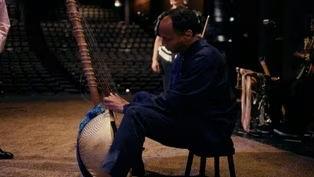
-This instrument is the kora, the 21-string West African harp-lute from Gambia, Senegal, Guinea, Mali, this region of West Africa, traditionally played by griots, who were not just musicians, but were also the chroniclers of the history and, also, carried the genealogy of the people from that region.
-So this is really central to the culture of that region.
-It's very central.
This instrument, also the balafon, which is an African marimba, and also the ngoni, which is a five-string, West African lute.
-So, this was not originally a part of Joplin's "Treemonisha."
But in the reimagining of the opera, it's been integrated into the opera.
-We wanted to represent that African history and the connection between ragtime and the music that people brought to this country.
And so the kora is just such an incredibly versatile instrument, and it's so beautiful.
You know, it can sound like a West African instrument.
It can sound like an American harp.
It can sound like a harpsichord.
So it's multipurpose, really, in how we use it here.
And we've reimagined these Joplin themes with these improvising instruments, with West African instruments.
So, this is based on the opening theme of the opera.
♪♪ And you'll hear that theme come back, but in quite a different way.
♪♪ ♪♪ ♪♪ ♪♪ ♪♪ -I feel like he took leaps and bounds at that time to throw a bottle in the ocean, in hopes that somebody would pick this up one day.
-He couldn't have been unaware that it would be hard to get that produced in his lifetime.
And he was right -- it didn't get produced in his lifetime.
But he still wrote it, and he put it in the Library of Congress.
And we don't take that lightly.
We really feel, like, honored to have picked up that bottle, and we're really inspired, and we want to continue to keep asking the questions that he was asking.
-I feel like we are the people that help to pick this up and give "Treemonisha" the life that I think we all feel it deserves, in terms of it being an all-Black opera and what that means, and that even from that time until now, we haven't seen anything like this.
So to me, it feels quite special and quite monumental for its impact.
-That's beautiful.
♪♪ ♪♪ ♪♪ [ Applause ] That night, at a dress rehearsal for a small audience, I was lucky to be among the first to see the new production.
-♪ She is the only educated person of our race ♪ ♪ You wouldn't understand ♪ ♪ Look at ya, you're a disgrace ♪ ♪ She teaches us to rise above the ignorance here ♪ ♪ So all you foolish conjurers can stay up in the woods ♪ ♪♪ ♪ All join hands and circle once more ♪ -♪ Oh, we're going around ♪ -♪ Don't go fast, and don't go slow ♪ -♪ Oh, we're going around ♪ -♪ ...light and fair ♪ -♪ Oh, we're going around ♪ -♪ Be careful how you shake your... ♪ -♪ Oh, we're going around ♪ ♪ Whoo ♪ -♪ Swing that lady ♪ -♪ Going around ♪ -♪ Swing that lady ♪ -♪ Going around ♪ -♪ Swing her gently ♪ -♪ Going around, keep on going around ♪ ♪ 'Round, swing ♪ -♪ Swing that gentleman ♪ -♪ Going around ♪ -♪ Swing that gentleman ♪ -♪ Going around, swing, swing, going around ♪ ♪ Keep on going around, keep on going 'round ♪ -♪ Gals be smiling ♪ -♪ Going around ♪ -What makes Joplin so likable is what makes him so important.
He was the first American composer to successfully merge Black and white music, in ragtime, in waltzes, and again in opera, to create something new, yet familiar -- music that people across the country and across cultures could love and still do.
-♪ Round ♪ -I'm Scott Yoo.
[ Applause ] ♪♪ [ Laughter ] ♪♪ ♪♪ ♪♪ -This program is available with PBS Passport and on Amazon Prime Video.
To find out more about this and other "Great Performance" programs, visit pbs.org/greatperformances.
And follow us on Facebook and Instagram.
♪♪ [ Laughter ]
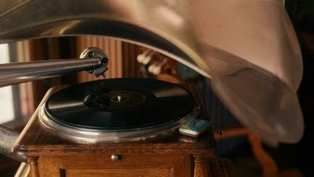
The First Recording of Scott Joplin's "The Entertainer"
Video has Closed Captions
Clip: S53 Ep13 | 4m 20s | Chris Ware and Scott Yoo discuss the first recording of "The Entertainer." (4m 20s)
Now Hear This – “Everyone Loves Joplin” Preview
Video has Closed Captions
Preview: S53 Ep13 | 30s | Scott Joplin was the king of ragtime, a new kind music for the turn of the 20th century. (30s)
West African Instruments in "Treemonisha"
Video has Closed Captions
Clip: S53 Ep13 | 3m 9s | In this reimagining of "Treemonisha," the West African kora take center stage. (3m 9s)
Providing Support for PBS.org
Learn Moreabout PBS online sponsorship New Episode
- Arts and Music

Innovative musicians from every genre perform live in the longest-running music series.

- Arts and Music
The Best of the Joy of Painting with Bob Ross
A pop icon, Bob Ross offers soothing words of wisdom as he paints captivating landscapes.
 New Episode





 New Episode
 New Episode
Support for PBS provided by:
Major series funding for GREAT PERFORMANCES is provided by The Joseph & Robert Cornell Memorial Foundation, the Anna-Maria and Stephen Kellen Arts Fund, the LuEsther T. Mertz Charitable Trust, Sue...