
Grant's Farm, Hour 1
Season 30 Episode 13 | 52m 23sVideo has Closed Captions
Meet us in St. Louis as ROADSHOW discovers memorable Missouri treasures at Grant’s Farm!
Meet us in St. Louis as ROADSHOW discovers treasures including an Andrew Clemens sand bottle, ca. 1885, a 1933 Goudey baseball card set 239/240 and a Joan Miró pencil on paper, ca. 1965. One memorable find is valued at $110K–$130K!
Problems playing video? | Closed Captioning Feedback
Problems playing video? | Closed Captioning Feedback
Funding for ANTIQUES ROADSHOW is provided by American Cruise Lines and Ancestry. Additional funding is provided by public television viewers.
Support provided by:


Grant's Farm, Hour 1
Season 30 Episode 13 | 52m 23sVideo has Closed Captions
Meet us in St. Louis as ROADSHOW discovers treasures including an Andrew Clemens sand bottle, ca. 1885, a 1933 Goudey baseball card set 239/240 and a Joan Miró pencil on paper, ca. 1965. One memorable find is valued at $110K–$130K!
Problems playing video? | Closed Captioning Feedback
Where to Watch Antiques Roadshow
Antiques Roadshow is available to stream on pbs.org and the PBS app.
Buy Now
Related to This Episode

ANTIQUES ROADSHOW's 2026 Production Tour
Enter now for a chance to win a pair of free tickets to one of the three stops on ANTIQUES ROADSHOW's 2026 Tour. Sweepstakes entry deadline is April 6.Providing Support for PBS.org
Learn Moreabout PBS online sponsorship♪ ♪ CORAL PEÑA: "Antiques Roadshow" is on the hunt for treasures at Grant's Farm in St.
Louis.
I brought a trophy in that I used to use as a trash can.
I'm shaking not because I'm nervous, but because I'm so excited.
(laughs) ♪ ♪ PEÑA: Grant's Farm is the popular St.
Louis attraction where "Antiques Roadshow" has set up to welcome thousands of eager collectors.
Named after the 18th president of the United States, Ulysses S. Grant, the attraction includes a modest cabin that Grant built prior to the Civil War.
In 1907, the cabin was moved to its current location by August Anheuser Busch, Sr., former head of the brewing company Anheuser-Busch.
Over a century later, the Busch family still owns Grant's Farm.
You don't have to go very far to find historical treasures here at "Roadshow" today.
♪ ♪ St.
Louis!
(exclaiming, laughing in background) I've been waiting for it for months.
GUEST 1: "Antiques Roadshow!"
GUEST 2: Smile, here we go!
(chuckling): Hey!
Well, it's a 1965 ES-330 Gibson is the model.
GUEST: Okay.
Tuners have been changed, which affect the value a little bit, but not tremendously.
Uh, this is roughly a, an $8,000 guitar now.
So you did good, and I bet you paid a lot less.
We got a bargain, um, 100 and a quarter.
Good deal.
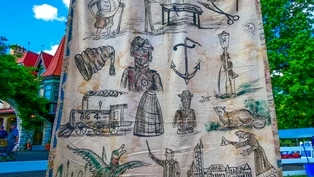
GUEST: This was painted by my great-grandfather Herman Petzel.
He was an immigrant from Germany.
Okay.
He was a member of one of the local German churches, St.
Liborius, and he was part of the German choir.
And it was as much a social club as a singing club.
And this is what is called a, a Schnitzelbank prompt.
It's like cue cards for a song.
Okay.
And the Schnitzelbank being a shaving bench in translation.
You name the different items, all in German, and then you sing the song.
♪ Ist das nicht ein Schnitzelbank?
♪ And then the response be, would be, "Ja, das ist ein Schnitzelbank."
And then you would name the different things.
(speaking German) And then you would move down the line... Okay.
...and each time, you would repeat everything as you went, until you got back to the Schnitzelbank.
It would be a, kind of a mnemonic for German Americans in St.
Louis?
Yes, yes.
Good.
And it wasn't unusual for breweries to print them out with their label... Right.
...and give them to the bars and stuff, so that they would sing the Falstaff or the Anheuser-Busch version of the Schnitzelbank.
This would've been his own version... Got it.
...that, that he, he was, things he was acquainted with.
I also learned that your great-grandfather was kind of a hero, right?
I mean... Yes, this was painted in 1904, and in 1905, his choir was at a venue in St.
Louis County.
There was an 18- or 19-year-old who got in trouble swimming.
And so they immediately turned to Herman, because everybody knew Herman was the best swimmer.
And unfortunately, he, he overpowered Herman, and they both drowned.
He was posthumously awarded a, a Carnegie Medal for heroism.
Wow.
Along with a stipend that was very helpful for my great-grandmother and her six kids... Wow.
...one of which was my maternal grandmother.
It really tells the story of St.
Louis in, around 1904, what was going on, especially what was going on with German Americans.
And most anybody from St.
Louis would easily recognize Union Station.
Right.
And then, being good Germans, who were very much against the temperance movement, would include a rather evil-looking caricature of Carrie Nation.
And Carrie Nation, of course, being the, the famous suffragette and also a pro... In the temperance... ...temperance... Who was known for s, breaking open beer kegs with a hatchet.
It's hard to know, really, without testing it, about the paint.
And it could be oil, but it appears to be painted on, literally, a cotton curtain.
If I were to insure this piece, I would put a value of $6,000 on it.
(gasps) Yeah.
(laughing): I'm gonna cry.
(chuckling) Yeah, of, it's... It'd be impossible to replace, of course.
(crying): Oh, gosh.
Thank you.
Of course.
My mother would've been s... (voice breaking): ...so proud.
It's more than I would've ever thought.
STEVE BYRD: Grant's Farm's an iconic St.
Louis attraction.
This has been the home to the Busch family for generations.
Back in 1903, the Busch family acquired this property, and in 1954, it became open to the public, hosting over a half a million people each year.
One of the things that makes us the most unique is being able to interact and get up close to all the different animal varieties that we have here, including, of course, a visit with the world-famous Budweiser Clydesdales.
I purchased it locally here in St.
Louis at an estate sale.
And when I opened it up, I saw the Lucille Ball autograph and the card and thought it was interesting, and I closed it back up and went to pay for it.
And I paid ten dollars for it.
And then, as I was leaving, 'cause it was in a stack with games in it, and so I don't think they realized-- the person that was checking me out-- that it was, had Lucy affiliation in it.
So we were talking, and we think that... Don't know the time of it, but that it might have been donated for charity for an auction here in St.
Louis.
That, that's all I know.
Gotcha.
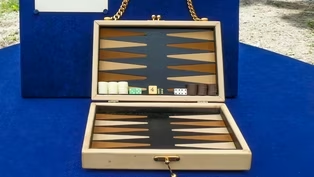
So when you came in today and you first showed us this, um, I, I was taking a look at this, and it's... Immediatel, it's a handbag.
It looks like a purse.
Yeah.
And the coolest thing about this is that it's more than meets the eye.
Obviously, it is not a purse.
It's backgammon.
And it has some pieces and things in there.
Um, and the very little you know is that it was probably donated for a charity auction, and that actually does make sense.
She was a very generous person.
And you have this card here that's typed up and very cursorily just says... "Lucille Ball's Backgammon Game."
That's it.
(laughing): Yeah.
It's a very short and sweet message.
Um, and then it obviously came with this signed photograph.
Is that an original signature, you think, or... This is actually an original autograph on the photograph.
So, it's the kind of thing that, when she sent it in for a charity auction, she obviously put that with it.
Okay.
I think they probably typed up that little card.
Yeah.
Most likely, it was one of those kind of silent auctions where they would have something sitting out and people could leave bids, and that's the type of little card they would've typed up for it.
We don't know exactly when this happened.
My guess is, it would probably be early '80s.
We do know that she was fond of playing backgammon.
Um, she was part of a Hollywood set that used to get together and play cards.
You always hear these stories about Gregory Peck and Lucille Ball and all these people getting together to play cards, which is pretty cool.
We're talking about it right now because everybody still loves Lucy.
Yeah.
I mean, she was the original that so many women who came after her who were comedians, but, beyond that, she, you know, started her own production company.
Mm.
So, it was pretty... Yeah.
...rare at the time that she owned Desilu and started her own, her own company.
So she was really obviously a, a power figure in Hollywood.
Um, but you said you paid... Ten dollars for it.
(laughs) Okay.
I think in an auction right now-- we have a lot of comps for other... Yeah.
...small handbags and personal items of hers-- would be about $1,500 to $2,500 now.
Yay!
Thank you so much.
(laughs) GUEST: Well, we bought this at a auction a couple, six months ago, paid a couple hundred dollars, and we're hoping it's going to be a little bit more than that.
(chuckles) It's what they used to call a newspaper morgue book.
It's basically every copy of the "St.
Louis Globe-Democrat" for the month of September 1951.
And it's got the color pages, got all the, the black-and-white stuff in it.
Everything's there.
GUEST: I brought this dagger that I believe is a World War II O.S.S.
dagger.
It was issued to my dad's uncle, so my great-uncle.
And what did he do during World War II?
He was in the O.S.S., and that's pretty much all I know.
So you don't know any details of his service?
No-- I think they weren't supposed to talk about it.
And do you know what the O.S.S.
is?
Uh, I, my family always said it was the precursor to, like, the C.I.A., like an intelligence agency-type.
It's exactly what it was-- the Office of Strategic Services was established in 1942 by FDR to be our first real intelligence agency.
This knife is exactly what you believe it to be.
(chuckling): Cool.
It is an O.S.S.
stiletto.
It's copied from the Fairbairn-Sykes commando fighting knife that the British developed.
You'll notice that it's not marked anywhere.
And that's called sterile.
Because these were being used behind enemy lines... Mm.
...and you didn't want to be able to trace them back to a country of origin or what units might be using them.
It was made by a company called Landers, Frary, and Clark, out of Connecticut.
They had made things during World War I, including fighting knives and canteens, but that's not what their primary business was.
Do you have any idea what they really did in peacetime?
Mm.
Nope, no.
Well... Spatulas?
(laughing) You're exactly right.
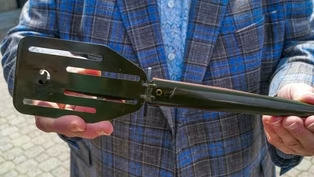
(laughs) They made everything that was made out of metal, from kitchen implements... God... ...like spatulas... Uh-huh.
...to, uh, toasters.
The, the firm was started in 1865, right after the Civil War, and was in business to 1965, making every sort of little metal item you could possibly think of.
Oh, okay.
So collectors actually refer to this scabbard, the sheath for the knife, as the pancake flipper scabbard.
(chuckles) Those grooves give you a place to put your belt and the handle supports the leather sheath.
Do you have any idea what this might be worth?
No, not really.
It's a rare and desirable knife.
They only made about 10,000 of these.
LF&C received a contract to make these knives in 1942, and they delivered them between 1942 and 1943.
The contract price was $2.03 apiece.
(chuckles) This one is in just about pristine condition.
The only thing missing is, there was a little rubber O-ring that went right here that held the hilt... Oh, okay.
...to the top of the scabbard.
Uh, in the condition it's in, I think a conservative auction estimate is $2,500 to $3,500.
All right.
And it could easily do more than that.
All right.
They do make fakes of these.
This one's 100% real and legit.
All right, cool.
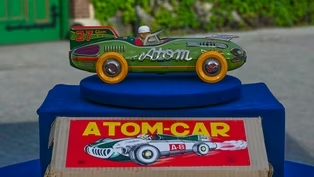
I brought in my Atom-Car that I got from my dad.
I guess he got it as a Christmas present when he was little, from his grandma and grandpa.
Okay.
And down the line, I was at my great-grandma's house, and I would play with it.
When the time came and she had to move out of her house, this is one of those things that she gave to me.
And I never really played too much with it.
Just always would get it out and kind of, like, "This is the coolest thing in the world," you know?
Okay.
And my wife's, thinks I'm a hoarder for some things, but... (chuckles) But this is one of the cool things that I have.
It's got a tag on one side.
I guess it was underneath the Christmas tree.
And then, uh, my dad looks like he scribbled his name at some point... Okay.
...on the top edge over on the other side.
Yonezawa is the name of the company in Japan... Mm-hmm.
...who produced this toy.
Early '50s, 19, mid-'50s.
The overall condition's great.
And the lithography, the detail, the patterns that are on it are really eye-catching.
What it's made of is a tinplate.
It's a sheet metal, a really thin sheet metal, and it's laid out on flat sheets and stamped with lithography.
The nice thing about doing the lithographed tin toys is, they're able to simply change the lithograph.
They would produce this particular model, the 27 Atom, for maybe a couple years, and then change it slightly to change the number, therefore creating a new toy without having the cost of retooling the entire assembly line.
One thing that's great is that it has a space theme.
It's a race car, it has this imaginative rocket ship design.
So it has a really wide appeal.
The front has a triangle adorning the Atom 27 badge.
Uh, and then that hood ornament just screams to me space race, space theme.
Now, on the back, as the wheels would spin, it would emit sparks, and they'd actually shoot out almost like a rocket out of the back of the car.
Oh, wow.
Now, condition is king.
It would've originally had rubber slips over the tires, so it would've gotten better traction.
Down here, you have what looks like some brush paint, some touch-up.
Mm-hmm.
I'm happy to tell you they are factory touch-ups.
(chuckling): Oh, really?
So, when the toy was created and stretched out, it might have left little creases, little tears in the litho.
No way.
And the factory'd go back and very sloppily touch it up.
And over course of time... (chuckling) ...the colors fade a little different.
Oh, I see.
And that's why we notice it so prominently now.
Huh.
And then on the front, we have your box up here.
Now, if you watch "Antiques Roadshow," we've said it many times before, but the box is extremely important in helping the value of the, the piece.
One step further that makes this extra-special is, is this box l, decal is in red background, which I've never seen before.
Oh, wow.
I've seen this decal, but it always has a black background.
Huh.
So, just the box alone should easily fetch $3,000 or so?
(laughing): Really?
Now, when you have the combination of the car and the box together... That's... ...this would fetch at auction between $6,000 and $9,000.
Holy cow.
Wow.
That's crazy.
With the right bidders competing, this could zoom even past that.
Holy cow.
I didn't realize it was that special.
This is a Reddy Kilowatt sign from Union Electric from 1929.
And, uh, super-original.
They actually put it on the street before they'd go into the hole.
So if you fall in it, you're really dumb.
(laughs) So we brought in a ceramic vase.
We actually inherited it from my mother-in-law, who passed a few years ago.
So we don't know too much about it.
But inside, we did find a certificate for a pottery.
So who knows?
But hopefully, we'll find out some more today.
It was given to me by my mother in 1972.
She got it from her mother in probably 1945.
And then prior to that, my grandmother got it from her aunts.
When, I don't know.
We have here a sapphire and diamond ring.
The diamond weighs, by formula, approximately a carat and a quarter.
And the sapphire is just over two, a little over two carats, about two-and-a-half carats.
The ring was probably made by a very high-end jeweler in New York City.
The diamond is beautiful, but the sapphire is really special.
One of the things that we can't always determine in this context is whether or not a stone has been subject to treatment.
So, there are certain inclusions that you see when a stone's been treated.
And what we're seeing under magnification is, this is a natural color.
(whispers): Great.
And that's very important in the colored stone market, because stones of this beauty are pretty unusual.
And when we determine a sapphire, we do talk about country of origin.
One of the things that we can't do here is do that.
(chuckles) Okay.
The stone would have to go to a laboratory.
What we think, though, from looking at this color and the shape and just everything about it, it's probably a sapphire from Burma, and those are quite desirable.
At auction, I would estimate the ring at $15,000 to $20,000.
Wonderful, great-- thank you so much.
Oh, thank you.
I appreciate it.
Do you wear it?
No, but I will be now.
You better.
(laughing) Yeah, I will.
Well, my husband and I took an art class at University of Missouri when we were in college.
And I fell in love with one of the artists, and it was Miró.
And not too long after that, we went to an estate sale, and this was on the wall.
And I'm, like, "Wow."
It was eight dollars, and I had to borrow it from my father.
(chuckling): 'Cause we didn't have it with us.
(chuckling): Okay.
So, that's how we bought it.
And then, we tried to figure out if it was real or not.
We went to the art museum, and she said, "Well, I'll give you the name of a dealer in New York City."
And the dealer turned out to be Pierre Matisse, Henri Matisse's son.
Uh-huh.
And he had a, a shop in New York, and he did all of the, I guess, everything for the Miró line.
And we wrote to him, and he said, "Looks like it's real."
Okay.
And then, few weeks later, he said, "But you need to send me the original."
Right.
And we sent it.
And he said, "Nah, I'm not so sure it's real."
(chuckling): Okay.
"Would you like me to check with the artist?"
And, um, you know, I'm, like, "Oh, that sounds like a good choice."
Sure.
"Yeah, sure, go ahead, check with the artist."
So, Miró lives in Spain, and Matisse was going to visit him, and he took the picture, and the artist said, "Yeah, I did it."
So, it took about a year for all the paperwork, but, uh, I'm thrilled to have it.
Yeah, and what year was that?
I think we bought it at the house sale in 1971... Okay.
...and started corresponding with the gallery in '72, and got the final letter in '73.
Mm-hmm.
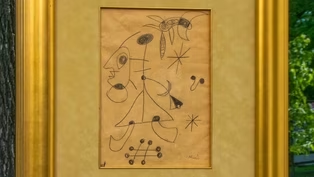
This work is a pencil-on-paper drawing by Joan Miró.
He's born in 1893.
He's a very interesting character in modern art and especially in 20th-century art.
Uh, by 1920, he already is meeting Picasso in Paris.
Mm-hmm.
And, uh, from there, Miró seemingly is part of not every major art movement, but a lot of them.
Really an artist who mastered every medium, from sculpture, to drawing to painting, and to prints.
So, in this particular case, he says here, in the note, "It is possibly an idea for a lithograph which I intended to do, done at the printer's."
And I think that, date-wise, his real, deep dive into lithography starts in the late '50s?
Late '50s, okay.
Uh, and then proceeds, really, throughout his career.
But given that you acquired it by '71, I, I would say we can pretty safely say this was likely done in the 1960s.
I think that an insurance evaluation would be $35,000.
Whoa!
(chuckles) That's, that's wonderful.
That's more than I thought it would've been.
Yeah, pretty good for eight bucks.
(laughs): Yeah, for eight bucks.
PEÑA: About 270 animals live in the Deer Park.
American bison are among the group.
CRAIG THOMAS: We currently have an impressive bison herd of 13.
We have, uh, 11 female and two males.
Trying to make sure that we, uh, can produce as many young bison as we can.
Grant's Farm has always had, uh, iconic animals like, like bison, and they're really one of the more impressive, uh, bovine species that we have.
So our guests get to drive through and see them, uh, just off the road as part of their welcoming experience to Grant's Farm, before they, they experience the rest of Grant's Farm.
PEÑA: Bison, also commonly known as American buffalo, are native to North America.
Wild bison may live for 15 years.
In captivity, bison may live as long as 25 years.
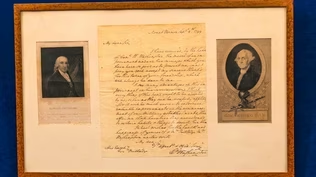
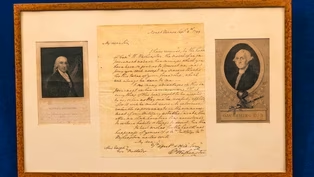
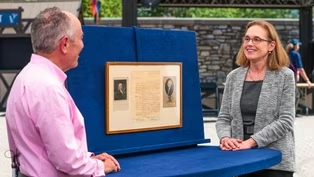
GUEST: I brought in a letter from George Washington, and it is addressed to Edward Rutledge.
APPRAISER: Okay.
My grandmother somehow got this, and we don't know where or how she got it.
She sold real estate and she sold antiques.
Oh, wow.
So, working at the antique store, she might have had opportunity to get this.
Really?
And I have no idea if it's actually real.
Sure.
Or is it a forgery?
Right.
(chuckles) So, there were a few things on this letter that really caught my eye, is first of all, the date.
It says September 1799, and that is actually several months prior to Washington's death.
Wow.
Uh, the other part of this is that the letter is talking about these gun carriages and is thanking Rutledge for his support.
George Washington and Rutledge had a wonderful relationship.
Oh, great.
Mutual respect and admiration.
Wonderful.
So, of course, Rutledge, being the youngest signer of the Declaration of Independence... Mm-hmm, mm-hmm, yes, right.
...was a founding father, right along with Washington.
He then runs for South Carolina governor, and he is now currently governor when this letter is dated.
Oh.
Toward the bottom, you can see that this is to his good friend, and it is also then signed by George Washington.
Now, we're not authenticators.
However, I did talk with three or four of my colleagues.
Wow.
We also looked at this under a loupe just to make sure that this wasn't a printed document... Oh, yes.
...and to make sure that the ink and the paper are of the time period.
Yes.
Because those are all the telltale signs.
Right, right.
That's what we look for.
Uh, what I can tell you is that we do believe that this is an authentic letter... Wow.
...that this is an authentic signature.
Oh, my goodness.
Oh.
The real value here is in the letter.
The other two images on either side, they're nice, but they don't really add as much.
So, the auction estimate for the letter would be $15,000 to $20,000... Okay.
...on this piece.
Wonderful-- that's just wonderful, wow.
And to say it's, it's probably authentic.
GUEST: It's hard to say where I got it.
It was at least 30 years ago.
I'd go to estate sales sometimes.
I bought items in, um, boxes, or just a whole bunch of stuff on a table.
But I, I saw that was special to some degree, so I kept her.
(chuckles) We know this artist.
Definitely is by Andrew Clemens, who was from McGregor, Iowa.
Wonderful.
And he had a disease as a child that caused him to lose his hearing.
So he went to the Iowa School for the Deaf and probably learned the basics of doing something like this there.
But he took it to another level, and he's become very well-known, much more well-known than he was in his lifetime.
He only lived to 37.
Born 1857, died in 1894.
Most of the time, he put pre-printed labels on the bottom of 'em, and it probably had a paper label on it at one time.
He perfected the art of harvesting the limestone off the walls near the Mississippi.
Amazing.
He... And he and his brother would pick things for certain colors, and then they would grind 'em up to a fine powder.
And every bit of that is done by compaction.
He did these in different sizes in pharmacy or apothecary bottles.
This is the smallest size.
He did 'em up to about ten inches.
And you could actually order one that had your name on it, or a date, or... He put eagles and locomotives and all kinds of stuff on there.
But what makes this an Andrew Clemens bottle?
First of all, it's the precision.
To me... It's amazing.
Yeah, he-- some of the bottles... I can't even imagine how he could do that.
Well, and that's why people love 'em so much.
He would pack it in there so tight with so much great detail-- he even shipped 'em.
This geometric stuff, like you see along the bottom and the top, and the flowers, were one of the things that he started doing pretty early on.
I think the cool thing about this is the sailing scene.
Oh, that is neat.
And we know that this one is probably from the 1880s, 'cause by that time, he had developed the technique of doing these nice floral scenes and the scene with his little sailing boats on the back of it.
I talked to my buddies at the folk art table, and we're very comfortable with this being in a retail range of $25,000 to $30,000.
Ooh, wow.
(laughs) (laughing): I'm thinking again about that selling... No, I'm not.
(chuckles) Maybe-- I, that's a lot of money.
That's great.
Well, uh, it's a old carnival game.
Looks like it might've used to have, like, a pellet or something.
But it's made, you push in the plunger, the doors fly open, and then... (rattling) ...this little fellow gets a spanking.
My grandparents lived in the country.
They lived near a railroad track, and, um, hobos used to come, and they would feed them.
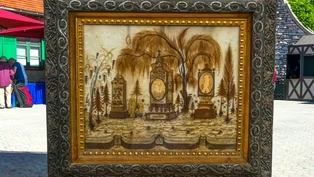
So one of the hobos took a lock of their hair and left and came back with this picture for them.
So this is all family hair.
And where did they live?
Where was this farm?
Belleville, Illinois.
There's a lot of hair in, in, in this.
There is a lot, yes.
And there's also personal photographs.
Yes.
So when did this come into your life?
It came into my life 37 years ago.
And... From my grandmother.
It's kind of a little bizarre.
(laughs) And some people think they're a little creepy.
Yes.
But they're done in the style of these late-19th-century memorials... Okay.
...that were done earlier in that century.
There are watercolors and there are a lot of needleworks.
And the quintessential piece is, typically, the weeping willow.
Oh, wow.
Okay.
And we see this in watercolors.
We see needlework.
I've not seen one made of hair.
Really?
Yeah.
I do not recognize the artist's hand.
I don't know of any other piece that's similar to this.
So you might say the artist did this, and it's one and done.
These are pictures of your relatives?
Yes.
Okay.
So they would have been cut out of a cabinet card.
Okay.
And cabinet card was 19th-century photography.
And they were done typically in studios.
And especially the one next to the monument is the husband and wife.
Mm-hmm.
And then you have the wife and then you have another family member.
Do you know who they are?
I do not.
I know it wasn't my grandparents, so it had, could have possibly been their parents.
We have this hair that is used everywhere, along with what I'm thinking is pressed felt.
It's on the fence on the bottom and it's on the monuments.
And everything is mounted to a ribbed paper.
So this is late 19th century.
Okay.
And I think in a really good retail setting, I would put a value on it of $5,000.
$5,000?
$5,000.
Okay, thank you.
And if you're insuring it, I would put a value on it of $7,500.
Okay.
You're not going to find another one.
Thank you-- yes.
Uh, this is a print from Anni Albers, a Bauhaus and Black Mountain artist.
I got it from a, a gallery in 2005, 2006.
I'd always been kind of collecting smaller-scale art, and this was the first thing of, I guess, notability that I purchased.
And could you give us an idea of what you may have paid at the time?
I want to say approximately $2,500.
I grew up in Asheville, North Carolina, which is in the shadow of Black Mountain.
Mm.
And so I've always been fascinated with all the artists there, from Anni Albers to her husband, Josef Albers, and Rauschenberg and the other artists that were in that community.
Anni Albers was born in Berlin in 1899, and she studied at the Bauhaus starting in 1922.
She mostly studied weaving while she was there, and then ultimately became part of their faculty in 1929.
She did come to the United States with her husband, Josef Albers, who also is a very well-known 20th-century artist.
And they founded the art department at Black Mountain College.
Mm.
I believe that was in 1933.
Hm.
She really was known for design at the start.
She was actually the first designer to receive a solo exhibition at the Museum of Modern Art, and that was in 1949.
Hm.
By 1963, I believe, she was moving almost exclusively to printmaking.
Mm-hmm.
So she really delved into screen prints.
And this is a screen print on paper.
We do have a signature and a date in the lower right, "Anni Albers, 1968."
Mm-hmm.
This is 26 of 50, and there's an "A" just before that.
I actually believe "A" is the title of this work.
Okay.
She's become one of the most important women artists of the 20th century.
Mm-hmm.
One of the most important artists of the 20th century.
Mm.
She's absolutely one of my favorites.
Her work has become quite desirable.
Mm-hmm.
I would say her market has taken off quite a bit since you purchased this work.
Okay.
Her works are quite rare.
This is only an edition of 50.
Yes.
So there's not a lot of them out there.
So given all of that, I would give a current auction estimate on this screen print at $6,000 to $8,000.
Oh, cool!
That's awesome!
I would recommend an insurance value of $10,000.
Awesome, that's great.
I can tell you that I have no idea what this is, but he's really heavy, and I think he's cute, but we call him Red Man.
(laughs) I got him at the Goodwill.
$3.99.
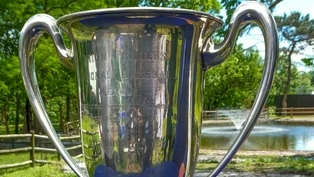
(laughs) Uh, it's a 1915 sterling silver trophy from the, uh, that the St.
Louis Typos won in Philadelphia.
It was his trash can.
Yeah.
In his office.
APPRAISER: How did you come to own it?
GUEST 1: My father had it, and when I went off to college, he took the trash can and put it in his window to sell.
It's, must have sat there for about four years, and then, in 1978, somebody came in that offered him $50 for it.
And my dad looked at me and he said, "Well, I, Gary, that's your trash can.
You want to sell it?"
And so I kept saying no after $50 increments, and the guy went up to $250, and, when the guy left in a huff, he, he says, "Gary, why didn't you want to sell it for $250?"
And I said, "Well, I, 'cause I think it might be sterling silver."
It is a sterling silver trophy.
(chuckles) You are correct.
But it's a fun piece 'cause it has a lot going on for it.
In addition to just being a very large, uh, piece of presentation silver, it has crossover appeal.
It's not a piece where the person that's buying this is gonna be looking for a perfect-condition piece.
Right.
They're more interested in the history that it represents.
Yeah.
Now, most people have never heard of the Union Printers' National Baseball League.
(laughs) Huh.
So they were originally established in 1908 with eight different teams.
And within a couple decades, they had grown to a peak of about 12 teams.
And these guys were all card-carrying union typesetters in the printing trade.
Finally, the league kind of dissolved naturally.
In the early 21st century... (chuckling) ...typesetting is no longer really a, a widespread career.
Technology took over.
In 1915, it was won by the St.
Louis Typos.
Right.
Love their name, that they were comical enough to, to choose "the Typos."
So great piece of presentation silver.
You can see there're some markings on the underside.
Yes.
It's marked here "sterling."
Um, "12 pints," which is the size.
And then it's marked for the retailer, who is J. E. Caldwell, out of Philadelphia, which makes sense on account of, this tournament was played in Philadelphia.
J. E. Caldwell could be seen as the premier jeweler of the time.
Oh!
So this is something that would have been retailed by them.
Can you tell me about what that, that Sharpie notation was?
(chuckling) Yeah, so, when I went to take it to get, uh, to the local pawn shop, they weighed it, and, uh, so they gave it to me in pennyweight and troy ounces, and I just Sharpied it on there.
And I haven't been polishing it, but last December, I had it polished, but the polisher left that on there.
(chuckles) Got it-- well, I think polishing was a, was a great choice.
(chuckles) It's not a piece where polishing is gonna hurt it.
So at one point, you were offered $250.
So the big question is, what is it worth now?
Exactly.
As a base value, just the silver alone, um, with silver prices currently at about $30 an ounce, it's about $1,500 in silver.
Right.
And then the question is, how much of a premium does an early piece of American baseball history add to it?
Granted, a not very well-known one... (chuckles) ...but an important piece of early American baseball history.
And I feel confident that, if it came to auction, we would expect it to do $2,000 to $3,000 at minimum.
Oh!
Okay, great, okay, yeah, that's better than I thought.
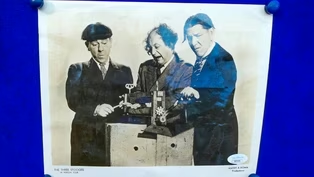
GUEST: This is a picture of the Three Stooges, Moe, Larry, and Shemp.
I bought this at an estate sale about a year ago.
It was literally one of the first estate sales I ever went to.
I just am a Three Stooges fan since the day I was born.
I paid only two dollars for it.
Wow.
And it came in a brown frame, and later that night, my wife had another picture that she wanted to use the brown frame for, so I took the Three Stooges picture out of the frame, and then on the back, found the autographs of the Three Stooges.
That's amazing.
So when you originally bought it, you had... I had no idea.
You had no idea that it was signed.
Right-- I couldn't believe it.
If my wife had not ask for the frame, it would have sat in the frame, and I would have put it somewhere in the house, or in the basement, even, and never would have looked at it.
The photograph itself is a really nice photograph.
It's an original 8-by-10 publicity still.
It's Moe, Larry, and Shemp.
But what I love about it is, the signatures really take it to a very much higher level in terms of its value.
I've noticed that we do have a little mark on the right-hand side.
It's, uh, a sign of its being authenticated.
Yep-- you'll notice that Moe wrote most of it, and then Larry and Shemp wrote the rest in pencil.
I'm, like, "That seems kind of odd.
Wouldn't they all be holding a pen?"
And, uh, I'm, like, "Well, I'll get it authenticated."
And I drove over, a, a baseball card show and took it in, and three hours later, they came back, said, "Yep, these three signatures are the Three Stooges."
And even though it's not Curly-- and I know most people are Curly fans-- believe it or not, my daughter and I are actually more Shemp fans.
Oh, that's fantastic.
So, so, so it even, it even is better... (laughs) ...you know, that we're Shemp fans.
So it worked out perfectly for you, because you got the perfect trio, because there were six individuals who played in the Three Stooges over the years.
Only three, of course, at any one time.
But that's amazing that you managed to get the three signatures of the three... Right.
...that you favored the most.
Yeah, yeah.
They're very hard to find, the autographs.
So it's a very desirable piece.
In terms of value, have you had any... Do you have any inkling of what it could be worth?
I know you only paid two dollars for it.
Yeah, I, I, I was guessing between $500 and $800, maybe, since it is old.
I have never seen a picture like this of them before.
I would expect this, conservatively, to be worth between $1,500 to $2,000 at auction.
Wow, okay.
It's a very desirable piece.
Okay.
Now, if it were signed on the front... Right.
...those types of photographs, signed on the front by the Three Stooges, have sold in, in the realm of around $3,000 or $4,000.
Right.
So it's not worth as much as one that's signed on the front, but it's still such a fantastic piece.
Uh-huh.
And what an amazing find!
Yeah, I assume if it was signed on the front, it would never ended up in my hands.
And so this is, yeah, this is just... It's, to me, it's priceless.
It's a Westinghouse Nikolai Tesla fan from the late 1800s.
I bought it at an estate sale, $450.
PRODUCER: Does it keep you cool?
Oh, yeah.
Does it chop off fingers?
It would.
(chuckles) When my grandmother passed away, we found it in her belongings and nobody knew anything about it, but I thought it was beautiful.
So I said, "I'll take that."
We think it's a, uh, cocktail shaker, 'cause there's, like, a strainer at this part.
Other people said urn, but we're gonna go with cocktail shaker.
APPRAISER: This is a cocktail shaker made in India.
GUEST: Oh, wow.
Would have been very fashionable then and actually is pretty fashionable now.
And what did they do to make something look Indian?
They did this kind of wonderful engraved design.
Yeah, right, right.
And they made it ver, gold, so it is going to be appealing.
(chuckles): Right.
Everyone that came to your grandmother's... (chuckling): Right.
...is going to go, "Is it solid gold?
Oh, my gosh!"
Right!
(laughing) But we know it's not, because we open it, and what do we see?
(laughing): Right.
It's tin.
(both laughing) Yeah.
It's an inexpensive kind of thing... Right, right.
...that looks really, really good.
(laughing) And that was purposeful, so that they could export lots of them.
It would look great in a low-light interior.
It's got a function.
So what do you think it's worth?
I have absolutely no idea.
Well, I think it's worth probably about somewhere between $50 and $100 at auction.
Okay, that's great.
That's great.
Yeah, terrific item, and what a great association with your elegant grandmother.
Exactly, thank you so much.
It's a good memory.
Thank you.
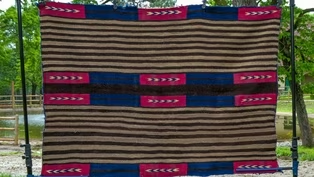
GUEST: Well, I think it's a Navajo blanket.
And, uh, I grew up in a small town in Southern Missouri, Eminence.
And there was a lady there who was also interested in Native American things.
And, uh, she had this, and I admired it for a while.
And at some point, for a birthday or Christmas or something, she gave it to me as a gift.
This is a Navajo blanket, and it's an exceptionally great Navajo blanket, because it's a classic woman's wearing blanket.
Mm-hmm.
This would've been something for special occasions, ceremonials, for, um, gatherings.
Okay.
When they traveled, when they met and greeted people, when they had people coming, visitors.
This would have represented the prowess of a great Navajo weaver and the stature of a Navajo woman that this would have adorned.
It's also, to make it more interesting, is, it's a chief's blanket style, which is a second phase.
And so we have these little quadrants and bars and we have these kind of chevrons elements in here, as well.
Mm-hmm.
What I really like about it is the history of weaving and all of the elements that come into this blanket.
So this great color is indigo.
It's, like, what makes a Navajo blanket even more desirable.
Hm.
And then the red.
The red is actually a raveled bayeta from an old blanket.
And then it's dyed again with cochineal, which is actually from a, a beetle.
And it creates a, a red, but it has just a subtle nuance of almost purple to it.
Mm-hmm.
That really nice hue.
The gray is, like, how do we get gray wool?
Well, they're carding, uh, brown wool in with the white, and it gets this really wonderful intermediate gray.
Okay.
You get these great stripes, these larger quadrants of thicker bands.
And then you get the spacings.
You get rhythms happening throughout the weaving.
This blanket is woven in about 1860 to 1870.
And it, it looks like it's maybe been cleaned.
And we have some condition issues with what's called the selvage, the edge that goes all the way around the perimeter, but it's all here.
There's a few little areas where maybe it's seen a little more wear than normal.
But again, this was a blanket that someone used, so it's survived all of this time.
Have you ever ha, talked to anybody about having it appraised before?
No.
Okay.
It's a really good, rare example of a Navajo woman's or even a, a young girl's... Hm.
...wearing blanket, and a blanket from this period probably is worth, a retail, and this is an as-is price, between $20,000... (softly): Wow.
...and $25,000.
Had no idea-- huh!
That's great.
I had no idea it was that old.
I thought maybe 1900, something like that.
Sure-- older than that.
(chuckling) And it goes back a ways.
BEATRICE BUSCH VON GONTARD: My grandfather was August A. Busch, Sr., and he built this house in 1910.
And before he built this house, he built the Bauernhof, which is where he had his stables and his carriage house.
So he was a farmer.
He was basically an early environmentalist.
He really cared about the land, the trees, the, the water, the soil.
This house, we always called it the Big House.
Seven of us grew up in this house.
And with my father, August Busch, Jr., and my mother.
Mom and Dad entertained a lot of people here, including presidents.
We really just enjoyed it as kids, just running around and having a good time.
No one lives in the house now, but we do use it for special occasions.
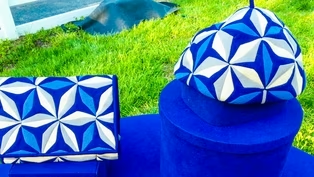
GUEST: I brought a felted wool beret and clutch that was my great-aunt's.
She traveled quite extensively, and so much so that her nephews all called her Aunt Way-Way, because she was away all the time.
(laughs) I was really excited when you brought these to the table.
Mm-hmm.
Um, probably very visibly so, because it's a brand that's pretty near and dear to my own heart.
Okay.
It's an Italian company.
They were called Lenci, or the full name was Ars Lenci, as in "ars," Latin for "art."
Lenci opens as a business in 1919 in Turin.
It is a family-owned business, and they actually specialize in felt painted dolls.
And they're wildly popular.
Everyone is collecting them, and they continue to collect them pretty much until the business closes in 2002.
What people don't know, outside of the doll world, I would say, is that for a very brief window in the '20s and '30s, they were also producing ceramics, very high-end ceramics, and fashion.
Fashion and accessories for mothers and daughters.
Okay.
And that is what we have here-- as you said, it is felted wool.
And these are pieced in a very particular way.
Yes.
Um, very beautifully.
Yes.
In a sort of quilted manner, even... Mm-hmm.
...in terms of where the, the way that they are pieced.
Um, you can see a little better on the interior just how they're made.
They had shops in other areas of Europe... Mm-hmm.
...as well as also being, uh, retailed and distributed by department stores in America.
Oh!
And one of the big publications that talked about Ars Lenci a lot in the '20s and early '30s was "Women's Wear Daily."
Oh!
So, American New York fashion magazine.
Okay, sure.
Lenci had just begun this production about 1927.
So "Women's Wear Daily" had a write-up in one issue talking about how Lenci was one of the two most important fashion houses currently making great garments for women.
I've seen some of the hats before.
They do come up occasionally.
What I've never seen before is a matching bag.
Okay.
I think by about the mid-1930s, they had completely stopped making anything of this sort.
So I could see that even with the push of "Ro, Women's Wear Daily," it wasn't enough to keep this side of the business going.
I would say, conservatively, in a retail setting, to have both the hat and the matching clutch, you're probably looking at about $3,000 to $3,500.
Oh, my goodness.
Aunt Way-Way, she, she saved my, um, grandparents... (chuckles) ...during the Depression.
She and her sister helped them when they had a young family, and so... Oh.
That's awesome.
Oh, my gosh.
That's awesome.
I wish I had known her.
I'm sure she had a lot of tales to tell.
So this is an advertisement for Clarke's Rye, which was, uh, a distillery in Peoria, Illinois, um, pre-Prohibition.
And this was one of their marketing pieces that they did.
It's called "the Old Codger."
They belonged to my dad first, but he's passed away, 2018.
And we came across some cleaning out a storage unit.
One of the last box we opened, it's, like, "Oh, my gosh, here's some baseball cards."
What do you know about how he obtained these?
Well, in 1933, Bill would have been about 12 years old.
And I could see him collecting these cards.
He had the scrapbook, and so he had every slot numbered.
There's 239 cards in the set.
Mm-hmm.
Some of 'em are a little wrinkled, so I could see him actually have one in his back pocket.
Okay.
Bringing it to school to trade.
Mm-hmm.
You know, with his buddies or something.
I'm shaking not because I'm nervous, but because I'm so excited... (laughs) ...to talk about these today.
The Goudey Gum Company, founded in 1919 by Enos Gordon Goudey, was strictly a gum company.
That was their business, was chewing gum.
So Enos Gordon Goudey retires in 1932.
He stays with the company as a consultant.
And then in 1933, they decide to do this idea of combining a baseball card with a stick of chewing gum, using the baseball card as a way to encourage people to buy their gum.
And out of this idea, they end up creating one of the most revolutionary sets of cards in the history of collecting.
They took it to a whole new level when you look at the aesthetics on these cards.
The vibrant colors, the quality of the printing far surpass anything that had been done previously.
And nearly every card in the set is considered a rookie card.
Right.
And everything done previously to that was either in tobacco or it was in candy.
And most cards before this were just regional.
The packs were one cent and you got one card.
Oh, boy.
That's it-- so the set had a checklist for 240 cards.
Right.
However, we see in your f, the first sheet here that card number 106 is not there.
Right.
What they did as a marketing ploy is, they didn't actually print card 106 so that people would continue buying more packs... Oh.
...chasing this card 106.
Got it.
They had so many complaints about people not being able to put together the set that you, people actually started writing off to the company, to Goudey, and so, in 1934, they actually then printed card 106.
They're extremely hard to find.
So whether you have 239 cards or 240 cards, they're both considered a complete set.
Right.
Because these have been housed in a scrapbook album like this for so many years, the color is fantastic.
The second thing I looked at were the tabs.
Okay.
Okay?
So good news is, we look at the Babe Ruth here, top center.
It's just slid in those little corners.
No issues whatsoever.
Okay.
But then I had to look at the heart-shaped tabs, and we've actually folded back a couple of those heart-shaped tabs.
The great news is, the glue has dried out and those little corners just fold right back... Okay.
...for the card to slide out.
Most of your key cards in here are actually in the best condition of all of 'em in here.
Okay.
To have a complete set typically is something that's done by a collector who has the budget to go out and seek each card individually.
I don't think I've ever seen a set that was ever discovered that was assembled like this in 1933.
Talking about the individual cards, the Lou Gehrig has a little bit of a centering issue on the left, but again, the color is as good as you could ask for.
It just has the little corners.
It's going to come, come right out of that.
That one, I expect at auction, would sell for $5,000 to $7,500.
Mm-hmm.
The Babe Ruth, it's in very good condition.
That one's gonna sell at auction for $20,000 to $30,000.
Okay.
(chuckling) So the infamous card 106, that was Napoleon Lajoie, Hall-of-Fame second baseman who retired in 1916.
Okay.
Currently, if somebody was to want to add that card 106 to this set to make it that 240 of 240, in very good condition, similar to these, you're looking at, like, $50,000.
Just to get that card?
Just to add 1-0, card 106 to this set.
Okay, okay.
I've inspected every page condition-wise to see where we're at.
And this set, at auction, I would expect to sell for $110,000 to $130,000.
All right!
Awesome.
I'm so happy.
And I would say for insurance purposes, $150,000.
Okay, okay, awesome.
PEÑA: And now it's time for the Roadshow Feedback Booth.
We're here today with our antique pickle jar, um, which we found out was from the 1800s, or the late 1800s.
Um, I paid $50 for it and found out it's worth between $80 and $100.
So I got a pretty good dill-- pickle.
A Vlasic piece.
And we're celebrating Dixie's 99th birthday, which will be next Tuesday.
This is my beautiful statue that I just obtained a few months ago, a little gift to myself.
Got her for around $200.
She's worth between $500 and $1,000.
That's gonna buy a lot of diapers.
(chuckles) Thank you so much, "Antiques Roadshow."
We brought a Picasso.
We thought we was gonna become as millionaires.
We thought the Picasso was worth a lot, but it was worth... Not a lot.
But it was a... (talks softly) It was worth a potato, not a Picasso.
We came to "Antiques Roadshow" today.
This is a plate that was given to my grandmother by a secret admirer, and we never knew anything about it.
But today I learned it's from about 1910.
No real value, but I'm just happy to have learned something about it.
And I brought something.
And I don't know what it is.
But if you get your finger caught in it, it really hurt.
Nobody else here knew what it was, either.
I love the "Antiques Roadshow."
PEÑA: Thanks for watching.
See you next time on "Antiques Roadshow."
Appraisal: 1799 George Washington-signed Letter
Video has Closed Captions
Clip: S30 Ep13 | 2m 21s | Appraisal: 1799 George Washington-signed Letter (2m 21s)
Appraisal: 1904 Painted Mnemonic Banner for Schnitzelbank Song
Video has Closed Captions
Clip: S30 Ep13 | 3m 30s | Appraisal: 1904 Painted Mnemonic Banner for Schnitzelbank Song (3m 30s)
Appraisal: 1915 Union Printers National Baseball League Trophy
Video has Closed Captions
Clip: S30 Ep13 | 3m 19s | Appraisal: 1915 Union Printers National Baseball League Trophy (3m 19s)
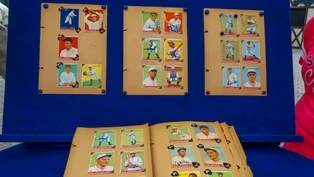
Appraisal: 1933 Goudey Baseball Card Set 239/240
Video has Closed Captions
Clip: S30 Ep13 | 4m 29s | Appraisal: 1933 Goudey Baseball Card Set 239/240 (4m 29s)
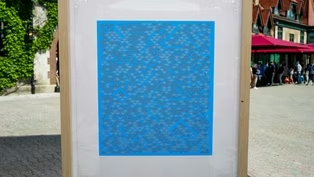
Appraisal: 1968 Anni Albers "A" Screenprint
Video has Closed Captions
Clip: S30 Ep13 | 2m 18s | Appraisal: 1968 Anni Albers "A" Screenprint (2m 18s)
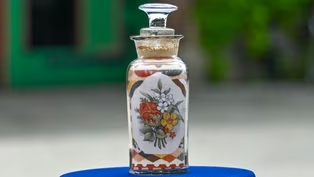
Appraisal: Andrew Clemens Sand Art Bottle, ca. 1885
Video has Closed Captions
Clip: S30 Ep13 | 3m 11s | Appraisal: Andrew Clemens Sand Art Bottle, ca. 1885 (3m 11s)
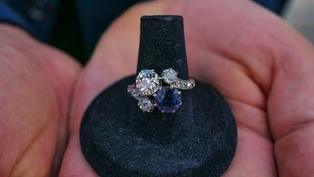
Appraisal: Edwardian Sapphire & Diamond Ring, ca. 1905
Video has Closed Captions
Clip: S30 Ep13 | 1m 39s | Appraisal: Edwardian Sapphire & Diamond Ring, ca. 1905 (1m 39s)
Appraisal: Hair Pictorial Memorial, ca. 1895
Video has Closed Captions
Clip: S30 Ep13 | 2m 37s | Appraisal: Hair Pictorial Memorial, ca. 1895 (2m 37s)
Appraisal: Joan Miró Pencil on Paper, ca. 1965
Video has Closed Captions
Clip: S30 Ep13 | 3m 16s | Appraisal: Joan Miró Pencil on Paper, ca. 1965 (3m 16s)
Appraisal: Lenci Felted Wool Clutch & Beret, ca. 1927
Video has Closed Captions
Clip: S30 Ep13 | 2m 55s | Appraisal: Lenci Felted Wool Clutch & Beret, ca. 1927 (2m 55s)
Appraisal: Lucille Ball Backgammon Game & Signed Photo, ca. 1970
Video has Closed Captions
Clip: S30 Ep13 | 2m 39s | Appraisal: Lucille Ball Backgammon Game & Signed Photo, ca. 1970 (2m 39s)
Appraisal: Navajo Woman's Wearing Blanket, ca. 1865
Video has Closed Captions
Clip: S30 Ep13 | 3m 3s | Appraisal: Navajo Woman's Wearing Blanket, ca. 1865 (3m 3s)
Appraisal: Three Stooges-signed Photo, ca. 1950
Video has Closed Captions
Clip: S30 Ep13 | 2m 57s | Appraisal: Three Stooges-signed Photo, ca. 1950 (2m 57s)
Appraisal: WWII OSS Stiletto with "Pancake Flipper" Sheath
Video has Closed Captions
Clip: S30 Ep13 | 2m 40s | Appraisal: WWII OSS Stiletto with "Pancake Flipper" Sheath (2m 40s)
Appraisal: Yonezawa Atom-Car Racer with Box, ca. 1955
Video has Closed Captions
Clip: S30 Ep13 | 3m 12s | Appraisal: Yonezawa Atom-Car Racer with Box, ca. 1955 (3m 12s)
Video has Closed Captions
Preview: S30 Ep13 | 30s | Preview: Grant's Farm, Hour 1 (30s)
Providing Support for PBS.org
Learn Moreabout PBS online sponsorship New Episode
- Home and How To

Hit the road in a classic car for a tour through Great Britain with two antiques experts.
 New Episode
 New Episode









Support for PBS provided by:
Funding for ANTIQUES ROADSHOW is provided by American Cruise Lines and Ancestry. Additional funding is provided by public television viewers.