
TvFilm
Jennie Thwing on "The World Said No"
Clip: Season 18 Episode 6 | 2m 20sVideo has Closed Captions
Animator Jennie Thwing discusses the creative process behind her film "The World Said No."
Animator Jennie Thwing discusses the creative process behind her film "The World Said No."
Problems playing video? | Closed Captioning Feedback
Problems playing video? | Closed Captioning Feedback
TvFilm is a local public television program presented by WMHT
TVFilm is made possible by the New York State Council on the Arts with the support of the Office of the Governor and the New York State Legislature.
TvFilm
Jennie Thwing on "The World Said No"
Clip: Season 18 Episode 6 | 2m 20sVideo has Closed Captions
Animator Jennie Thwing discusses the creative process behind her film "The World Said No."
Problems playing video? | Closed Captioning Feedback
Where to Watch TvFilm
TvFilm is available to stream on pbs.org and the PBS app.
Providing Support for PBS.org
Learn Moreabout PBS online sponsorship- My name is Jennie Thwing and my film is called "The World Said No."
My goal in this film was to just experiment with kind of creating nature.
I didn't initially start with a premise or a story.
I started with animations of nature and then it kind of morphed into people existing in nature and then nature fighting back.
My work is really sound-driven, so a lot of times I'll start with the sound of creating the atmosphere of that moment, if that makes sense.
And then as I start to get a feel for like, oh, this is a quiet moment, now the wind is blowing and it, you know, and because the wind is blowing, I'm animating trees moving and there has to be the sound of water, and so there's a creek moving through the scene.
So I think a lot of the story is kind of audio driven.
(gentle music) I went to school for painting, my undergrad degree was in painting, and so visually, at least in the cel animation, it's definitely more painterly than traditional animation, right?
Like I'm not doing cel animation like comic style animation, so a lot of the scenes are almost painted.
I think my background plays a lot into my work.
Growing up in a natural place, like in the Rocky Mountains, I think really influenced the choices that I make in my artwork.
It's almost like I'm fantasizing about my childhood in the work.
Secondly, I would say being a parent I think has changed my subject matter, that everything prior to being a parent, a lot of it was like me and my existence in the world, versus once you're a parent like the subject became more about kind of society and we need to make sure that we take care of society.
But I don't know if I have an intended feeling that people should feel.
I think you could take, it's like whatever you choose to take out of it story-wise is fine, but I would hope that they would at least connect to the visuals and the audio and the sense of what it's like to be in nature.
(music fades out)
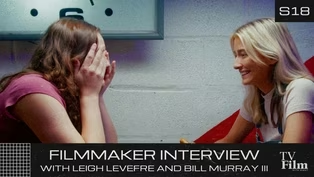
Bill Murray III and Leigh LeFevre on "Never Again"
Video has Closed Captions
Clip: S18 Ep6 | 3m 25s | Filmmakers Bill Murray III and Leigh LeFevre discuss their creative process. (3m 25s)
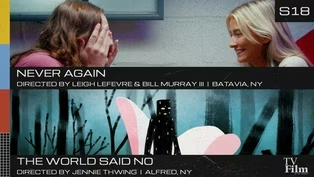
"Never Again" "The World Said No" | Preview
Video has Closed Captions
Preview: S18 Ep6 | 30s | Join our host Jermaine Wells to watch "Never Again" & "The World Said No" this Friday on TVFilm! (30s)
Providing Support for PBS.org
Learn Moreabout PBS online sponsorship






Support for PBS provided by:
TvFilm is a local public television program presented by WMHT
TVFilm is made possible by the New York State Council on the Arts with the support of the Office of the Governor and the New York State Legislature.