
May 15, 2026
5/15/2026 | 55m 20sVideo has Closed Captions
Xiang Lanxin; Rahul Bhatia; Edith Eger; Marianne Engle
Xiang Lanxin discusses the Trump-Xi summit in China. Rahul Bhatia unpacks Indian PM Narendra Modi's party's grip on Indian politics. And we revisit a conversation with Dr. Edith Eger, a Holocaust survivor who died at the age of 98.
Problems playing video? | Closed Captioning Feedback
Problems playing video? | Closed Captioning Feedback
May 15, 2026
5/15/2026 | 55m 20sVideo has Closed Captions
Xiang Lanxin discusses the Trump-Xi summit in China. Rahul Bhatia unpacks Indian PM Narendra Modi's party's grip on Indian politics. And we revisit a conversation with Dr. Edith Eger, a Holocaust survivor who died at the age of 98.
Problems playing video? | Closed Captioning Feedback
Where to Watch Amanpour and Company
Amanpour and Company is available to stream on pbs.org and the PBS app.
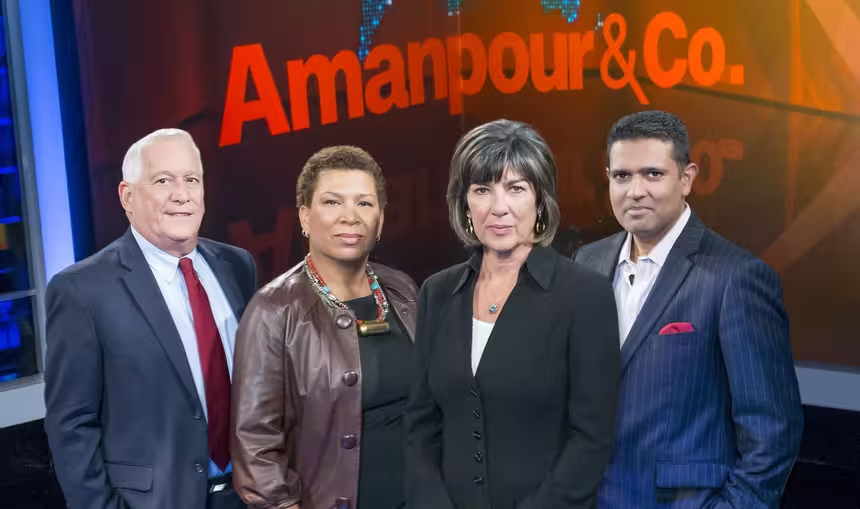
Watch Amanpour and Company on PBS
PBS and WNET, in collaboration with CNN, launched Amanpour and Company in September 2018. The series features wide-ranging, in-depth conversations with global thought leaders and cultural influencers on issues impacting the world each day, from politics, business, technology and arts, to science and sports.Providing Support for PBS.org
Learn Moreabout PBS online sponsorshipHello, everyone, and welcome to Amanpour & Co.
Here's what's coming up.
This U.S.
presidency, for me, is maybe the only historic opportunity for China to deal with a United States which considered China as a normal great power competition.
Trump's history-making trip to China.
We get the view from Beijing with foreign policy expert, Professor Xiang Lanxin.
Then... There's a sense that India or the idea of India has kind of slipped away from us.
Modi extends his political grip after a landmark win.
Is the world's largest democracy drifting toward one-party rule?
I ask acclaimed author and journalist, Marul Bhatia.
Also ahead.
Everything can be taken away from a human being except what they put in their mind.
And that really kept me going.
Remembering the remarkable life of Dr.
Edith Eger, the Holocaust survivor, psychologist and author who inspired millions with her message of hope.
A look back at her conversation with Walter Isaacson alongside her daughter, Dr.
Marianne Engle.
♪♪ Amanpour & Co.
is made possible by... cultural differences in our communities.
And by contributions to your PBS station from viewers like you.
Thank you.
- A warm welcome to the program, everyone.
I'm Paula Newton in New York, sitting in for Krishnananpour.
Two superpower leaders, two days of talks, and an agenda with global consequences.
Nearly a decade on from his last trip, this time President Trump faced a more assertive China against the backdrop of a very different world order.
Having returned to office promising to "Make China Pay," Trump now appears more focused on managing competition than escalating it, seeking diplomatic wins as he contends with waning approval ratings back at home.
This bond of commerce and respect that stretches back 250 years is the foundation for a future that benefits both of our nations.
The American and Chinese people share much in common.
We value hard work.
We value courage and achievement.
We love our families and we love our countries.
We love our children.
Together we have the chance to draw on these values to create a future of greater prosperity, cooperation and happiness and peace for our children.
We love our children, this region and the world.
It's a special world with the two of us united and together.
All of this unfolding under the shadow of the war in Iran, now in its third month, which has thrown China's global influence into sharper focus.
Over the last 13 years, President Xi has transformed China, tightening control at home while embracing a bolder strategy abroad.
So how does Beijing view all of this?
Just before Trump wrapped his visit, I spoke with Professor Xiang Lanxin.
He's Professor Emeritus of International History and Politics at the Graduate Institute in Geneva, and he joined us from Shanghai.
Professor Xiang Lanxin, thank you so much.
We want to welcome you to the program.
Thank you for being here.
Inviting me.
A lot to parse through this summit and what are truly historic events.
In the long arc, though, of Chinese engagement with the West, I am wondering, how do you see this moment?
It's very, very important in my view.
It's for a very good reason.
I think this is maybe the first time Chinese have to deal with a president who has apparently three faces we have to deal with.
That is, President Trump is a revolutionary in terms of internal and external relations.
And then you have a president who is a bully.
I'm referring his style of conducting foreign relations.
Most likely, I think, a dealmaker, a real dealmaker.
So China is handling three Donald Trump at the same time, which is quite amazing.
It's totally unique and a very important moment.
Yes.
You've made quite an analogy there and a lot to parse in the world of politics.
But I don't have to remind you at the moment in time in history that this summit is occurring.
It is a deeply fractured international system.
And so much of the world right now is war-weary.
China has really tried to present itself as the stable superpower.
Do you believe it's having success and enduring success in that foreign policy objective?
China has certainly had quite a successful achievement in many areas, but I don't think China alone can make that stability permanent or lasting without the cooperation from the United States.
And this US presidency, for me, is maybe the only historic opportunity for China to deal with a United States which considered China as a normal great power competition, rather than an ideological rival, as many previous presidents, particularly President Biden would call democracy versus autocracy.
That is ideological base is a throw out of window.
Therefore, it's much more important, critical for the two major powers in the world to engage in a serious way.
This is what I think is the benefit of Trump's revolution.
I am wondering, as you're talking about this as a singular opportunity with this president in his second term, I mean, he is not going to be president in a few years.
When you look at this epoch in time, do you actually believe China can achieve much, no matter who the next president of the United States is?
Well, my sense is the MAGA movement will continue.
MAGA is a serious political movement.
I wouldn't discount what Trump says.
He started what's a common sense revolution.
And he did.
He did, especially the way he sees international affairs.
That is totally different from the previous president.
I haven't seen that in my lifetime at least.
So I think there is a chance, there is a great chance, yes, he will be the stabilizer of international affairs or international system.
It is truly transactional what we're seeing now on the global stage between these two powers and in those transactions, Iran and what is going on at this hour in Iran looms large.
I'm wondering if you think that the position of the United States, specifically President Trump, that his position is weakened coming to China at this point in time.
And does he need China to weigh in here?
Or, to put another view on the table, does China need this conflict resolved as well?
And for that reason, they must come to some kind of a resolution.
Well, yes, I'm sure he needs China.
He hopes China can help.
But on the other hand, I think his decision to go to war with Iran apparently is a misjudgment.
So I believe the whole world knows that, and the Chinese know that as well.
But the important thing is China's priority deal with a president who does not base his China policy on ideological thinking.
Therefore, China wouldn't do too much to provoke him or criticize his behavior with this war.
But what's more, he needs to find a ladder to climb down.
China would love to help him, but so far I don't believe he has a chance to do so.
He seems to be stuck there.
Europeans are willing to help him, but China could not really help him in a practical way.
Diplomatically, we can, but not really.
I don't see any measures to help him with the Strait of Hormuz until the war officially ended.
So far, we don't see it.
But if I'm hearing you correctly, you're saying that China will see this out for the next few weeks, the next months even, no matter what's at stake for China in the Strait of Hormuz.
There's really, you believe, nothing China will do to step in here to solve this?
My point is that China would love to do something to help, but I doubt China can.
Because you see the situation now is Iranians now is escalation dominant side.
Iran is really in the position to make a decision how to end the war, to be ended.
I don't believe Iran is even willing to listen to China.
If China make a straightforward proposal saying open straight to Hormuz or finish the war, it's not really going to work that way because Iranians are in a different position now.
Interesting what you say, that China does not have the leverage, because I know a lot of people assume that it does.
I do want to move on to Taiwan and obviously... Go ahead.
No, what I'm trying to say, China had limited leverage, not sufficient enough to really help end the war.
Let's say, compared with the Ukraine situation, China probably have a little bit more leverage on Putin.
Fascinating that you say that.
And I do wonder if during the summit that conflict will come up as well.
It's not been spoken of so far.
Taiwan is clearly watching this summit nervously.
There are reports that Beijing sees the moment, particularly as you and I have been discussing the fact that the U.S.
may be looking for an off-ramp.
Do you see this as an opportunity for China to demand some concessions from President Trump on Taiwan?
And I say this because certainly in opening, even at the state banquet, President Xi really had quite strident remarks about what the risks are in Taiwan.
Yes, I think on that issue, Chinese actually quite consistent in that.
Because United States side offered several statement before that US side want stability in the strait.
China know this, China understand that.
Taiwan issue is the only issue that could bring US-China into a real war.
Here we're talking about not just conventional, but even potentially once US-China actually in the war, nobody dare to say that nuclear weapon can be ruled out no matter what.
So in that sense, China proposed, I noticed language Chinese use this time, they accept American argument about importance of stability in the strait.
But they add one thing this time, which is new for me.
It's called the constructive, the strategic stability.
It's called the constructive stability building.
So that is a suggestion to say we may need to find some new idea for both sides to reassure each other.
Sometimes I believe during Obama administration at one point they call it a strategic reassurance.
That kind of language of each other, both sides will be at ease, not leading to a confrontation.
So this is why Chinese keep on emphasizing, also in the context of the U.S.
had a large quantity of weapons on the table to be sold to Taiwan.
So this is why Xi Jinping is emphasizing that.
In this light, do you believe the status quo is acceptable to China right now on Taiwan?
Well, if the United States sticks to what is traditionally called strategic ambiguity, which is pretty much abandoned by the Biden administration, if you recall.
Biden basically turned this into strategic calamity, abandoning Nixon-Kissinger period of American strategy.
So if the US stick to strategic ambiguity at the same time, which also means double deterrence, right, against China as well as against Taiwan independence.
That's what strategic ambiguity functions.
You know, when you go to strategic clarity means war, basically.
So this is the point they have to negotiate.
They need, or the Chinese would hope, Trump administration to come up with some new language to assure Chinese that strategic ambiguity is still there.
Interesting that that will in fact present a change in strategy as far as some American policy analysts might say.
I do want to move on to what the Chinese opinion is of the United States at the moment.
We had an American writer in Shanghai, Jacob Dreyer, wrote in The New York Times that China has stopped looking up to America, that ordinary Chinese now see the United States as a cautionary tale rather than a model.
What do you think?
That's exaggeration.
I do believe the majority of Chinese still look up to the United States.
They know the United States, the history and the advantages.
I'm talking about the system.
The United States is perhaps one of the best that provides the best competitive economic system, competitive economic system, economic opportunity.
I live in the States for many years as a student.
I know most Chinese still quite admire American system, culture.
Yes, many of them looking at what Trump is doing, they now increasingly become disappointed.
Venezuela, for example, those kind of behavior, grabbing a president out of his bed, those kind of behavior certainly, no matter what you say, it's against the UN Charter, and not to mention Iran war.
So these kind of behavior apparently upset many Chinese as well, but on the whole I do not believe the idea of the US in decline, China in the rise, China would take over, that is a small minority of people who really believe that, not a majority.
Professor, thank you so much.
We'll have to leave it there.
But some fascinating insights and we thank you.
Thank you very much.
Thank you.
Now, from the Americas to Europe to Asia, nationalist movements are on the rise.
Few places illustrate that shift more clearly than the world's largest democracy, India.
Last week, Prime Minister Narendra Modi's party secured a landmark election victory in West Bengal for the first time ever.
A state long seen as one of the last major bastions of opposition politics.
It's a result that further strengthens the BJP's grip on power, an extraordinary comeback just two years after losing its parliamentary majority.
For supporters, it's a sign of Modi's enduring popularity.
For critics, it's another step toward a more centralized Hindu nationalist vision of India.
Ruhl Bhatia is an award-winning journalist and author of "The New India," an acclaimed account of the country's political transformation.
And he joined us from Mumbai.
Ruhl Bhatia, welcome to the program.
Thank you.
You know, India's Prime Minister Narendra Modi is urging Indians to stop buying gold, to work from home, to limit foreign travel.
I mean, I think it's fair to say that even some in his own country are puzzled by some of these requests.
These, of course, are all signs of how hard the Iran war is hitting India's economy.
But the Prime Minister also seems to be emboldened.
He's asking his populace for these personal sacrifices.
I'm wondering, in your opinion, is this a sign of strength or of weakness?
I don't think it's either, actually.
I think it's something that the Prime Minister does now and then, whenever there is stress to be found in the system.
This happened during a period we call demonetisation back in 2016.
And I think there was plenty of sacrifice involved then, then during COVID again, and now you see it again during the Iran war.
I think what, at least with the commentary that I've read, there are a few questions about why now, when the Iranian war, or rather the Iran war began a couple of months ago.
I do want to go to what has also been historic in the last few weeks, and that is the fact that last week, India's governing BJP won legislative elections in the state of West Bengal.
This was truly historic.
It was a landslide victory and comes after a steady stream of those election wins for the BJP.
The BJP, Narendra Modi's party, we'll say, has now power in 20 of 28 states.
Can you kind of parse this out for us?
How did this happen and what do you believe to be its significance now?
Well, the first thing I did after the election results came out about 10 days ago was essentially have conversations with people in politics, friends in media, and people who understood Bengal.
And the thing that I got back from them was, you know, there was mixed feedback.
At one level, there were, people did say that the previous government over there really did not give people what they wanted.
That, you know, there was, I guess, a sense that things could have been a lot better.
And so the BJP sort of came in by a landslide.
In terms of West Bengal, though, the BJP defeated Mamata Benzuri, who had served as West Bengal's chief minister 15 years.
She is a fierce critic and a key opposition voice in the country.
Is this indicative now of the fact that Narendra Modi essentially has a clear pathway here, that he has managed to defeat one of his key opponents and critics?
I think so.
The sense that I got when I had these conversations was that people don't really know what to do.
I was speaking to an advisor of one of the big political parties over here in Mumbai, and he said that there's a sense that you've just been bulldozed, and you really, really have no idea how to deal with this juggernaut, which is the BJP.
And it's not just the BJP, it's a whole bunch of forces and agencies that sort of come and work together to make life very difficult for anybody else who is contesting elections.
Yeah, and it's in fact can be a dangerous development in a democracy.
Again, oppositions in these kinds of democracies serve a huge role in terms of looking out for not just minority interest, but obviously as some kind of counter to government policy.
Manjari herself, though, was citing voter interference in this election.
She's refusing to resign, accusing the BJP of, in her words, "forcefully capturing" those elections.
I go back to what you said about bulldozing.
It's not the same thing.
Is there any evidence in your view that she was cheated out of her rightful win?
election?
Well, look, when you look at the people who were taken off these voter rolls, I think I read, you know, I was reading some figures and I think in some constituencies, up to about 90% of them were Muslim.
And so you see this disproportionate representation of people who would not necessarily vote for the BJP being struck off the rolls.
And that I think feeds into this larger fear of something called delimitation in India, which is, I guess what Americans know as gerrymandering, which is essentially redrawing lines so that, I guess, your majorities are clearer, and you tend to win more constituencies.
So yes, there is certainly a feeling among people that I've spoken with, and of course, you know, politically, that it's not, and I have to choose my words very, very carefully here, it's not, you're not contesting on an even keel.
Interesting that you have to choose your words carefully.
And I know you want to be precise in what you're saying, but of course it's fraught on the ground in India.
I do want to talk about your book, The New India.
You wrote it a few years ago and it explores, of course, India's shift toward Hindu nationalism and rising authoritarianism.
Obviously something that comes to the fore almost daily in Indian politics now.
How much do you believe that this religious nationalism played a part in the election?
And I go specifically to your experiences about whether or not Muslim voters were disadvantaged or in somehow excluded, because I have also read and correct me if I'm wrong, that some Muslim voters in fact did vote for the BJP.
Yes, this is something that comes up every now and then.
I think when I was working on my book, and I was speaking to, I focused a lot on, I guess, the Muslim lived experience in India.
One of the things that I heard over and over again was that way back in 2014, just before Prime Minister Modi sort of won, became Prime Minister, there were Muslim families that voted for him.
They were struck by his promises and the idea that India would sort of march forward, there would be development, the kind of development they hadn't seen in many years.
And so, yes, people did vote for him.
There was also this feeling that, look, things can, you know, there are systems, there are checks and balances, and things will never be as bad as people fear.
And so, you know, you count on these, these notional checks and balances and say that they will protect you, and you ignore a lot of other things.
And so I feel like when I was talking to people about the way their families voted and what they think right now, the sense that I got was there is at some point regret at what they did.
Now, this has happened in Bengal too, but at the same time, look, there is polarization.
You just, you know, every single day brings new instances of somebody threatening somebody along religious lines.
Just this afternoon, I think yesterday, I was seeing a video of some party member saying that he would not do a single thing for Muslim voters because they did not vote for him.
So you see things like this and you should have heard the cheers.
The cheers were incredible.
When I say incredible, I mean unbelievable.
And so you see a lot of this happening.
And it really is a familiar sight right now.
Every election, something like this does happen.
- It's a familiar sight.
And I think as you noted in your book, that you would hear, because it's not obviously just polarization.
No, it is bigotry.
And you discussed in your book the fact that you were shocked at some things that even from friends you would hear that you could never picture them saying a decade ago.
Do you see that unfortunately as a persistence in Indian society that it will actually separate along those very nationalistic and religious lines.
I can't speak to that, but I can speak to, I can speak to polarization and bigotry and about how it lies under the surface pretty much everywhere in places that you just wouldn't expect.
It should, it should not surprise me even now, but every time I encounter it from people I don't expect it to come from, it, it comes as a surprise.
It comes from friends, it comes from family.
And there's something hidden, something deep, that the BJP and the RSS, which is the parent body of the BJP, which is 100 years old.
There's something in these in these messages that resonates with people.
And I must admit, I don't know what exactly it is.
There is a certain amount of grievance.
There is a certain amount of that feeling that you haven't got your due, that your country belongs to you, and that your faith is under threat.
And there is this constant othering that you see, you know, it, it, it almost feels, it almost feels like, at times, Muslims and other minorities are immigrants in this country.
You know, that's what it, that's what it feels like.
And, and so much of, so much of the rhetoric you, you hear around debates around immigration, they kind of, they echo with some of the things you hear in, in India, when people talk about Muslims and other minorities.
Now, what will this lead to?
I'm not sure.
I have heard from a few people that there's only so much that people can take.
I've heard from Muslims, I've heard from Hindus.
I've, I've, it's, I want to say that at some level, people are still, they have that faith in the constitution.
A person that I, that I followed around for 18 months, whose house was burnt down, he keeps talking to me.
He was talking to me throughout the time we were together, and as recently as last week, two years after the book came out, we were chatting.
And he said to me that it's the constitution that he derives his strength from.
And so you know that there are, while there is talk of people having had it, and what that implies is, you know, taking extreme steps, extreme measures.
There are tons of people out there who still want to give this a fair chance.
And I think it's, you know, there's just peace on their mind.
How much does Narendra Modi himself though, in the figure in Indian politics, he is likely to run again in a few years.
How much does he really have become such a bold leader that has come to exemplify Indian politics itself?
How much is he a factor here in all of this?
I think people take their lead from the person on top.
And I think there's a sense that India has kind of slipped away from us, or the original idea of India has slipped away from us a little bit.
But here's the thing, you know, I think leaders can be influential, they can be persuasive.
But ironically, as I was looking at the right-wing, you know, ground movement, and looking at how effective they were, and the things that they did to come to power and stay there effectively all these years, it actually gives me great encouragement.
Because I think somewhere the things that people want, what they want this country to be, secular, peaceful, a place where everybody prospers, that is, it exists, it is a widespread feeling.
And so I know that, you know, from time to time, I do this as well.
I tend to sort of focus my energies on the Prime Minister.
But behind him is this enormous groundswell that thinks of India one way, that wants it to be a certain way.
in opposition is another groundswell of people, just this quiet majority, and they are a majority, who really do want a different kind of country.
And that is extremely encouraging.
Yeah, and I hear you in terms that you believe it will ultimately be redemptive.
And I'm sure most people in India feel that way as well as this democracy continues to mature.
Whenever I look at politics, I think it's a good idea to actually look at the culture as well.
I was fascinated by this new Indian film, Durandar 2.
It is a sequel to Durandar.
Recently, it became the highest grossing and most popular, one of the most popular films anyway, in Bollywood in India of all time.
It is almost four hours long and it has generated a lot of controversy.
And that's because of its nationalist rhetoric and its depiction of Pakistan specifically.
And Rahul, forgive me for the unorthodox question, but Prime Minister Modi himself has been forced to weigh in here.
He defended the film against critics who've labeled it as propaganda.
What does this film tell us and its success about where India might be politically right now?
Despite myself, I watched the film.
And it took me a few months, but I got there.
And it was enjoyable.
And I think that's what makes it so insidious.
It has a bunch of messages which are nationalistic.
But there is at its heart this formula, which is, it starts off with trauma, and then there is inevitable redemption.
There's a lot of bloody revenge along the way, a lot of violence along the way.
And I think it's that old formula that's been kind of scaled up to the national level.
What does it tell you?
I think there's no doubting that it is propaganda.
It so clearly fits in with a series of other films that have been made that misrepresent what actually happened, that dramatize what happened.
But they plead to this idea of a country that will have its way in the end, that is competent, that works in the shadows and has these capabilities of stealth and can embed itself deeply within enemy networks and strike at a moment's notice.
So I think this idea fits in with this extremely sort of martial understanding that a lot of people, especially on the right, who've come through these networks and schooling systems and little camps, not little, but huge number of camps that exist across India, where they eventually become sort of foot soldiers and they enter various arms of the government and other such places.
What it does is it fits in with this idea of India being a martial nation, that it has military might, that it is capable of responding.
And what happens then is, even if people don't watch this four-hour movie, there are clips of it that do the rounds.
You will find foot soldiers sharing clips, talking about it.
They will use bits of it to sort of dramatize the, and I say this in inverted commas, the cruelty of minorities in India, the otherness of their ways.
So all of it sort of adds up and feeds into the same beast that we're all dealing with right now.
Yeah, indeed, a very provocative film.
For some people it's just been entertainment, but as you said, it has come to mean other things in India and beyond.
Rahul Bhatia, we will leave it there.
I want to thank you for being on the program.
Thank you so much.
Now earlier this week, we marked the death of Dr.
Edith Eger, who survived the horrors of the Holocaust and spent the decades following helping others heal as a renowned clinical psychologist and best-selling author.
Now, back in 2024, Edith and her daughter, Marianne Engle, joined Walter Isaacson to look back on her remarkable life.
And here is their conversation.
Dr.
Edith Eger and Dr.
Marianne Engle, welcome to the show.
Thank you so much.
We're delighted to be here.
A lot of people now, especially younger people, think of the Holocaust as way back, way back in history.
They don't remember anything about it.
But, Dr.
Edith, as you call yourself, you were there.
Yes.
I want you to tell us about the story so we never forget.
Tell us about Auschwitz, and tell us about, maybe start with the cattle car going to Auschwitz.
The cattle car was very crowded, and my mother was sitting in a bench.
My father was sitting on the floor with the girlies.
I begged my father to shave so he would look younger, but he didn't listen to me.
When we arrived, I was met with a sign, "Our white monks fry.
Work makes you free."
And my father was very encouraging, that we're just gonna work a little while and then we go home.
And of course, that did not happen.
But my mom told me, and I like to quote her today, that everything can be taken away from a human being except what they put in their mind.
And that really kept me going, that this is temporary, and I'm going to make it no matter what.
And so, I did a lot of praying, and I think that was useful for me to look at life from inside out.
In the very first day you were at the death camp of Auschwitz, your parents are killed.
And there's something very poignant that happens, which is they come to you and you're with your sister, and they point to your mother and say, "Is that your mother or your sister?"
Tell me what happened then.
You were in line, and you and your sister were together with your mother in between you.
Yes.
And you saw this man in the white suit.
Yes.
The man in the white suit was Dr.
Engle, and he pointed with that, they call it a finger game today, that you go either to the left or you go to the right.
And unfortunately, I said, "It's my mother."
And so, I'm going to the left and my sister and I to the right.
And I followed my mom.
And he grabbed me.
I never forget those eyes and said, "You're going to see your mother very soon.
She's just going to take a shower."
And they were doing that because they were killing the older people.
And by having referred to the woman as your mother, they realized she was older.
Did that make you feel guilt over the years or survival remorse?
Tremendous guilt.
What I could do, what I should do.
But of course, you cannot change the past.
It did happen.
And I remember my sister yelling at me when I asked God when will I see my mother.
And the God said, "She's burning there, pointing at the chimney."
And so that's how I entered Auschwitz, and it was the middle of May 1944.
In your beautiful book, The Choice, you talk about dancing for Dr.
Joseph Mengele.
Tell me about what happens when he comes in and when you see him.
Tell me the story about dancing for Dr.
Joseph Mengele.
He welcomed us very warmly and wanted to know who is talented because he would like to be entertained.
And so the friends that I knew, because I dance for the community when I live, and so just threw me in front of him.
And very friendly, he said, "Dance for me, dance for me."
And I began to really say to myself, "You better be good."
And I did a split right away that minute.
I did a very good one.
And I came through my feet, you know, from the front and from the back as well.
I was-I wish I could have a picture for you.
Maybe somewhere they were filming.
You danced to Tchaikovsky and then he gave you bits of bread.
Tell me about that.
I was frightened to death.
I was so anxious to please so I would not be sent to the gas chamber.
It was a very challenging and difficult, unprepared event.
What did you do in the camp, you and your sister, to keep yourself alive, to keep going?
We had to undress the people who were lying dead or not.
And we were asked to cut the teeth of everyone.
It was very scary because we didn't know what's gonna happen in the next minute.
We did not know whether we're gonna end up in a gas chamber ourselves, but staying alive was the goal.
What to do?
We had a lot of humor, kind of sarcasm that we used, cynicism, all that, just to be sure that this is temporary and we're going to make it.
Hope.
Hope was never, ever given up.
And I tell you, today I have three children, five grandchildren, and seven great-grandsons.
And that's my revenge to Hitler.
In May of 1945, the Allies come in to liberate the people of the camp.
I think it was an African-American soldier who helped save you, and you were underneath a pile of corpses.
Well, I felt someone's hand, and I looked up, and I saw tears in his eyes.
And yes, I looked up.
It was a man of color.
I wish I could see him now.
He must be in his late 90s for sure.
Marianne, you discovered on your own about your mother's history in the death camps.
Tell me how you discovered it, what you felt, and then what you said to her.
So, when I was about 12, at that point I was reading, you know, grown-up books, I started to look behind some of the books in one of the bookcases, and I found this big book.
And I took it out, curious, and it had the most disgusting, horrible pictures I'd ever seen.
And they were so frightening.
And I didn't know anything about my mother having been to Auschwitz, but I knew that my mother had a sad, a deep sadness in her.
And there was something in her eyes that was always just a little sad.
She was the warmest.
Every, all my friends loved her.
She was a warm, wonderful mother, but I could just see that.
And when I saw these pictures, I mean, it was horrific.
I went straight to my father and said, "Daddy, what is this book?
And was mom there?"
And he sat me down and he said, "This was Auschwitz.
And yes, your mother was there."
And I, of course, was amazed.
In a way, kind of not as surprised as you might think, but also shocked.
And then my mother found out that my father had told me, and she was furious.
Wait, wait, wait.
Why were you furious, Dr.
Edy?
Because I kept it a secret, because I wanted to assimilate, and I didn't want anybody to label me a certain way, or feel sorry for me that I was an Auschwitz.
I don't know.
I've been lying and pretending an image of me that really wasn't my true self.
For many years after you came to the United States, you didn't talk to your children about it.
You kept it a secret.
And you became a psychologist and you were helping Vietnam veterans deal with post-traumatic stress.
Tell me how you then decided to deal with your own PTSD.
Because I was honest with myself, that I created a personal history that was not the true self.
And I began to just use my past, actually, to let people know so they can remember and revisit the places where they've been and relive that experience and then revise your life.
And so you had to go back to Auschwitz.
You went, as an adult, back to Auschwitz.
Is that why?
- Yes, to me, it was important to go to a place and touch that place where I was sure that this is temporary and I'm gonna die here.
And I walked out of Auschwitz.
So today I do recommend definitely to everyone to revisit where you've been, relive that experience, but don't set up house for that.
Marianne, you became a psychologist, got your doctorate, and then your mother also did that afterward.
Tell me how you processed and watched her change after the visit to Auschwitz.
She went back to the area where she had been living there, and she saw a man in a uniform, and she started to panic.
The old fear came back, and she started to get very panicky.
And then she suddenly remembered that she had a purse, and in the purse was an American passport, and that she could leave Auschwitz, but this man worked there and he couldn't.
And my father, who was with her when she walked out, said that she hopped, skipped, jumped, did cartwheels, and what happened afterwards is that her face changed.
Her eyes didn't have that fear in them anymore, and it was profound, really.
And then her ability to help people.
You know, she got her PhD in her 50s, so anybody who's watching this, whatever dream you have, look at my mother, what she's accomplished.
You can, and she did, and she has.
And so, you know, I'm so proud of her.
And she's had a phenomenal change because she let herself accept it.
- Dr.
Edy, why did you want to write a book so badly?
- I was very heavily relying on the story being told, how good people do such terrible, very, very bad things.
I think that was my duty to my parents so they didn't want to die in vain.
Why do you call them good people?
Because I don't think we're born with sin.
I think we're born and we learn.
We learn to hate.
They also learn mentality.
It's your attitude is the key word.
It's the way you look at everything as an opportunity.
And Auschwitz was a classroom and an opportunity for an opportunity for me to develop the skills that I can now use to guide other people.
I like the idea of guide.
I like that much more than being a therapist.
It's not an illness.
It's a feeling that helps you to recognize that no matter what, you're not the victim.
It's not your identity.
Marianne, how has your mother's story impacted your family, your kids, and why is it important to them after so many years?
My goodness, I'm making you teary just asking that question.
For me, I think that my mother being so honest about herself and her own history and talking to the children about it and the fact that she was able to write these books and to tell them and all the great-grandchildren can ask her whatever they want, as well as our children too, of course, I think has made the hugest difference in their lives and their understanding of the way the world can be such a horrible place to people, but also such a loving place because she is so loving.
So she has had this openness with them always.
I think it's critical to how they see the world.
And for all of the people who are watching this, I know that many of you have parents, or maybe you are parents, who won't tell your children your story.
Please do it.
- Thank you.
- Thank you.
- And that's it for our program tonight.
If you want to find out what's coming up on the show each night, (upbeat music) - Sign up for our newsletter at pbs.org/amanpour.
I wanna thank you for watching Amanpour & Co.
Join us again tomorrow night.
[MUSIC]
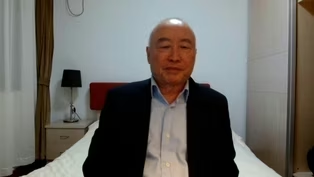
China Scholar on Taiwan, Trump-Xi and the Chinese View of U.S. Power
Video has Closed Captions
Xiang Lanxin discusses how Taiwan may impact the Trump-Xi summit in China. (5m 43s)
Providing Support for PBS.org
Learn Moreabout PBS online sponsorship New Episode
- News and Public Affairs

Top journalists deliver compelling original analysis of the hour's headlines.
 New Episode
- News and Public Affairs

Today's top journalists discuss Washington's current political events and public affairs.
 New Episode
 New Episode


 New Episode
 New Episode
 New Episode
 New Episode
Support for PBS provided by: