
Market to Market - June 26, 2026
Season 51 Episode 5145 | 26m 45sVideo has Closed Captions
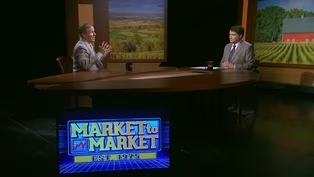
Commodity market analysis with Shawn Hackett.
On this edition of Market to Market ... The Senate goes to work on Farm Bill 2.0. State and Federal laws collide as the Supreme Court rules in favor of Monsanto. A growing effort to protect farmland from development. And, commodity market analysis with Shawn Hackett.
Problems playing video? | Closed Captioning Feedback
Problems playing video? | Closed Captioning Feedback
Market to Market is a local public television program presented by Iowa PBS
Market to Market - June 26, 2026
Season 51 Episode 5145 | 26m 45sVideo has Closed Captions
On this edition of Market to Market ... The Senate goes to work on Farm Bill 2.0. State and Federal laws collide as the Supreme Court rules in favor of Monsanto. A growing effort to protect farmland from development. And, commodity market analysis with Shawn Hackett.
Problems playing video? | Closed Captioning Feedback
Where to Watch Market to Market
Market to Market is available to stream on pbs.org and the PBS app.
Providing Support for PBS.org
Learn Moreabout PBS online sponsorship[PAUL YEAGER] Coming up on Market to Market -- the Senate goes to work on the Farm Bill 2.0.
State and federal laws collide as the Supreme Court rules in favor of Monsanto.
A growing effect to protect farmland from development.
And commodity market analysis with Shawn Hackett, next.
[ANNOUNCER] I wouldn't be here without my customers.
Yeah, I'd like to thank the customers.
They're very dear to our hearts.
It's about the people that you're working with and the relationships that you have.
Thank you.
Thank you.
Thank you.
Thank you from the bottom of my heart.
♪♪ [ANNOUNCER] Tomorrow.
For over 100 years, we've worked to help our customers be ready for tomorrow.
Trust in tomorrow.
Information is available from a Grinnell Mutual agent today.
[ANNOUNCER] Support for Market to Market has been provided by a bequest from Philip Lietz of Alta, Iowa, in recognition of public television's commitment to agricultural programming.
[ANNOUNCER] Market to Market is made possible in part by a grant from the Corporation for Public Broadcasting.
[ANNOUNCER] This is the Friday, June 26th edition of Market to Market, the Weekly Journal of Rural America.
[YEAGER] Hello, I'm Paul Yeager.
A tough week for the housing sector.
First, Congress passed an affordable housing bill, but President Trump canceled the signing ceremony, originally scheduled by the White House, in favor of applying pressure to lawmakers on the Save act.
Then new home sales fell.
The May measure was off by 7.3%.
The market had shown resilience during the period of higher interest rates.
Unlike existing home sales, which have remained constrained.
The mix of actual goods and services purchased, the PCE moved higher again in May, this time by 4/10 of a percent year over year.
Inflation added 4.1% and core PCE put on 3.4%.
Now, orders for durable goods.
Those are items designed to last at least three years.
Fell 4.5% in May.
The president hosted farmers and ranchers at the White House Thursday evening.
He told the group Iran will now purchase U.S.
Grown commodities of wheat, corn and soybeans, even though the U.S.
Is not a consistent supplier of those goods to Iran.
President Trump is also asking Congress for more than $11 billion in additional aid for Roe and specialty crop farmers for crops planted in 2026.
Now, this would bring the total of direct payments for the year to just over $55 billion.
That's in data, according to USDA.
More relief could be on the way as part of the farm bill that is now several years overdue.
Here's our story from Laurel Bower.
[SEN.
JOHN BOOZMAN] Today, I'm proud to release the Agriculture Act of 2026.
[NARRATOR] The Senate Agriculture Committee introduced its draft of the farm Bill this week.
This comes after the House took the first major step in late April by a vote of 224 to 200.
It prioritized more money for farmers, changes to Snap requirements and fewer regulations on agriculture.
Now, Senate lawmakers are working to craft their own version.
[SEN.
JOHN BOOZMAN] My goal is to advance a bill that can earn broad bipartisan support.
[NARRATOR] The Senate Farm Bill 2.0 draft includes enhancing financial safety nets for farmers, upgrading rural infrastructure and updating loan limits to reflect current inflation.
It aims to strengthen crop insurance and boost rural broadband, while omitting provisions on year-round E15 sales.
The hog industry's prop 12 and pesticide labeling.
[JONATHAN COPPESS] We're now three years delayed from when the reauthorization should have happened, and they made, I think, some really bad policy concerning policy decisions last summer.
And since that time, we have had these massive market disruptions, the trade wars with China and the tariff conflicts, and now the war in Iran, the Strait of Hormuz problems, there's a whole lot going on that this bill is not like we're just picking things up that they could have done years ago.
And it's not really it's really, I guess my frustration a little bit is we're missing the moment.
We're missing the challenges, the moment that farmers are facing, and they're not addressing them.
[NARRATOR] Many commodity groups applaud the tax, attempting to deliver more certainty and help strengthen the farm safety net.
However, some House lawmakers have concerns about the Senate's farm bill draft.
[REP.
ANGIE CRAIG] If the improvements made to the farm safety net were so strong, then why are farmers asking for supplemental farm assistance.?
[NARRATOR] While significant policy differences remain between the House and Senate versions, farm organizations nationwide are expressing their hopes that after multiple extensions and years of debate, Congress will deliver a long-term farm bill that provides certainty for rural America.
[JONATHAN COPPESS] You know, I think it's just one of these times when we I think should and want to expect more and better from our from our representatives in Congress to really tackle these problems head on and not just push this down the road and kind of press release their way out of it.
[NARRATOR] The current extension of the 2018 farm Bill expires this September.
For Market to Market, I'm Laurel Bower.
[YEAGER] The end of June brings a flurry of rulings from the building at one First Street Northeast in Washington, D.C.
On Thursday, the Supreme Court ruled against a case from Missouri pitting federal and state laws against each other.
The case centered on the use of FIFRA, or the Federal Insecticide, Fungicide and Rodenticide Act over cancer label warning laws.
David Miller reports.
[NARRATOR] The landmark seven two decision by the High Court struck down thousands of cases, asking for billions of dollars in damage by deciding in favor of herbicide maker Monsanto and its roundup herbicide.
Had the court ruled against Monsanto, the remedy would have been paid by the current owner of the brand.
Agricultural chemical giant Bayer.
The verdict focused on the labeling of products overseen by the Environmental Protection Agency.
Those seeking monetary remedy made the case that roundup labels failed to warn about what they called the cancer-causing effects of glyphosate, the active ingredient in roundup.
However, those lawsuits were brought in state level courts where, according to the decision, rulings against federal regulations are not valid.
Officials with EPA have never added warnings to the products label because they have been unable to find a link between glyphosate and cancer.
Glyphosate has been removed from consumer grade products and remains commercially available for applications like weed control on row crop operations.
For Market to Market, I'm David Miller.
[YEAGER] The current average for an acre of farmland in Iowa tops $11,000.
Now, as the saying goes, they're not making it anymore.
But as millions of acres give way to data centers, retail developments, and new housing, the case for keeping ground in production gets harder to make.
Financially preserving what's still in agriculture can be done.
Colleen Bradford Krantz shows us how.
In our cover story.
[NARRATOR] Kira Santiago's Central Illinois Flower Farm exists thanks to a legal maneuver by landowner Dave Bishop to protect his East Peoria farm, which Santiago now rents from development pressure.
Bishop, who also owns a farm near Atlanta, Illinois, couldn't bear to sell the 100 acres first purchased in 1868 by his great grandfather and farmed by each subsequent generation.
[DAVE BISHOP] It is ideal development property because you've got some trees already, as well as some flat land.
So, there is a lot of development interest.
If you look at it from the air, you will see a subdivision that is poised to attack, as well as East Peoria city limits just across the field.
[NARRATOR] Despite encroaching housing developments, he put off numerous interested buyers over the last 20 years.
[DAVE BISHOP] It's quite often likely to be double the price of farmland typical farmland.
If the land doesn't mean anything to you, and it's just an opportunity for profit, I can see how people would do that, since I have a five-generation vested interest in this land, it means something to me.
[NARRATOR] Five years ago, Bishop learned about agricultural conservation easements, a way to permanently protect land for agricultural use only.
It meant sacrificing development potential for preservation.
[DAVE BISHOP] You don't do that in a knee jerk reaction type of way.
If you know, because you're giving up a significant income potential.
But if you do decide to proceed with it, you need to find someone who acts on your behalf.
In setting all this up.
[NARRATOR] Bishop's loss was covered by USDA and the Conservation Fund, and Illinois based Prairie Lands Conservancy holds the easement.
Similar groups across the nation help achieve the same goal.
The nonprofit American Farmland Trust, founded in 1980, is a national leader when it comes to efforts to permanently protect farmland, especially in high development areas.
The organization connects landowners to state and local land trusts and helps guide lawmakers.
[KRIS REYNOLDS] We're losing about 2000 acres a day to development pressure, and so our approach as an organization is to is to promote farmland protection programs that are voluntary, that offer farmers and landowners opportunity to protect that land with an ag conservation easement, which in turn allows that land to stay in agriculture for perpetuity.
[NARRATOR] At the current pace of 2000 acres lost to development daily from 2001 to 2016, another 18 million acres will likely disappear by 2040, nearly the size of South Carolina.
Reynolds, who is a fifth-generation farmer, worries about feeding the nation if poorly planned development continues on prime agricultural soils.
[KRIS REYNOLDS] Those are lands that we refer to as prime, versatile and resilient because essentially, there's a lot of options of what can be grown on those lands now and into the future.
[NARRATOR] The process of gaining an agricultural land easement involves third party land trusts, legal costs and often waiting lists.
Farmland is appraised at its current value versus its value, with restrictions against development.
The difference becomes the easement cost, sometimes donated by landowners, sometimes 50% covered by a land trust, and possibly the other 50% by a federal, state or municipal program.
[KRIS REYNOLDS] It doesn't mean that, you know, you're giving anybody else access to that land, but it does mean that that land is going to stay in agriculture.
[NARRATOR] As the value of the land is reduced by giving up development potential.
The property tax burden could ease once established, protected land can still be sold, but new owners must maintain agricultural use.
Currently, 30 states have agricultural easement programs, but most Midwestern states, including Illinois, Iowa and Indiana, lack state government purchase programs.
Reynolds encourages allowing for future flexibility when it comes to farming types and farming practices.
[KRIS REYNOLDS] For the most part, you know the easement language, you know, it needs to be fairly, fairly open because we don't know what agriculture might look like in 100 years.
So, it doesn't need to be so restrictive that we're, that we're saying that, you know, it has to be corn and soybeans produced on this farm.
[NARRATOR] Very little land, less than 1% nationwide is currently protected by agricultural conservation easements.
Florida, which is expecting another 10 million new residents by 2070, is using several types of legal maneuvers, including this kind of easement, to try to save farmland and other green spaces.
[TOM HOCTOR] It seems like the rate is at least on the order of 60,000 acres of rural land lost a year.
Based on our newest estimate, and Florida, the pace of development is probably faster than anywhere else in the U.S.
We have really good data.
Do we have the political will to get it done?
There's a lot of agricultural land that we could protect if we're proactive, we have the opportunity to do that.
Them staying in agriculture is completely compatible with our long-term conservation goal.
[NARRATOR] As for Dave Bishop in Illinois, his children supported the idea of locking the land into agricultural uses.
After several years of preparation, the assessment revealed the difference between development and agricultural values was several hundred thousand dollars.
[DAVE BISHOP] We used some of the easement money to repaint and work on the house, do some repairs on it.
The entire roof had to be replaced on the barn and some other work done on it.
The amount of money that we got from the easement was enough to keep this in shape for, you know, another 30 years hopefully.
[NARRATOR] The conservation group checks the farm annually to ensure compliance.
Bishop's youngest son hopes to eventually farm the East Peoria land, which is currently rented by Santiago, the flower farmer, to serve metro area residents in the future, it's a possibility the easement helped protect.
[DAVE BISHOP] It's not for everybody.
There is no question about that.
The point for me was, I know now that this land will always be a farm.
[NARRATOR] For Market to Market.
I'm Colleen Bradford Krantz.
[ANNOUNCER] Next, the Market to Market report.
[YEAGER] USDA's Acreage and Stocks reports are due next week.
Traders lined up positions while factoring in extended heat that's scheduled to return to the.
The Corn Belt for the trading week that's ending June 26th.
The nearby wheat contract sold off $0.24 in the September corn contract lost $0.04.
China's absence was made up for by a potential strike in Argentina, impacting the export market and the soy complex.
The August soybean contract gained $0.08, while August meal put on two.
90.
December cotton lost $3.63 per hundredweight.
July class three milk futures shed $0.54.
The livestock market was mixed.
August cattle decreased $0.80.
August feeders put on three.
25.
And the August lean hog contract lost $0.15.
In the currency markets, the U.S.
Dollar Index added 51 ticks.
August crude oil sold off five.
52 per barrel.
Comex gold was down by one.
59 $0.60 per ounce, and the Goldman Sachs Commodity Index cut more than 30 points to settle at six 1710.
Here now to lend us his insight on these and other trends as regular market analyst.
Shawn Hackett.
Hello, sir.
[SHAWN HACKETT] Hey, Paul.
Always better to be here during the summertime than the winter time.
[YEAGER] See us next week and see if you would say that.
Same impact.
The heat is a story.
It's been dry.
It's been hot in the wheat belt.
But come Friday, we had yet another round of sell offs.
What is driving it?
[HACKETT] I mean, when I look at an El Nino weather pattern, a lot of the dry areas that people were worried about, they've gotten rains.
The temperatures haven't been too hot.
The key to the U.S.
Crop, it's got to be hot daytime temperatures and dry.
We've had some dryness easing back, and we are still anticipating a very good July.
Super El ninos have never not delivered a good July weather, even though some heat might come into the equation next week.
[YEAGER] I know we're going to.
That's easily on the bingo card many, many times for this discussion.
We'll get to El Nino and a couple other things, but I've got something global that I want you to answer.
Dan in Nebraska hit us up with a whole bunch of great questions.
This is the one we picked, so it's small, but I'll read for you.
You often emphasize that global liquidity factors and currency fluctuations drive individual commodity markets more than standard technical tools.
With ongoing geopolitical shifts and volatility in the US dollar.
Which specific global currency trend do you think will have the most disruptive impact on U.S.
Agriculture exports over the next six months?
Why did you want to talk about this with wheat?
[HACKETT] Well, because wheat is grown and traded almost everywhere in the world.
So, when you have the dollar moving up or down significantly, it alters the price differentials and the arbitrage between U.S.
Prices and those prices.
And so, there's just the most overall impact where soybeans, it's Brazil and us in corn, it's Brazil in US and maybe China a little bit.
But, you know, I mean, it's a more of a, a bipolar type of a market wheat.
It's a world market.
And so, the dollar always, always a bigger impact.
And so, a strong dollar is not good for U.S.
Wheat prices historically.
[YEAGER] Let us can keep that export market thinking here for the old crop of corn.
Mexico had been buying a lot.
There's this discussion that begins supposed to begin on Wednesday.
The review of the USMCA.
What's that going to do with this old crop story?
Is it even an impact?
[HACKETT] You know, I have to assume we're going to solve and make an agreement that's going to work for everybody.
I can't imagine Trump ahead of a midterm elections is not going to deliver something for agriculture.
So, I'm not too concerned that we're not going to develop an appropriate extension of that agreement.
And corn exports have been good.
I expect they will continue to be good, especially with prices as undervalued and cheap as they are today.
[YEAGER] Let's talk about this El Nino then with the new crop story, because we've got people in certain pockets who watch this program saying it is yellow.
It is not healthy.
We've got others who are about to be in an amazing heat wave.
What's the biggest driver in this new crop story?
[HACKETT] If you're going to get the weather market going, if you're going to get everyone excited about a weather problem in July, you need to have hot, dry weather, not just for a week, like into the middle late July time frame.
We have not had that since 2012.
That's how long it's been Super El Ninos.
We've had six since 1950.
Not a single one has ever produced an enduring ridge.
In July.
Everyone has delivered timely rains and reduced high daytime temperatures overall, and I don't see anything that I see from our work that suggests we're not going to have a very good weather in July, and it's the future that counts.
The problems of the past have already been traded.
[YEAGER] The problems of the future.
Okay, but let's talk about the current.
Then in July, you talk about this ridge.
Tell me the thinking.
If I am someone holding the crop, growing the crop, battling the forecasts of this super El Nino, is there anything I can do to prepare?
[HACKETT] Well, I mean, the only thing that I can say is if you're someone that's sitting there saying, I got too much old crop corn left from last year or I haven't, I have corn that I know I need to sell at harvest time.
I'm not exactly where I need to be.
You need to look for any kind of short covering rally on this temporary ridge that's coming.
And if you get a bump, if you get some short covering in these markets, you want to take advantage of that because historically it typically means in a year, a retest of the lows in August.
And that's the time that we could look for a more enduring low.
[YEAGER] And real quickly, we even have this one of the biggest market reports we have coming this week on acreage with corn.
Why is corn going to drive this discussion as well?
[HACKETT] Well, I mean, there's a big debate out there.
Usually when you plant quickly, you add some more corn acres from the planting intentions report.
Of course, this was not a normal year.
We do believe our work suggests, because of the dryness that you talked about in late spring time, those fringe acres got pulled back.
And we still think we can get a reduction of maybe a million acres below planting intentions so that while not a game changer, every little bit helps.
And it would certainly tighten up the balance sheet a little bit for next year.
[YEAGER] In the bean market, the old crop, we're still trying to get rid of it.
We're China's not calling.
There was a few sales.
Can they come in and save this market?
[HACKETT] You know, we certainly hope that they can.
I just I'm not sure what to think about this whole agreement that we supposedly made between the meeting and all and the 17 billion of commodities and the 25 million metric tons are supposed to buy.
I don't know what's going on with the chess match here, other than to say domestic crush is strong.
The crush margins are still good.
That's what's holding the market from really caving in when China is going to strike.
If they're going to strike, I would think it would be August, not now.
[YEAGER] The new crop story.
Does the weather impact this at all yet?
[HACKETT] If we're going to get a weather reaction, it's going to be next week because we're going to -- [YEAGER] It would be this early because normally you think of beans being later, not as around the July 4th.
[HACKETT] Yeah.
I still think you would get a reaction in the in the soybean market, once we get past this temporary ridge and we go back to kind of where we were, I don't see an opportunity in August for beans to catch a weather market.
Super El Ninos, this is the most aggressive super El Nino we've seen since 1950.
Just does not bode well for a weather related, sustainable weather-related rallies any time soon.
[YEAGER] Live cattle came back and showed that they still are serious, but had losses at the end of the week.
What happened?
[HACKETT] I just think the cattle market is stuck in suspended animation.
We're not going to import animals across the border anytime soon.
Now that we have screwworm detected, we're not rebuilding the herd any time soon, which we just know is a is a mathematical equation.
We know grilling demand is there and it has to finish out.
At the same time, beef prices are the same price today on the beef cutout as it was a year ago.
We're importing low quality beef, but haven't imported high quality beef from anybody.
So, we're just stuck.
Paul.
We're stuck.
And I think we're just getting caught by the whims of the winds of the market any given week, back and forth.
But I don't really see that changing.
[YEAGER] And we're not retaining heifers either.
On the feeder side.
[HACKETT] No.
[YEAGER] Is that something that nothing's indicating that that's going to happen anytime soon?
[HACKETT] Right.
I don't see it.
I don't see any indication that's going to happen anytime soon.
And so, it comes down to can we import higher cuts from somebody else.
Brazil is making a play for that.
You know, and what's really ultimately going to happen here is that Mexico is building their own infrastructure to sell beef to us.
At some point, they're going to be able to do that.
And that whole, you know, buying feeders across the border is going to be gone forever.
I really don't know what to say about cattle other than consumers are not going to chase beef prices any higher.
At the same time, the supply isn't there and the packers aren't making money.
[YEAGER] But they're not doing it to the hog market either.
[HACKETT] No, they're not.
The hog market's been very, very disappointing.
I'm very surprised.
I've been sort of more constructive on it.
And it's kind of caved in.
We have a kind of a flat animal type of situation with supply.
We have been getting good exports, especially to Mexico.
But it's just we've not been able to get the domestic demand strong enough to overwhelm the market.
And it's been quite disappointing.
What I will say, however, commitment of traders, capital flows, something we talk about a lot.
We've seen some of the most wild buying in Co two in the last 3 or 4 weeks that we've seen in a very long time.
Usually when we see that kind of sudden purchases in the COT market, in a particular market, it means maybe this market's overdone it to the downside.
We'd be looking for some technical action to reverse higher here.
[YEAGER] So a whole lot going on.
And guess what.
We're just getting started.
Shawn, thank you for your time.
Shawn Hackett everyone.
And you've been watching the analysis portion of our program.
In a moment, we'll continue our discussion in an online only segment.
Find it by searching Market Plus with Shawn Hackett wherever you get your podcasts, you can also go to our website of Markettomarket.org to listen.
We are close to another milestone on our YouTube channel because of you subscribing.
Now those thousands who are already there know the channel is full of all the video from the program, the episodes, the Market Plus, the stories, and the MtoM podcast.
Subscribe now@youtube.com slash Market to Market.
Next week, a mid-year review of the economic picture in rural America.
Thank you so much for watching.
Have a great week.
♪♪ [ANNOUNCER] Market to Market is a production of Iowa PBS, which is solely responsible for its content.
[ANNOUNCER] Market to Market is made possible in part by a grant from the Corporation for Public Broadcasting.
[ANNOUNCER] Support for Market to Market has been provided by a bequest from Philip Lietz of Alta, Iowa, in recognition of public television's commitment to agricultural programming.
[ANNOUNCER] I wouldn't be here without my customers.
Yeah, I'd like to thank the customers.
They're very dear to our hearts.
It's about the people that you're working with and the relationships that you have.
Thank you.
Thank you.
Thank you.
Thank you from the bottom of my heart.
♪♪ [ANNOUNCER] Tomorrow.
For over 100 years, we've worked to help our customers be ready for tomorrow.
Trust in tomorrow.
Information is available from a Grinnell Mutual agent today.
 New
NewMarket Plus with Shawn Hackett
Video has Closed Captions
Clip: S51 Ep5145 | 13m 55s | Market Plus with Shawn Hackett (13m 55s)
Providing Support for PBS.org
Learn Moreabout PBS online sponsorship New Episode
- News and Public Affairs

Top journalists deliver compelling original analysis of the hour's headlines.
 New Episode
- News and Public Affairs

Today's top journalists discuss Washington's current political events and public affairs.
 New Episode
 New Episode
 New Episode
 New Episode
 New Episode
 New Episode


 New Episode
 New Episode
 New Episode
Support for PBS provided by:
Market to Market is a local public television program presented by Iowa PBS