
January 27, 2026 - PBS News Hour full episode
1/27/2026 | 57m 46sVideo has Closed Captions
January 27, 2026 - PBS News Hour full episode
Tuesday on the News Hour, the Trump administration changes its leadership for immigration operations in Minnesota after public backlash from two deadly shootings. Taiwan fears that the American operation to oust Venezuela's leader might embolden China to invade. Plus, we hear from the whistleblower who said DOGE mishandled Social Security data, a claim the Justice Department now admits is true.
Problems playing video? | Closed Captioning Feedback
Problems playing video? | Closed Captioning Feedback
Major corporate funding for the PBS News Hour is provided by BDO, BNSF, Consumer Cellular, American Cruise Lines, and Raymond James. Funding for the PBS NewsHour Weekend is provided by...
Support provided by:

January 27, 2026 - PBS News Hour full episode
1/27/2026 | 57m 46sVideo has Closed Captions
Tuesday on the News Hour, the Trump administration changes its leadership for immigration operations in Minnesota after public backlash from two deadly shootings. Taiwan fears that the American operation to oust Venezuela's leader might embolden China to invade. Plus, we hear from the whistleblower who said DOGE mishandled Social Security data, a claim the Justice Department now admits is true.
Problems playing video? | Closed Captioning Feedback
How to Watch PBS News Hour
PBS News Hour is available to stream on pbs.org and the free PBS App, available on iPhone, Apple TV, Android TV, Android smartphones, Amazon Fire TV, Amazon Fire Tablet, Roku, Samsung Smart TV, and Vizio.
Providing Support for PBS.org
Learn Moreabout PBS online sponsorshipGEOFF BENNETT: Good evening.
I'm Geoff Bennett.
AMNA NAWAZ: And I'm Amna Nawaz.
On the "News Hour" tonight: The# Trump administration changes .. leadership for immigration operations in Minnesota## in response to public backlash from the# two fatal shootings of U.S.
citizens.
GEOFF BENNETT: Taiwan expresses# fears the U.S.
operation to## oust Venezuela's leader might# embolden China to invade.
AMNA NAWAZ: And we hear from the# whistle-blower who said DOGE mishandled## Americans' Social Security data, a claim# the Justice Department now admits is true.
CHUCK BORGES, Former Chief Data Officer,# Social Security Administration: That database## houses personal information, as I unde.. on all living and dead Americans.# So this is a real risk to everybody.
(BREAK) AMNA NAWAZ: Welcome to the "News Hour."
President Trump said today# he's going to de-escalate## tensions amid his aggressive immigration# crackdown that's centered on Minneapolis.
GEOFF BENNETT: And toward that end,## the president said he wanted what he called# an hon.. of Alex Pretti and had his border czar, Tom# Homan, meet with state and local officials.
But at the same time, Mr.
Trump said during a trip# to Iowa today that the adjustments should not be## seen as a pullback.
And he again blamed Pretti# for carrying a gun, which was legally permitted.
As special correspondent Fred de Sam Lazaro# reports, skepticism of President Trump's changes## remains high in the Twin Cities, even after the# departure of Border Patrol Commander Greg Bovino.
FRED DE SAM LAZARO: Gregory Bovino's# final night in Minnesota was a loud## one.
Protesters turned up the volume outside what## they believed was Bovino's hotel.
Police# arrested some demonstrators at the scene.
Bovino leaves a community far more on edge# than it was when he arrived.
Under his command,## federal agents fatally shot another U.S.# citizen on Saturday, Alex Pretti.
It came## two weeks after Renee Good was killed by ICE# officers.
This week, Bovino claimed without## evidence that Pretti had been planning to# -- quote -- "massacre law enforcement."
DONALD TRUMP, President of the United States:# We're doing a big investigation.
I want to see the## investigation.
I'm going to be watching over it.# I want a very honorable and honest investigation.
FRED DE SAM LAZARO: In Washington today, PBS# News' Liz Landers asked President Trump about## his administration's characterization of Pretti,# who had a state permit to carry a firearm.
LIZ LANDERS: Do you think he was# acting as an assassin in Minneapolis?
DONALD TRUMP: Who's that?
LIZ LANDERS: Mr.
Pretti.
Your#.. DONALD TRUMP: No.
No.
Without being checked,## you can't have guns.
You can't# walk in with gun.. LIZ LANDERS: What about the Second Amendment?
DONALD TRUMP: Listen, you can't walk# in with guns.
You can't do that,## but it's just a very unfortunate incident.
FRED DE SAM LAZARO: Meantime, House Minority# Leader Hakeem Jeffries called on the president## to fire Homeland Security Secretary Kristi# Noem.
He appeared on MS NOW this afternoon.
REP.
HAKEEM JEFFRIES (D-NY):# Kristi Noem is a despicable,## corrupt, pathological liar.
And in the# event that she is not terminated, we are## prepared to initiate impeachment proceedings# against her in the House of Representatives.
FRED DE SAM LAZARO: Back in Minneapolis, Bovino's# replacement, White House border czar Tom Homan,## arrived for meetings with Mayor# Jacob Frey and Governor Tim Walz.
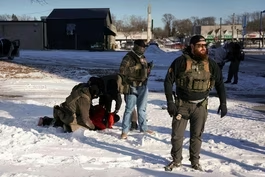
Outside, the streets were# quieter than in recent days,## Minnesotans paying tribute to their neighbors.
CHRISTINA LEESON, Minneapolis,# Minnesota, Resident: You're## compelled to do some.. try to figure out how in the hell can# this keep happening to this community?
FRED DE SAM LAZARO: And out-of-towners# showing their support for the community## and skepticism of today's leadership change.
DAN CRAWFORD, Charlotte, North Carolina, Resident:# One is out.
There's another one coming in.
I## don't know if things are going to change or# not.
I doubt it, the way this year has gone.
FRED DE SAM LAZARO: For the "PBS News Hour,"# I'm Fred de Sam Lazaro in the Twin Cities.
AMNA NAWAZ: For more on the Trump administration's# evolving response to the deadly shootings## in Minneapolis, we're joined now by our# White House correspondent, Liz Landers.
So, Liz, we saw in Fred's report there President## Trump told you he did not think Pretti# was an assassin.
Why is that significant?
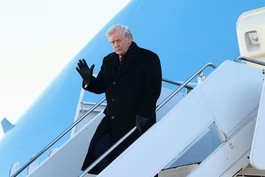
LIZ LANDERS: It's notable because the# administration is changing their tone on## what happened in Minneapolis.
On Saturday,# within hours of this shooting happening,## White House Deputy Chief of Staff Stephen Miller# took to social media to call Pretti an assassin.
And that was reposted by the vice president# of the United States.
So, within a few hours,## you had two top White House officials taking# this stance that he was an assassin.
Today,## we're seeing the president distancing# himself from that, saying that Pretti## and Renee Good's shootings were both# terrible.
He said: "I hate to see that."
And I also just want to note something else# about our exchange about handguns there and## the gun that Pretti was apparently carrying on# his person when that happened.
He was legally## permitted to have that gun.
And Minnesota has# open-carry policies there if you have a permit.
AMNA NAWAZ: We also know that# the homeland security secretary,## Kristi Noem, her top aide, Corey Lewandowski,## had a two-hour meeting last night at the# White House.
What do we know about that?
LIZ LANDERS: The New York Times reported that## they requested the meeting with the# president in the Oval Office with a## number of top White House officials to# talk about what happened in Minnesota.
And, apparently, the president is still backing# Noem.
He said today that he has confidence in her,## that she's not going to step down.# He said she's doing a very good job.
And I also want to add, Amna, that, within the# last few minutes, the Department of Homeland## Security has sent a note to Congress with more# information about what actually happened in## the Pretti shooting, saying that two federal# officers fired shots on Saturday.
That's new.
AMNA NAWAZ: We should also note that, during# all this criticism of ICE, the president is## in Iowa today.
He's giving a speech about the# economy.
Tell us what we should know about that.
LIZ LANDERS: The president and the White# House has wanted to refocus the message## on affordability.
We heard the White# House press secretary talking about that.
The president touting while he's been on the# ground in Iowa that gas prices are down there,## that his tax bill that passed over the# summer will be cutting taxes on tips,## Social Security, some of those other# signature issues that he's been discussing.
But this is also a political visit that he's# making.
Iowa has several key midterm races.## We're in a midterm election year now.
There# is an important Senate race there, governor's## race.
And there are even congressional# races, Like Congresswoman Miller-Meeks,## who won her seat by a mere 800 or# so votes in last year's election.
So there was some good old-fashioned campaigning# that he was doing on the ground there at a diner## earlier today, talking with Iowans, touting# some of his policies, also talking politics.
AMNA NAWAZ: All right, our# White House correspondent,## Liz Landers, beginning our coverage tonight.
Liz, thank you.
GEOFF BENNETT: Minnesota is the latest flash# poin.. Border Patrol, and other agencies.
But it's# far from the only place being targeted.
Aggressive tactics have played# out in Chicago, Los Angeles,## New York, Washington, D.C., and now# Maine.
The protests, the clashes,## and the violence have raised urgent# questions about where this all leads.
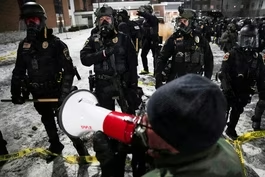
In a recent piece for The Guardian, Claire# Finkelstein warns that what's unfolding in## Minneapolis closely mirrors a U.S.
civil# war simulation she oversaw in 2024.
Claire Finkelstein is the director# of the Center for Ethics and the## Rule of Law at the University of# Pennsylvania, and she joins us now.
Thank you for being with us.
CLAIRE FINKELSTEIN, University of# Pennsylvania: Thanks for having me.
GEOFF BENNETT: And we should say# these simulations you .. weren't designed to predict a second civil# war, but were instead meant to stress-test## the system.
What motivated those exercises?# And what were you most worried about then?
CLAIRE FINKELSTEIN: There were# really two things that motivated us.
And let's remember this was conducted in September# of 2024.
So it was before the presidential## election.
But we were worried.
We were worried# about what had happened on January 6, 2021.
We were also worried in the# wake of the immunity decision,## and what was that going to mean for potentially# a more unfettered Trump second term and whether## or not the rule of law would prevail and about the# tensions, potential tensions between the federal## government and state and local governments,# and what that could mean for the rule of law.
GEOFF BENNETT: When you look at# what's unfolding now in Minneapolis,## what feels uncomfortably# familiar from those simulations?
CLAIRE FINKELSTEIN: Well, one# of the things that happened was,## we saw a spinning out of control.
And# I hope that's not what's happening in## Minneapolis, but a lot of what's been# happening is going in that direction.
We saw a spinning out of control of the# federal government.
We saw a refusal to## abide by court orders.
We saw the difficulty# that courts have in acting in time and## difficulty enforcing their orders.
So# we have seen all of that.
And then the## attempt to attack state officials# is something that we also looked at.
GEOFF BENNETT: Why are clashes# between state authority and## federal forces so much more destabilizing# than traditional or conventional unrest?
CLAIRE FINKELSTEIN: Because traditional unrest is## really about the people.
It's# not about government, per se.
And, hopefully -- and this is what we have had# for most of our history -- you have the federal## government and the state governments working# together to try to get control over that unrest,## to de-escalate the situation, and# to work ideally in harmony together,## or at least to have a functional working# relationship and to partner together.
A lot of those partnerships are of long standing,# person-to-person relationships.
That was one of## the things we found in our tabletop exercise,# which is that those personal relationships## can be very effective in de-escalating# situations, sort of backdoor conversations.
But when you have the federal government# and the state government unable to work## together and giving different narratives, it's# profoundly confusing to people.
And, of course,## it will have a tendency to escalate violence, as# well as to really do damage to the rule of law.
GEOFF BENNETT: And you have said# that ICE is acting in ways that## even exceed what was imagined in your# simulations.
What stands out to you?
CLAIRE FINKELSTEIN: We did not have federal# agents or federal troops openly defying## the law, firing on protesters, and,# frankly, killing them in cold blood.
We had imagined federal agents a little more# like what happened in Portland in 2020 or## even Philadelphia that summer, where agents# were going back and forth with protesters,## some of whom were violating the law, and# where federal agents were using harsh tactics,## but not to the point where they were# openly attacking American citizens and## actually quite clearly exceeding# rules for the use of force.
GEOFF BENNETT: And further applying# your insights to this moment,## the Department of Homeland Security,# its officers have fired shots during## enforcement arrests or at people protesting# their operations 16 times since July.
No officer has faced criminal charges# and the administration has not announced## disciplinary proceedings against any# of the officers or the agents involved.## So how should we understand this# moment, two American citizens shot## and killed by masked federal agents,# with no immediate accountability?
CLAIRE FINKELSTEIN: So you said the# right word, which is accountability.
That is key.
Even if there is a deal struck -- and# I'm heartened by the fact that President Trump and## Governor Walz had a productive phone conversation,# but a deal is not enough.
There needs to be## accountability for the illegal actions of federal# agents, at least a full and fair investigation.
And state investigators need to be# in on that.
Beyond that, of course,## state investigators have the right to# conduct -- and prosecutors have the## right to conduct their own prosecution in# this situation.
Now, the federal government## will claim immunity or will claim that the# agents have at least qualified immunity.
But there's a lot to argue there legally.# And I think there's every reason to think## that those agents were going beyond# what they needed to do in order to## carry out their official duties, which# would vitiate the claims of immunity.
GEOFF BENNETT: In your simulation, at# what point does a democracy stop being## governed by law and start being governed by power?
CLAIRE FINKELSTEIN: If courts can't or# won't resolve the conflict between the## federal government and the state, then we# have a serious threat to our democracy.
We rely on courts.
And everybody should# want these disputes to be resolved in a## court of law and should commit themselves,# whether they like the decisions or not,## to abide by court decisions.# When that doesn't happen,## as to some extent happened in our scenario,# then you have got a real threat to democracy.
GEOFF BENNETT: Claire Finkelstein, director# of the Center for Ethics and the Rule of## Law at the University of Pennsylvania,# thank you for your time this evening.
CLAIRE FINKELSTEIN: Thanks for having me.
AMNA NAWAZ: In the day's other headlines:## At least 42 people are now reported to# have died as a result of last .. winter storm.
That includes three young# brothers in Texas who fell into an icy pond.
And forecasters are warning the temperatures# will remain well below normal for the Eastern## U.S.
in the coming days.
Crews in Nashville# are working around the clock to clear fallen## trees.
More than half-a-million customers# were without power today, mostly across the## South.
Many Americans are facing dangerously# cold temperatures even inside their homes.
NATHAN HOFFNER, Nashville Resident: I'm layered# up in my bed, two pairs of pants, socks, hoodie,## a cardigan.
So it's probably at least 40 -- at# least 30 to 40 degrees in my house right now, yes.
AMNA NAWAZ: As millions across# the country are still scraping## away and digging out from the ice and# snow, weather officials are warning of## another winter storm that could hit the# Southern and Eastern states this weekend.
TikTok has reached a settlement in a# landmark case related to allegations## of social media addiction.
The terms# of the deal were not disclosed.
But it## means TikTok will not be part of a trial# getting under way today in California,## where plaintiffs will argue that social media# companies intentionally tried to hook young users.
They're seeking monetary damages and want# companies to change the way they design## their platforms.
That trial will continue# against Facebook owner Meta and YouTube.## Snapchat was part of that case, but# reached its own settlement last week.
Federal investigators say that last year's# crash between an American Airlines jet and a## U.S.
Army helicopter over Washington, D.C.,# was -- quote -- "100 percent preventable."
MICHAEL GRAHAM, National Transportation# Safety Board: Any individual shortcomings## were set up for failure by# the systems around them.
AMNA NAWAZ: At a day long hearing today,## NTSB officials said air traffic controllers# were routinely overwhelmed and had grown## accustomed to close calls.
They also said# the jet's pilot was not alerted about the## helicopter and that the airspace over the# nation's capital was crowded that night.
NTSB Chairwoman Jennifer Homendy expressed## frustration that years of warnings to# reroute helicopter traffic were ignored.
JENNIFER HOMENDY, Chair, National# Transportation Safety Board: Yet,## we know, over time, concerns were raised# repeatedly, we.. however you want to put it, stuck in red tape# and bureaucracy of a very large organization.
AMNA NAWAZ: Just last week, the FAA# placed further limitations on planes## and helicopters sharing airspace# near Reagan National Airport.## All 67 people on board both# aircraft died in last year's crash.
Activists now say that more than 6,000 people# were killed in Iran's recent crackdown on## nationwide protests, and they warn that# number could rise.
The latest figures## come from a U.S.-based human rights group,# are nearly double the official death toll.
The protests began late last month amid widespread# anger over a weakening currency and rising prices.## Just today, Iran's real rial fell to an# all-time low against the U.S.
dollar.
And,## this week, a U.S.
aircraft carrier group# arrived in the Middle East to lead any## American military response to Iran's# bloody suppression of the protests.
Back in this country, the nation's# population is growing at a slower rate## because of President Trump's immigration# crackdown.
That's according to estimates## out today from the Census Bureau.# The U.S.
population grew by just 1.8## million people in the year that ended# last July to around 342 million people.
That amounts to just 0.5 percent growth,# which is the slowest pace since the early## days of the COVID pandemic.
The# bureau cites a historic decline## in net international migration as the# driving factor behind the decline.
UPS is planning to cut up to 30,000 jobs# this year and shut two dozen facilities## as part of a broader restructuring effort.# The package delivery company says it will## also continue its pivot away from Amazon# deliveries and focus on more profitable## areas of the business.
UPS shares ended# slightly higher following that news.
Elsewhere on Wall Street today, stocks ended# mixed ahead of tomorrow's rate decision by the## U.S.
Federal Reserve.
The Dow Jones industrial# average lost more than 400 points on the day.## The Nasdaq managed to gain more than 200# points.
The S&P 500 also ended higher.
And a Shakespearian family tragedy has# made BAFTA history.
Chloe Zhao's "Hamnet"## is now the most nominated film by a female# director in the history of the British Academy## film awards.
It's up for 11 nominations,# including best director for Zhao herself.
Meantime, the political thriller "One Battle After# Another" starring Leonardo DiCaprio leads the pack## with 14 nominations.
Ryan Coogler'S vampire# epic "Sinners" is close behind with 13 nods.## All three are nominated for best# film alongside "Marty Supreme"## and "Sentimental Value."
The winners will be# announced as ceremony in London next month.
And the world has been marking international# Holocaust Remembrance Day, a chance to honor## the millions killed by Nazi Germany during World# War II.
The U.N.
established the day more than two## decades ago to coincide with the anniversary# of the liberation of Auschwitz-Birkenau.
Today, survivors paid tributes at the Nazi# death camp 81 years since it was freed by## Soviet troops.
More than one million people# died there, mostly Jews.
While, in Germany,## Berlin's famous Brandenburg Gate was# lit up with the words "We remember,"## as flowers and wreaths were laid# at the city's Holocaust memorial.
Still to come on the "News Hour":## TikTok users claim they're being censored# after the change to U.S.
ownership;## a new book explores how Jackie Robinson and Paul# Robeson were pitted against each other during the## Red Scare; and a free diver gives her Brief# But Spectacular take on protecting the ocean.
GEOFF BENNETT: Just days after a group# of mainly American investors approved by## President Donald Trump took over control# of TikTok's U.S.
operations, some users## now say the app is censoring and limiting# their content, including posts and messages## about Jeffrey Epstein and the shooting deaths of# U.S.
citizens by federal agents in Minneapolis.
One content creator says his U.S.-based followers## couldn't access his post about# the shooting death of Renee Good.
MAN: So, this is how it should appear.# The latest video under my three pinned## videos is the ICE shooting analysis.# But this is what my page looks like,## according to people who message me.
And# even weirder, this is how it appears in## their watch history, a blank square.
The red# X-mark is just them pointing it out to me.
GEOFF BENNETT: And California# State Senator Scott Wiener said## TikTok wouldn't let him share this# post about ICE for several hours.
STATE SEN.
SCOTT WIENER (D-CA): I am advancing# a bill now to say that, in California,## it's not going to be just local and# state law enforcement who can be## sued if they violate your rights,# but federal agents can as well.
GEOFF BENNETT: California Governor Gavin# Newsom announced a new state investigation## to determine whether TikTok is violating state law# by censoring content critical of President Trump.
The company issued a statement today saying it# had suffered a cascading systems failure that## had caused multiple bugs on the platform after# a power outage at one of its U.S.
data centers.
For more, we're joined by tech journalist# Jacob Ward, host of "The Rip Current" podcast.
Welcome back to the "News Hour," Jacob.
JACOB WARD, Founder, The Rip Current:# Hey, Geoff.
Great to be with you.
GEOFF BENNETT: So you have# a lot of politically engaged## users now saying they feel censored# on TikTok, videos getting zero views,## their reach suddenly disappearing.
Based# on your reporting, what is going on here?
JACOB WARD: Well, I mean, I think, on the# one hand, it's important to just remember,## in the context of American# public discourse, right,## that the way we communicate with one another is# controlled by a handful of private companies.
And, as a result, we don't get to# know.
So, Geoff, we don't really know,## is there some sort of censorship going# on here?
Or is this, as TikTok's new## ownership says, a cascading failure that# originated from one of its data centers?
What I can say is that it seems as if every# kind of creator trying to post content,## whether they were cooks or makeup artists or# political content creators, none of them could## post for a while there.
And so it doesn't# seem like it's specifically aimed at it.
But if you're someone whose work is# consistently something that speaks## out against the government at the moment,# then you're going to feel particularly## persecuted.
But it seems that it sort of# went across everybody.
So at the moment,## this doesn't feel like it was an# intentional piece of censorship.
I think this ownership group is too# newly in charge to make that kind of## move.
But that's not to be confused# with the idea that they couldn't do## that.
I think the capability of doing so# is incredibly powerful and worth watching.
GEOFF BENNETT: Well, let's talk more about# that, because people point to Elon Musk's## takeover of Twitter, now X, as an example of# how ownership can reshape a platform's ideology.
So, given how this deal came# together and who approved it,## is TikTok vulnerable to that same kind of shift?
JACOB WARD: Yes, well, Musk, right,# rewrote the rules of what any of## us expect as to how ownership of a major# communications platform would work, right?
And so you're absolutely right to bring# him up because he really sort of, like,## changed the change the game.
And now we're in# a world where close allies of the president## of the United States now are co-owners of this# incredibly powerful and influential platform.
And what they have bought from this Chinese# consortium and sort of in partnership with## this Chinese consortium is a very sophisticated# system for censoring anything you want.
Because## this thing had its origins in China, it# has incredible capabilities to detect## in real time whether you're saying# things it doesn't want you to say.
I have been in the position of making# reference to the Nazis during World War## II.
And the word Nazi can get you kicked# off of a livestream or get the reach of## your post put away.
So it's very easy to do# so.
I don't think it's happening right now,## but if in future they decided to do what Musk# decided to do, they would have every kind of## controls available to them to pull that off,# because that is exactly how TikTok is built.
GEOFF BENNETT: And TikTok recently updated its## terms of service.
So what should# users of this platform understand?
JACOB WARD: Yes, in many ways, they have# just sort of rewritten a more broad set of## language for capabilities that the# platform seems to have had before.
But, for instance, they're saying that they# can much more precisely track your location.## You can turn that off in your device settings# on your phone.
They also say that they will## be able to follow you elsewhere when you# are elsewhere off of the platform.
They## can send advertising out to get you.
So# that's something you can also turn off.
But all of this, I think we should remember,# is pretty standard-issue for the surveillance## capitalist world we are in currently.
All# of these platforms are trying to do the## same kind of stuff.
Just this is a more explicitly# spelled-out thing in the terms of services, Geoff.
GEOFF BENNETT: And, separately, Jacob TikTok# has reached a settlement to avoid being involved## in this landmark social media addiction# trial.
What more should we know about that?
JACOB WARD: That is such an incredibly big deal# in my world, that I have been waiting for this## trial to start because of the incredible amount of# documentation that has come out already in this.
And so TikTok and Snap, the maker of Snapchat,# those two have settled, which leaves Google,## YouTube and Meta, which is Facebook# and Instagram.
And incredible stuff## is already coming out that shows not# only did these companies deeply value## the business -- the business value of kids# was an enormous thing for these companies.
And they were aware of harms to kids for years# and years and years without necessarily acting## on them.
The companies, of course, say that# they are always trying to make improvements.## But the discovery we are seeing here is# going to give us a view into how social## media has worked and worked especially on the# minds of children for many years here, Geoff.
GEOFF BENNETT: Jacob Ward, host of "The# Rip Current" podcast, always a pleasure.
JACOB WARD: Appreciate it, Geoff.
AMNA NAWAZ: China removed its# top army general last weekend## in what many analysts see as a move to# cement loyalty to President Xi Jinping.
GEOFF BENNETT: It is rattling Taiwan# and one of its islands, Kinmen,## that is much closer to China than Taiwan,# amid already heightened fears that the U.S.## capture of Nicolas Maduro could embolden# China to mimic the move against Taipei.
Special correspondent Patrick Fok has more.
PATRICK FOK: In the distance, Xiamen, part# of mainland China.
On a day as clear as this,## you can see just how close it is.
This is# Kinmen, an archipelago administered by Taipei,## even though the main island of Taiwan lies# more than 100 miles away.
Its proximity to## the mainland has put it on the front# line of cross-strait confrontations.
These anti-landing spikes are remnants of its Cold## War defenses decades ago to prevent# an amphibious invasion by China.
TUNG SEN-PAO, Kinmen County Councillor# (through translator): Practically speaking,## its use is now limited.
Warfare has# changed cons.. this beach is a stark reminder of the battlefield.
PATRICK FOK: Tung Sen-Pao is a local# counselor.
He's lived here his whole life and,## like many people from Kinmen, is numb# to communist aggression.
Only weeks ago,## China launched some of its largest ever live-fire# war games, assimilating a blockade of Taiwan.
In recent years, Beijing's ramped up# its military muscle against the island,## which it considers its own, but# has stopped short of invading.## Since the shock capture of Venezuela's# leader, some believe that could change.
TUNG SEN-PAO (through translator): It's quite# possible that one day China might adopt a similar## approach or methodology to wage war, directly# targeting Taiwan's capital or presidential office.
PATRICK FOK: Washington's operation in# Caracas drew swift condemnation from China,## calling it a violation of international law.
SUN LEI, Deputy Permanent Chinese Representative#to ... Nations (through translator): The U.S.
has placed its ... multilateralism and military actions above## diplomatic efforts, posing a grave threat# to peace and security in Latin America,## the Caribbean and even internationally.
PATRICK FOK: But the rate has also drawn# comparisons at home in China on social media,## with many commentators saying it offers# a blueprint for Beijing to take Taiwan.## The prospect of a strike may# not be far from its sights.
2027 is widely cited by military analysts# and government officials as a critical## milestone for China's ambitions regarding# Taiwan.
U.S.
intelligence believes that's## when President Xi Jinping has# instructed Chinese forces to be## capable of what's termed a strategic# decisive victory over the island.
But there's another school of thought on# how the Trump administration's show of## force might make Beijing reassess# its designs on reunification.
Wang Ting-Yu is a Taiwan legislator and# believes America's decisive operation## in Venezuela may act as a deterrent.
He says,## if China had the ability to pull off something# similar, it would have done so a long time ago.
WANG TING-YU, Taiwanese Parliament# Member: China has intention.
They## are willing to do this from a long# time, they try to invade Taiwan,## annex Taiwan.
There is a gap between your# ambition, your intention and your ability.
PATRICK FOK: Still, China's military capabilities# are growing.
Over the past decade, average annual## spending on defenses has risen by about $100# billion.
Taiwan's government, meanwhile,## has proposed to beef up its own forces by nearly# $40 billion per year to counter the China threat.
But it's been blocked by the legislature,## controlled by an opposition that# favors closer ties with Beijing.
WANG TING-YU: We need to do more to enhance our# self-defense capability, to enhance multilateral## cooperation to deter China's ambition.
I think# that will be the true lesson we learn from this.
PATRICK FOK: In Kinmen, life goes on regardless.# By night, this group of islanders gathers to enjoy## the most American of pastimes, among them,# teachers, soldiers and ordinary workers,## with little concern about the powerful# geopolitical forces surrounding them.
CHEN SUI LIEN, Kinmen Resident (through# translator): What happens will happen.## There's nothing you can do.
Whatever# we say can't change the situation.
PATRICK FOK: Whatever their# fate, they hope this place## remains a baseball diamond and not a battlefield.
For the "PBS News Hour," I'm# Patrick Fok in Kinmen, Taiwan.
AMNA NAWAZ:## The Social Security Administration# now says members of Elon Musk's DOGE## team working at the agency last year# accessed and shared sensitive data.
In a court filing earlier this month,# the Trump administration amended what## it had previously disclosed, writing that one# DOGE employee at SSA signed an agreement with## an unnamed political advocacy group to# analyze voter rolls to -- quote -- "find## evidence of voter fraud and to overturn# election results in certain states."
In another instance, a DOGE member shared# personally identifiable information of 1,000## people in an encrypted e-mail attachment,# though the government says they aren't sure## what specifically was shared or whether it# was accessed.
And SSA also said DOGE shared## data on third-party cloud servers that are --# quote -- "outside SSA's security protocols," so## the agency doesn't know what information was# shared or if it still exists on the server.
The latest disclosures seemed to confirm some# key concerns first raised in a whistle-blower## complaint last summer filed by# the agency's chief data officer.
That whistle-blower, Chuck# Borges, involuntarily resigned## from government in August and filed a# retaliation complaint late last year.
I spoke with him earlier# alongside his lawyer, Debra Katz.
Welcome to you both.
Thanks for being here.
DEBRA KATZ, Attorney for Chuck Borges: .. CHUCK BORGES, Former Chief Data Of.. AMNA NAWAZ: So, Chuck, before w.. details, these new details -- filing, rather, confirms what first you# shared when you came forward in## your whistle-blower complaint months ago.
What did you think when you saw all this,# especially after months of government denials?
CHUCK BORGES: I will be honest.# I was pretty disappointed.
This is a situation where the public loses.
My# disclosure essentially outlined three concerns## that I had.
The first was that DOGE employees had# inappropriate access to our data.
The second was## that they violated a temporary restraining# order and that the third was that they had## uploaded sensitive Social Security data to a# cloud server without adequate security controls.
In all three of those instances,# the public state is at risk.
So to## have validation of those first# two concerns is disappointing,## especially in light of the fact that these could# have been investigated and uncovered months ago.
AMNA NAWAZ: Well, speaking to that timeline,# Debra, the court filing was on January 16.
There## were a number of corrections to the previous# testimony from agency officials.
What's your## understanding of why it took so long for the# government to correct those previous testimonies?
DEBRA KATZ: Because the government's not# telling us the truth.
I still don't think## we know the full story.
The allegations# that Mr.
Borges raised are quite serious.
And he raised them with the federal agency# that is responsible, Office of Special Counsel,## for investigating his disclosures.
And rather# than investigating it, they have kicked it to a## different agency.
In terms of his retaliation# claims, they haven't investigated at all.
So we have a situation in a very real sense# where the fox is guarding the henhouse.
AMNA NAWAZ: Let's talk about what's at stake here.
Chuck, you mentioned in some of the details of# what you came forward to share.
Broadly speaking.. what are the dangers as you see them of sharing# that kind of personal data on a cloud server?
CHUCK BORGES: Right.
So, Social Security data is your most#sensitive personal information.
It's the information that's on your birth# certificate.
So when you apply for a## mortgage and you have to answer security# questions, and it's what's your mother's## maiden name and what's your place of birth# and what's your father's middle name?
All of that information is held# resident at Social Security.## So to put that personally identifiable# information that can be used to propagate## identity theft, mortgage fraud, steal small# business loans, impersonate dead people into## an environment where it could be downloaded or# accessed inappropriately or stolen or shared,## it's a risk to literally every single living and# dead American's ability to have a daily life.
AMNA NAWAZ: And we should point out, we don't# know what was on the cloud server, correct?
CHUCK BORGES: So my disclosure pretty# specifically alleges that a database## called the Numident, which is the master# database of your personal information,## was uploaded to an AWS cloud environment.
Now, that is different from the court filing# last week, which resided around specific data## access for specific DOGE employees.
But if those# first two things that I alleged were correct,## I'm very concerned about the third one, especially# when, when you're normally protecting data, it## is very easy to produce documentation that shows# that the data has been safe and secure all along.
AMNA NAWAZ: Let me try to square some of# the information we have seen out there now.
CHUCK BORGES: Sure.
AMNA NAWAZ: Because, when you came forward, you warned the personal information of some# 300 million Americans could be at risk.
The## government and their filing says information# from 1,000 people was shared on e-mail.
Do you believe it#could be limited to just 1,000?
CHUCK BORGES: No.
AMNA NAWAZ: There's no way?
CHUCK BORGES: No.
AMNA NAWAZ: An.. CHUCK BORGES: So, again, my disclosure# outlined a pattern o.. This court filing validates the# first two pieces of that puzzle.## The third piece has not yet been validated# or refuted yet with any documentation.
But if the first two allegations are correct, I'm# very concerned about the third.
As far as the 300## million, that was just initial news reporting.# That database houses personal information,## as I understand it, on all living and dead# Americans.
So this is a real risk to everybody.
AMNA NAWAZ: Debra, there's also this other# piece of it we reported on where DOGE## employees were alleged to have secretly been# in contact with a political advocacy group,## part of an effort, as we know now, seeking voter# information and personal information there.
Those employees, we understand,## have now been referred to a federal watchdog# group to see i.. which would bar government employees from# using their job for political activity.
What## do you know about that probe?
Do you trust# that there will be accountability there?
DEBRA KATZ: I trust there will# be no accountability there.
In fact, when members of this administration have# been found guilty of violating the Hatch Act,## there's no consequences, none at all.
The# Hatch Act is -- there are no civil -- there## are no criminal penalties.
If this has# happened, these are criminal violations.
And they need to be fully investigated, and# these people need to be prosecuted.
And there## needs to be a complete, thorough investigation# to see the extent of this.
And I believe,## as Mr.
Borges just said, it's far greater than# the thousand documents that they acknowledge,## 1,000 people that they acknowledge are at risk.
AMNA NAWAZ: A thousand is a far cry from the# 300 million that you say would be at risk here.
So can Americans know, can they be#sure that their data has not been compromised?
CHUCK BORGES: They can't be# sure until the agency releases## documentation that proves or refutes# my allegations one way or the other.
To date, they have released zero.
As a matter# of fact, if I recall right, one of the people## involved in the investigation into my concerns# was one of the people named in the disclosure.
AMNA NAWAZ: We also need to disclose# here for our audience's benefit,## you are now running for office.
CHUCK BORGES: I am, correct.
AMNA NAWAZ: Correct?
You.. CHUCK BORGES: I am.
AMNA NAWAZ: Tell.. CHUCK BORGES: I had a very g.. that to do the right thing.
Now I see the# challenges we have at the federal level.
I## see them replicated at the local level.# I want to fix where I live.
I want to## be a leader that will do the right thing,# rather than what's politically expedient.
And I want to solve people's problems and# replace leadership that, quite frankly,## doesn't have the imagination, the initiative,# and in some cases the moral integrity to do it.
AMNA NAWAZ: We have talked to a number of# other whistle-blowers from various agencies## who talked about harassment, backlash after# they come forward.
Did you see any of that?## Do you have any message for people who# are still working in the government?
CHUCK BORGES: I do.
I did not receive any political retaliation.# There were some legal .. which I have never had a lawyer until now.# So I'm guessing that's pretty common.
But## I'm still here.
I'm still safe.
I'm# scared.
And I'm sure we're all scared.
But you can't let the fear control what you do.# If you know something, if you see something,## you have a duty to your fellow Americans to step# up and find a way to get the truth out there.## Let's foster a more transparent government.# Let's foster one that protects people.
So, if you're out there and you're scared,# reach out to me, reach out to others, reach## out to attorneys who can help you.
Let's make# sure the American people know what's going on.
AMNA NAWAZ: Chuck Borges here with his attorney,## Debra Katz, thank you both for# your time.
Really appreciate it.
DEBRA KATZ: Thank you.
CHUCK BORGES: Thank you.
AMNA NAWAZ: And following our conversation this# afternoon, the Office of Special Counsel reached## out to Chuck Borges' attorney to gather more# information about his retaliation complaint.
GEOFF BENNETT: At the beginning of the Cold War in 1949,## baseball great Jackie Robinson appeared# before the House Un-American Activities## Committee to publicly disavow the comments# of another prominent Black American actor,## singer and activist Paul Robeson.
That fateful# testimony is the subject of a new book, "Kings## and Pawns: Jackie Robinson and Paul Robeson in# America," by journalist and author Howard Bryant.
I sat down with Bryant recently to# unpack the parallel lives of these## two trailblazing men and the forces that# ultimately pitted them against each other.
Howard Bryant, welcome back to the "News Hour."
HOWARD BRYANT, Author, "Kings and Pawns: Jackie# Robinson and Paul Robeson in America": Yes, thanks## for having me back.
GEOFF BENNETT: And let's start our conversation# with the key.. in front of the House un-American Activities# Committee in 1949.
Paul Robeson was this## outspoken activist with Soviet sympathies and# he had been quoted as saying -- it turned out## the quote was somewhat exaggerated, but he was# saying that Black Americans would never fight## for a country like the U.S.
against a country like# the Soviet Union that believed in their equality.
And this was Robeson's response# in front of the committee: JACKIE ROBINSON, Major League Baseball Player:# I have been asked to express my views on Paul## Robeson's statement in Paris, to the effect that# American Negroes would refuse to fight in any war## against Russia because we love Russia so much.# I haven't any comment to make, except that -- on## that statement, except that, if Mr.
Robeson# actually made it, it sounds very silly to me.
But he has a right to his personal# views.
And if he wants to sound silly## when he expresses them in public,# that's his business and not mine.
GEOFF BENNETT: So how did Jackie Robinson find# himself there pitted against Paul Robeson?
HOWARD BRYANT: Well, the biggest reason# he found himself pitted against Robeson## is from his employer, Branch Rickey,# the president of the Brooklyn Dodgers,## the man responsible for integrating# the big leagues with Robinson in 1947.
Jackie really felt a responsibility.
He felt# a loyalty to Rickey.
Rickey really implored## him to appear.
Jackie didn't want to do# it.
He felt like it was not his area.
He## was not that well-versed in the politics and# certainly not the politics of the Cold War.
But he also felt another responsibility,## which was in his memoir he would say that# he did not want the white allies who were## sympathetic to civil rights to abandon that# fight if they felt that Black citizens were## disloyal to the United States, and he felt# a sense of responsibility to ensure that.
GEOFF BENNETT: Paul Robeson,# we should remind folks,## was a giant of his time.
Is his# disappearance from popular memory,## is that a historical accident or# a deliberate act of forgetting?
HOWARD BRYANT: It's a 100 percent deliberate act.
And it shows the power of the Cold War and# the power of McCarthyism and so much of the## language that we're hearing today about# enemy of the people and the enemy within.## This is what it was back then.
And I think# there was no greater disqualifying word,## no greater weapon against an American citizen# than to call them a communist at that time.
And I think one of the things that I was really# trying to get at is the tension in the African## American community in this book, because so much# of the Black establishment felt that Robeson was## toxic, and they abandoned him as well and, in# doing that, really isolated him and set the stage## for the federal government and the rest of the# country to really turn its back on him as well.
It was certainly not an accident.# Time did some of it but really## it was deliberate because of# the tensions of that period.
GEOFF BENNETT: And how did Jackie Robinson come to## think of that testimony later in# his own life?
Did he regret it?
HOWARD BRYANT: Well, exactly, Geoff.
And I think that the -- regret is a hard# word for Jackie, because h.. just like Robeson was an athlete.
And it's# really hard to admit that he was wrong.## However, he and Paul Robeson both ended# up at the end of their lives quite## disillusioned at the lack of progress# in the country, and Jackie especially.
That's why the title is what it is.
The questions# of whether or not I did the right thing and## whether or not I was being used or manipulated# or whether Robeson was or whether we all were,## Rachel Robinson gave a great interview# in 1976 where she said that Jackie was## a patriot.
He was a citizen.
And it was# -- he was, my country, right or wrong.
But he did receive -- she said, we# got two bad pieces of advice that## we never really lived down.
One was Jackie# Robinson's support of Richard Nixon in the## 1960 presidential election.
And the other was# this testimony and -- against Robeson in 1949.
And so he didn't exactly say I# regret doing it, but he did say,## if asked to do it again, I would say no.# So I think that's as close as we got to it.
GEOFF BENNETT: You call this story an# exposed route on the beaten path of the## story of baseball integration.
What made you# want to write about this era and these men?
HOWARD BRYANT: Really,# embarrassment was the first.
I have been such a baseball fan for so# long and I have been reading about .. Robeson and Jackie Robinson.
And how many# times if you read baseball history that## Jackie Robinson testified against Paul# Robeson?
And then I just kept reading,## and I felt like the story was so# relevant to today.
And it's so important.
These two giants, how could it# be that you had -- at one point,## Paul Robeson was the most famous Black# man in the world and Jackie Robinson,## the most important Black athlete in the second# half of the 20th century.
How did this happen?## How did they find themselves in opposition?
What# were the forces that put them in this predicament?
And, to me, it was just so representative of this# question that African Americans are constantly## having and we have to this day about belonging# and about patriotism and about that twoness,## that ability to, one, be patriotic and feel like# you are part of this country while at the same## time living in at that time a segregated society# and all of the forces that sort of came to it.
It's a really important moment that I# just felt was completely underreported.
GEOFF BENNETT: Building on your point# about the parallels between that time## and our -- this current moment, what lessons# do you think this story has for us right now?
HOWARD BRYANT: I think the biggest lesson# to me when I think about -- especially when## I think about Paul Robeson, is the# power of the times that you live in.
The complacency that we have today is very,# very similar to the complacency that people## felt back then, that the country wouldn't go as# far, that we still believed in our institutions,## and the institutions would save us# and that common sense would prevail.
And you think about that, it sounds# very similar to how we are today,## that this is just the time and we will get# through it.
But the effect of the Cold War,## the effect of McCarthyism on Paul Robeson's life,# the United States did not allow him to leave the## country.
They refused to issue him a passport,# which was unconstitutional, and yet it happened.
There were all kinds of legal and extralegal# things that took place there that really## destroyed this man.
And, on the other# hand, when it came to Jackie Robinson,## we talk about April 15, 1947 as the# transformative moment that it was,## but we also don't talk about what it# did to Jackie Robinson as a person.
And so what I wanted to do was# sort of break from a little bit## of the mythology and dig into the# effects of what these pioneering## men have -- what they went through in real time# and the -- and, really, when I think about it,## how -- what is past is prologue.
So much# of what is happening then is happening now.
GEOFF BENNETT: The book is "Kings and Pawns:## Jackie Robinson and Paul Robeson in America"# by journalist and author Howard Bryant.
Howard, always great to speak with you.
Thank you.
HOWARD BRYANT: Thank you again, Geoff.
AMNA NAWAZ: Free diver and ocean conservationist# Hanli Prinsloo has spent her life helping others## connect with the ocean and understand# our responsibility to care for it.
Here, she shares her Brief But Spectacular# take on protecting what we love.
HANLI PRINSLOO, Ocean Conservationist:# Something I love sharing with people## is that our bodies are 70 percent# water; 70 percent of the surface## of our planet is ocean.
Our tears have the# same salinity as the ocean.
We are water.
And I truly believe that we protect what we love# and that, when something we love is threatened, we## act.
I grew up on a horse farm outside Pretoria in# South Africa, and my childhood consisted of riding## horses bareback, climbing the tallest trees,# catching frogs, and listening to owls at night.
I had two rules, come home before# the sun sets and don't die.## Some of my earliest memories# are of wanting to be a mermaid,## exploring the dams on the farm, the rivers,# that stillness of being below the surface.
Free diving came to me later in my life.# Free diving is when you go down on one## breath and swim underwater holding your# breath.
In my mind, the penny dropped,## and I was like, that is what# I have been wanting to do.
There's a small village on the southeastern# cape of the Baja Peninsula called Cabo Pulmo,## where the jackfish that school there are# about this size and there are thousands## of them.
And when you get in the# water, you just see this ball of## silver underneath you.
And as you dive# down, it opens up and swallows you.
And suddenly you can't see the surface# of the water, you can't see around you,## you can't see the bottom, and you're surrounded# by this swirling, living cloud of fish.
It feels## like I've dived into the center of our world, of# our planet and become something other than myself.
The ocean has not been a place for# everyone in South Africa.
And in 2010,## I started the I Am Water# Ocean Conservation Foundation,## wanting to share the ocean with more than# the few who get to go into the water.
And for many of the young children# we work with, it is the first time## anybody in their extended family have# had this experience.
And it's empowering.## My dream is to instill in my children some of# the wildness I got to experience as a child,## whether it's the fascination and reverence# of an inchworm on a plant in our garden or## the absolute majesty of a kelp forest# soaring from the bottom to the surface.
I want them to always remember that they are wild.
My name is Hanli Prinsloo, and this is my Brief# But Spectacular take on protecting what we love.
AMNA NAWAZ: As always,## you can watch more Brief But .. GEOFF BENNETT: And that's the "News# Hour" for tonight.
I'm Geoff Bennett.
AMNA NAWAZ: And I'm Amna Nawaz.
On behalf of the entire "News Hour"# team, thank yo..
A Brief But Spectacular take on protecting what we love
Video has Closed Captions
Clip: 1/27/2026 | 3m 35s | A Brief But Spectacular take on protecting what we love (3m 35s)
How the White House tone on Minnesota shootings has evolved
Video has Closed Captions
Clip: 1/27/2026 | 2m 53s | How the White House tone on Minnesota shootings has evolved (2m 53s)
Minn. clashes mirror civil war simulation, professor says
Video has Closed Captions
Clip: 1/27/2026 | 7m 28s | Minnesota confrontations mirror simulation of how civil war begins, law professor says (7m 28s)
Minneapolis skeptical of immigration leadership change
Video has Closed Captions
Clip: 1/27/2026 | 3m 12s | Minneapolis residents remain skeptical after immigration enforcement leadership change (3m 12s)
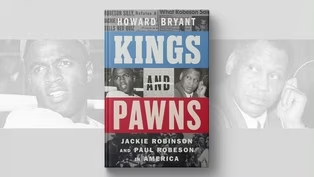
New book explores Robinson's testimony against Robeson
Video has Closed Captions
Clip: 1/27/2026 | 8m 10s | 'Kings and Pawns' explores Jackie Robinson's reluctant testimony against Paul Robeson (8m 10s)

Taiwan fears Maduro ouster may embolden China to invade
Video has Closed Captions
Clip: 1/27/2026 | 4m 58s | Taiwan fears U.S. ouster of Maduro may embolden China to mimic the move (4m 58s)

TikTok users allege censorship after U.S. ownership change
Video has Closed Captions
Clip: 1/27/2026 | 6m 16s | TikTok users say they are being censored after change to U.S. ownership (6m 16s)
Whistleblower responds after DOJ says DOGE mishandled data
Video has Closed Captions
Clip: 1/27/2026 | 9m 18s | Whistleblower responds after DOJ confirms DOGE mishandled Social Security data (9m 18s)
Providing Support for PBS.org
Learn Moreabout PBS online sponsorship
- News and Public Affairs

FRONTLINE is investigative journalism that questions, explains and changes our world.

- News and Public Affairs

Amanpour and Company features conversations with leaders and decision makers.












Support for PBS provided by:
Major corporate funding for the PBS News Hour is provided by BDO, BNSF, Consumer Cellular, American Cruise Lines, and Raymond James. Funding for the PBS NewsHour Weekend is provided by...