Here and Now
Here & Now for February 13, 2026
Season 2400 Episode 2431 | 26m 47sVideo has Closed Captions
Watch the entire episode of Here & Now for February 13.
Watch the entire episode of Here & Now for February 13.
Problems playing video? | Closed Captioning Feedback
Problems playing video? | Closed Captioning Feedback
Here and Now is a local public television program presented by PBS Wisconsin
Here and Now
Here & Now for February 13, 2026
Season 2400 Episode 2431 | 26m 47sVideo has Closed Captions
Watch the entire episode of Here & Now for February 13.
Problems playing video? | Closed Captioning Feedback
How to Watch Here and Now
Here and Now is available to stream on pbs.org and the free PBS App, available on iPhone, Apple TV, Android TV, Android smartphones, Amazon Fire TV, Amazon Fire Tablet, Roku, Samsung Smart TV, and Vizio.
Providing Support for PBS.org
Learn Moreabout PBS online sponsorship>> The following program is a PBS Wisconsin original production.
>> For the first time in Wisconsin, measles has been detected in wastewater surveillance, serving as an early warning sign of potential community spread, and immigration enforcement continues to divide public opinion and Congress.
[MUSIC] I'm Frederica Freyberg.
Tonight on "Here& Now" Republican Congressman Scott Fitzgerald on immigration funding and elections.
An interview with Wisconsin Supreme Court candidate Chris Taylor and Eric Ayisi reports on the top issues in the 2026 state of the tribes address.
It's "Here& Now" for February 13th.
[MUSIC] >> Funding for Here and Now is provided by the Focus Fund for Journalism and Friends of PBS Wisconsin.
>> The ICE surge is ending in Minnesota.
White House borders are Tom Homan announcing the move as U.S.
Senate Democrats vote to block funding for homeland security over demands for stricter rules of engagement for immigration agents.
Also this week, the House passes new election rules aimed at preventing noncitizens from voting.
Tonight, we're joined by Republican U.S.
Representative Scott Fitzgerald from Wisconsin's fifth congressional district.
And Congressman, thanks very much for being here.
>> Good to be with you.
>> So a busy week, as always in Washington.
What's your reaction to the immigration enforcement surge ending in Minnesota?
>> I mean, I think the president handled it very well.
Tom Homan has become a figure that, quite honestly, is very well trusted by both sides of the aisle.
If you go back even to the Obama administration, the president had a relationship with Tom Homan.
And and ever since then, he has been obviously a figure that's high profile.
But I think what the president did there made a lot of sense.
De-escalate, bring down the temperature.
Let's let's figure out how to do a better job of this.
And so far it's it seemed to have worked well.
>> So how would you grade the overall operation making mention here?
Of course.
Of the two U.S.
citizens killed by agents in the midst of it?
>> Yeah, both obviously very unfortunate incidents.
I think it did show that the idea that if you were going to go into any community in the United States and you were going to receive resistance from local law enforcement, or if there was going to be kind of this this situation where Ice was not really operating under the idea that they were going to be able to go in and apprehend people using some type of detain order, then what you would end up with is this back and forth in the streets.
And and certainly that wasn't productive.
So, you know, unfortunately the border was open for four years under the Biden administration.
And one of the things that President Trump ran on was that he was going to apprehend those that had criminal records and and deport them.
And, you know, but how that was going to be accomplished is as varied from state to state.
>> Do you feel as though law enforcement should be better at de-escalating a special, especially after seeing what happened in Minnesota?
>> Well, I think we're in uncharted waters, right?
I mean, this is not something that the average law enforcement agency has really dealt with in the past.
If if there was not such a high number of illegals and those with criminal records, it's very easy for them to simply go to any county jail where they've already been apprehended.
And there would just be a turnover to to Ice.
And other than in some sanctuary cities, that is the way it's always happened.
Now there's a much higher number of illegals in the states right now than we've ever seen before.
But, you know, that process has always served us well, but we find ourselves in in a different position right now.
>> Meanwhile, the stopgap funding for Homeland Security expires at midnight.
What's your response to Democrats demands for new rules for Ice and other agents, including not wearing masks and requiring the use of judicial warrants?
>> Yeah, I mean, I think if you look at the laundry list of things that Senator Chuck Schumer had rolled out from the Senate, it was kind of dead on arrival in the House.
So there would have had to have been some other type of negotiation.
And and it appears that the white House did kind of make a run at it, that they were trying to pull together a list that might have been acceptable, but the ten or so items that that the Senate had laid out was not going to happen.
So we find ourselves in a unbelievable situation.
I think, of the Democrats kind of holding this up again, and a very small government shutdown related to homeland security, which makes no sense because Ice is funded.
It was funded in the one big beautiful bill.
There's still excess dollars there.
Homeland security says they can operate for months with with Ice being able to still accomplish their jobs.
But yet you're shutting down things like the Secret Service and you're shutting down TSA at the airports, and you're shutting down the Coast Guard operations.
So there's all these other provisions and parts of of Homeland Security that are going to be left unfunded.
And, and they all run out of money at different times.
So it's this really is the the most political move we've seen so far, I think from, from the Senate Democrats.
>> Would you like to see a surge of immigration enforcement in Wisconsin?
>> I've been asked that question specifically about like the city of Milwaukee.
I don't I don't think it's been necessary.
I know some people disagree with that, but we just don't see the numbers that we've seen kind of in some of these other areas.
But I know Madison is a sanctuary city there.
There doesn't seem to be the level of of certainly, I guess, animosity between local levels of government and, and Ice being able to do their job.
So it just doesn't appear to me that, that we would be at the top of the list where where maybe those Ice agents may, may end up.
So it's it's kind of, I guess a wait and see, but but doesn't, doesn't appear to be the a good a good thing for Wisconsin and I think maybe not necessary for Ice.
>> On elections legislation ahead of the midterms.
New requirements would require proof of citizenship to register and vote.
Now, Democrats, of course, say this is voter suppression and solution in search of a problem, because non-citizen voting is a small number.
What about that?
>> I mean, I've been through this as majority leader of the Wisconsin State Senate.
I've now been through it through numerous bills in the House of Representatives.
Listen, at the end of the day, 85% of Americans think that you should have to present some form of ID when you go vote.
It's bipartisan support.
The the response from the other side of the aisle has been, I think, almost laughable in that they continue to just pretend like that, that type of poll number or support for voter ID doesn't exist.
>> This is.
>> There's no other reason to support it other than people are not presenting their their IDs at the polls.
>> Congressman, this is something more than that though, right?
It's a passport or a birth certificate to register to vote, which is a higher bar than just a photo ID.
>> Yeah, I mean, there's there's a lot of criticism from the other side of the aisle.
I mean, you can nitpick any of these bills by saying that you're asking for more information other than a driver's license.
But in most states, I mean, the documents that you need to provide to get that driver's license, unless there's a full out kind of anybody who shows up, gets that, gets that initial document, they fill it out and they're granted a driver's license.
It is still some form of ID and I, and I'm not saying that, you know, the bill, the save act, which which I think is well done and has been crafted correctly, I, you know, I've never been a big supporter of just federalizing these election laws.
I think it's important to keep some of these things decentralized.
So for me, somebody that served in the state legislature for so long, I mean, there is part of this discussion in which I'm saying, listen, this is what American people need to believe in the election cycle, especially in Wisconsin, where I run into constituents all the time that still think that the 2020 election was manipulated by rules related to Covid.
It happens all the time.
I run into people all the time that talk to me about that.
This would instill some what I what I think some concrete evidence that people that show up at the polls have some type of document in their hand, some type of, of driver's license in their hand to prove that they're a citizen and prove that they're a wisconsinite and they should be voting in that election.
>> Congressman Scott Fitzgerald, we leave it there.
Thank you so much.
>> Thank you.
Good to be with you.
>> Turning to the spring election for the Wisconsin Supreme Court, the seat opening up after Conservative Justice Rebecca Bradley decided not to run again will not change the balance of the court.
The conservative candidate is appellate court judge Maria Lazar, and the Liberal candidate is appellate court Judge Chris Taylor.
Here and now, senior political reporter Zac Schultz sat down with each of the candidates last week.
We heard from Maria Lazar tonight, Chris Taylor.
>> Judge Taylor, thanks for your time today.
>> Thanks so much for having me.
I really appreciate it.
>> Let's start with your judicial philosophy.
Tell me how you came by it and how it impacts you when you're on the bench.
>> Well, in every case, I'm guided by the same things.
I'm guided by a desire to do justice for the people who are in front of me.
I'm guided by a obligation to apply the law as fairly and as consistently as possible.
And then I'm also obligated to hold those who violate the law accountable, regardless of who they are or how how powerful they are.
So those are really the three principles that guide us.
My decisions in cases.
>> So you've been in this race for a while, and originally your opponent was going to be the incumbent, Justice Rebecca Bradley.
What was your reaction when she decided not to run again?
>> You know, my focus really is on the people, the state of Wisconsin, regardless of who my opponent is.
I am in this race because I care deeply about the people in our state.
They deserve a justice and a court that is going to stand up for their rights and protect their freedoms, and they deserve a court that is going to make sure that the other branches of government are held accountable, including the federal government, when they overreach into the independence of our state.
So I'm very focused on getting to the people, talking with the people.
My approach doesn't change based on who I'm running against.
This is a campaign about the people of the state of Wisconsin, and I'm going to be a justice for the people of the state of Wisconsin.
>> Building off that, then you don't see a big difference between Rebecca Bradley and Maria Lazar your opponent.
>> Now.
You know, I think they're very similar in a lot of ways.
They have very extreme positions that are out of touch with the people.
Wisconsin on reproductive health care.
My opponent, Maria Lazar, celebrated the overturning of Roe versus Wade.
She has made comments that she would have enforced an 1849 criminal ban that would have outlawed abortion.
In almost every instance, she has made comments that she thinks a six week abortion ban would be a good thing, signaling to the legislature that this might be a law that she would be okay with as a judge.
So those things indicate that she cannot be counted on to protect rights and freedoms of Wisconsinites.
And she wants to take us backwards.
I want to take the state and the people of the state forward.
>> Given the last couple of races we've seen in Wisconsin, how much money do you think it's going to take to win this race?
>> You know, I'm hoping not as much as what we have seen.
It has gotten ridiculous how much money are in these races.
And when I was in the legislature, I fought against the erosion of our campaign finance laws.
The reality is, here in Wisconsin, we have very little laws that prevent these out-of-state billionaires and big money special interests from coming into this race.
They're going to be coming in to support my opponent.
That is how she got elected to the Court of Appeals.
These same right wing billionaires that we saw last April have supported her in the past.
>> The first fundraising numbers that came out showed you with a commanding lead in fundraising.
Is there a danger that some of your supporters may think, oh, this race is over?
>> I hope not, because this race is not over.
We are right in the thick of it.
I take nothing for granted.
I worked very hard to get out in all corners of the state, and of course my campaign worked very hard to raise the resources that I would need out of my, I think, 19,000 campaign contributions, 15,000 of those are $100 or less.
So I am receiving a lot of support from the people of the state of Wisconsin.
That contrasts with my opponent.
Her average campaign donation was $1,800, and she only had 16 donations that were $100 or less.
So she's clearly getting her support and will continue to do so from the billionaires, from the big corporations.
I'm going to the people and asking for their support because this race is about them.
>> Unlike the last couple of races, this one's not going to likely determine the majority on on the bench.
Does that run the risk that this flies under the radar for some people because they don't feel the stakes are as high?
>> I mean, I don't think so because the majority on this court can be changed on a dime.
We have five state Supreme Court elections coming up.
And so just because there's now a pro-democracy majority on this court by only one vote does not lessen the importance of this court.
And when we have so many elections coming up, there's four more state Supreme Court elections coming up after mine.
No one should take anything for granted.
This court can change very quickly, but if I am able to get elected, there will be a pro-democracy majority on the court until at least 2030.
>> A couple of years ago, when Janet Protasiewicz won her race, she kind of changed the game in terms of talking as a candidate about her values versus issues and making sure to stay away from how she would decide.
But explaining to voters, this is what I care about.
This is what I'm passionate about.
How do you approach talking about your values or issues?
>> Well, I think it's really important that voters see who I am and they deserve that.
They are electing me to a ten year term to the highest court in our state.
So I am very open about what my values are.
You know, I value every person's ability to make their own personal private health care decisions.
My opponent does not.
She has stated that that is not a value that she has.
I value courts protecting people's rights and freedoms and holding people and entities accountable when they violate our law and violate our Constitution.
My opponent has shown that she is a rubber stamp for the most powerful and the right wing extremists in the decisions that she has issued.
And so I think it's really fair game for the public to know.
These things are things we value.
>> How do you approach precedent?
Because we've seen as the court shifted majorities over the last few years, a number of cases looking at old cases that have been settled in the past, Marklein being one of those.
But in that category, what would you do to when you approach a precedent decision?
>> Well, first of all, you have to look at does the precedential case violate the Constitution?
Does it does it protect or take away people's rights?
So that is the first thing that I would look at.
Secondly, I think if it is an issue that evolves in constitutional rights, you look at, well, has this been in place for a long period of time such that people have relied on these protections like Roe versus Wade?
It's a perfect example.
The Dobbs case took away rights that American women in Wisconsin women had come to depend on over the last 50 years, throughout the duration of my life.
And so that was very alarming that it was so flippantly done, 50 years of precedent.
Again, that conflicts my opinion about Roe versus Wade, conflicts with my opponent, who celebrated the reversal of Roe versus Wade.
So what I look at, though, in looking at precedent, is did this case comport with constitutional protections or did it not?
So there is appropriate cases where precedent should be overturned.
I mean, look at Plessy versus Ferguson.
Separate but equal.
We all know that is wrong.
And thankfully there was a case that overturned that type of discrimination in Brown versus Board of Education.
>> You're running for Wisconsin Supreme Court position.
But how much of what's happening nationally and President Trump's impact will will overshadow this race, as voters take all that into account when they're making their choices at the ballot box?
>> Well, look, I think that we have an incredible opportunity in this race, the people of the state of Wisconsin, to elect a justice who is going to stand up for their rights, for their freedoms, who is going to hold the federal government accountable when they overreach into the state?
And I'm going to protect the independence of Wisconsin.
We are an independent state.
We have our own constitution, our own laws, and everyone is subject to those when they come in the state of Wisconsin.
So I will be a strong justice making sure our people are protected and our state is protected.
>> All right, Judge Taylor, thanks for your time.
>> Thank you.
I really appreciate it.
>> Ceremony and policy.
At the 22nd annual state of the tribes address at the State Capitol this week, the address was marked as a chance to hear about accomplishments and challenges of tribal nations and encourage collaboration with the state "Here& Now".
And ICT reporter Erica Ayisi was there.
>> We.
Minocqua Khaba.
Good morning everyone.
I share with you my Anishinaabe name woman who leaves tracks where she walks.
>> Chairwoman Nicole Boyd of the Red Cliff Band of Lake Superior Chippewa Indians, highlighted achievements and challenges of the state's 11 federally recognized Native American tribes.
Focusing on tribal sovereignty and government to government partnerships.
>> We are not here simply to take.
Our ancestors knew this.
They fought for this, and they left us the teachings of reciprocity.
>> Boyd asked to work together with the state in preserving water rights on tribal lands, referencing concerns about the Enbridge oil pipeline through the bad River Band of Lake Superior Chippewa Reservation.
>> Why is it wrong to expect that the feasibility of projects of this magnitude be ecologically sound and ensure the water will be protected?
>> She also asked for more tribal input with the proposed bill to change the name of the Apostle Islands National Lakeshore to National Park, which is close to the Red Cliff reservation.
>> Were we wrong to request that there be meaningful due diligence as part of the decision making promise.
>> Relating to Governor Tony Evers recent treaty rights and the protection of wild rice?
Executive order.
Boyd asked that Manoomin, or the wild rice, be elevated to the state.
Official.
>> Green wild rice has seen a significant decline over the last many years, and promoting it will allow us a platform to continue our efforts to restore and protect this vitally important resource.
>> On economic development, Boyd touted positive gains, noting the collaboration with the 2025 NFL Draft in Green Bay with Oneida Nation.
>> This event brought in an astronomical $105 million to the state of Wisconsin.
>> She asked for legislation for online sports betting wagered through Wisconsin's tribes to be approved.
>> The state will see increased revenue through the state gaming compacts, and consumers will have the legal protection needed to ensure they receive fair play.
>> In health care.
Boyd mentioned an increase in wellness and treatment centers on reservations, and that drug overdose deaths are down.
But to assist in opioid recovery and chronic pain, calls for bipartisan support for medical marijuana in the state.
>> For centuries, indigenous people have used this plant medicine for various medical and ceremonial purposes.
>> Boyd also says the state Task Force to Address missing and Murdered Indigenous Women and Relatives needs improved policies.
That includes helping survivors heal.
>> We must invest the resources needed to prevent violent crimes against women and children.
>> As to education, Boyd would like to see the UW-Madison tribal tuition program expanded.
>> Including the College of Menominee Nation and Lac Courte Oreilles.
Ojibwe University would also provide tribal members an opportunity to attend college close to home that strongly supports their identities.
>> Sagen Lily Quale of the Red Cliff Band of Lake Superior Chippewa Indians says Boyd's call to make rice the official state grain has deeper cultural connections as a living relative for the tribal community.
>> To be able to rely on that relative as not only, you know, medicine that connects us to place in space, but also connects us to ancestry and tradition is really beautiful.
>> Paul Smith of the Oneida Nation says Boyd's message to protect waterways on and around tribal lands could bring more visitors to northern Wisconsin.
>> The national shoreline that she wants to protect with the frog Bay National Park, with protections on Lake Superior and the protections around the the waters through bad River, it's all those things are connected to tourism.
>> Bryan Wilson RFK, Jr.
also of the Oneida Nation, says Boyd's message on tribal economic contributions to the state resonates with his 100% indigenous owned small business.
>> And we're adding to our employees and with health benefits and retirement programs.
>> Boyd closed the state of the tribe's address with a message of resiliency for Wisconsin's tribal members and partnership among state and tribal leaders.
>> This is the place our ancestors fought for and are buried within, and we will continue to exercise our treaty rights in perpetuity.
>> In Madison.
I'm Eric Ayisi for “Here& Now” and ICT.
>> For more on this and other issues facing Wisconsin, visit our website at PBS Wisconsin and then click on the news tab.
That's our program for tonight I'm Frederica Freyberg.
[MUSIC] Have a good weekend.
>> Funding for "Here& Now" is provided by the Focus Fund for Journalism and Friends of PBS Wisconsin.
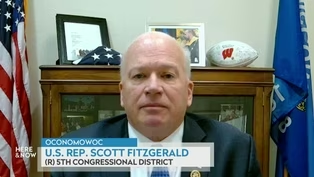
US Rep. Scott Fitzgerald on De-escalation and Funds for ICE
Video has Closed Captions
Clip: S2400 Ep2431 | 9m 42s | Scott Fitzgerald on law enforcement de-escalation and the Department of Homeland Security. (9m 42s)

Wisconsin's Tribal Nations Assert Reciprocity and Resiliency
Video has Closed Captions
Clip: S2400 Ep2431 | 5m 39s | Chairwoman Nicole Boyd delivers the 2026 State of the Tribes Address. (5m 39s)
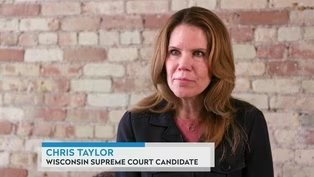
Chris Taylor on the 2026 Wisconsin Supreme Court Race
Video has Closed Captions
Clip: S2400 Ep2431 | 9m 44s | Chris Taylor on her perspectives on the law and the politics of judicial elections. (9m 44s)
Providing Support for PBS.org
Learn Moreabout PBS online sponsorship
- News and Public Affairs

Top journalists deliver compelling original analysis of the hour's headlines.

- News and Public Affairs

FRONTLINE is investigative journalism that questions, explains and changes our world.












Support for PBS provided by:
Here and Now is a local public television program presented by PBS Wisconsin