Here and Now
Bryna Godar on a Lawsuit Over Immigration Holds in Wisconsin
Clip: Season 2400 Episode 2446 | 5m 33sVideo has Closed Captions
Bryna Godar on a lawsuit against county sheriffs over the status of 48-hour ICE detainers.
University of Wisconsin Law School State Democracy Research Initiative attorney Bryna Godar explains a lawsuit against five county sheriffs in the state over the legal status of 48-hour ICE detainers.
Problems playing video? | Closed Captioning Feedback
Problems playing video? | Closed Captioning Feedback
Here and Now is a local public television program presented by PBS Wisconsin
Here and Now
Bryna Godar on a Lawsuit Over Immigration Holds in Wisconsin
Clip: Season 2400 Episode 2446 | 5m 33sVideo has Closed Captions
University of Wisconsin Law School State Democracy Research Initiative attorney Bryna Godar explains a lawsuit against five county sheriffs in the state over the legal status of 48-hour ICE detainers.
Problems playing video? | Closed Captioning Feedback
How to Watch Here and Now
Here and Now is available to stream on pbs.org and the free PBS App, available on iPhone, Apple TV, Android TV, Android smartphones, Amazon Fire TV, Amazon Fire Tablet, Roku, Samsung Smart TV, LG TV, and Vizio.
Providing Support for PBS.org
Learn Moreabout PBS online sponsorshipauthority to restrict non-tribal members from fishing within its reservation.
In other news, a lawsuit against five Wisconsin sheriffs in Walworth, Brower marathon, Kenosha and Sauk counties over Ice detainers or immigration holds waffles between being heard in state or federal court.
A federal judge in Madison this month remanded the case to the Wisconsin Supreme Court.
The sheriffs wanted heard in federal court and have appealed that remand.
The question before any court is whether those 48 hour ice holds are legal in Wisconsin.
Our next guest unpacks the issue.
Bryna Godar, staff attorney at the UW Law School State Democracy Research Initiative, joins us now.
Thanks very much for being here.
>> Thanks for having me.
>> Well, first of all, how does an Ice detainer work?
>> An Ice detainer is a request sent by Ice to local or state law enforcement agencies, asking them to hold somebody for an additional 48 hours beyond when they would otherwise be released under state law.
And these are voluntary requests.
So the local law enforcement officers can decide whether to follow that request or not.
If they do follow it, then the person would remain in custody beyond when they would otherwise be released.
>> Waiting for Ice to come and retrieve them.
>> Yes.
Yeah.
>> And so how common is the use of these Ice detainers across Wisconsin?
>> So according to some data from October 2021 through June 2025, I sent more than 3300 detainer requests.
Not all of those were necessarily honored, coming in.
And counties really vary in whether they are working with Ice to honor those, or if they have policies that limit how frequently they honor those detainers.
>> Presumably, this has ticked up during the current Trump administration.
So what has that cooperation on the part of sheriffs and sheriff's departments resulted in?
>> So the petitioners in this case are arguing that that results in unlawful detention of individuals past when they would typically be released.
And that can have significant impacts for individuals potentially dealing with child care or dealing with missing work.
This can apply to people who are not just at the end of a criminal sentence, but also in pretrial detention.
So who might otherwise be detained for a relatively short time?
Those additional couple days can have a significant impact.
And there are also concerns that cooperation between local law enforcement and Ice can erode trust in local communities with law enforcement, and lead to underreporting of crimes and less of a close relationship with the immigration community.
>> So the lawsuit argues that these holds are not legal because sheriffs have no authority with administrative warrants to conduct a second arrest of someone.
Would you expect that the state and federal courts would have a different view on that?
>> I think it depends on whether they view this as really an issue of state law or federal law.
So the plaintiffs in this case are arguing that this is really just an issue of state law.
And that is something that you would sort of expect the Wisconsin courts to actually have the more expertise on and be able to decide in a more authoritative way.
What the respondents are arguing is that there's this federal law issue of whether federal law sort of independently provides some basis for that arrest authority.
And so if they succeed in getting this case into federal court, the federal courts might be more open to that.
And it seems like respondents think that federal court might be more favorable to it because they are seeking to get it into federal court.
enforcement, under state statute, can arrest if there are reasonable grounds to believe that the person is committing or has committed a crime.
Wouldn't an argument be that someone entering into the country illegally and staying constitutes a crime?
>> So first of all, the statute, it is not a crime under state law to enter and be in the country unlawfully.
And so it's not clear that that statute itself would give the authorization for state law enforcement to make that arrest.
But even if it did, federal law only criminalizes a narrow subset of immigration violations, particularly entering the country unlawfully.
So somebody, for example, who enters with a lawful visa and then overstays that visa has not actually committed a federal immigration crime.
Also, Ice detainers can issue two folks with green cards who then are facing deportation proceedings because they have committed a crime subsequent to entering the country, but they are not actually unauthorized until they go through those proceedings.
And so there are many people who are subject to Ice detainers who have not committed any sort of federal immigration crime.
>> So if it is decided in state court, would it only apply in Wisconsin versus applying nationally if it was decided in federal court?
>> Yes.
So if it's decided in Wisconsin, it would only apply in Wisconsin.
The reach of a federal court decision would depend on what issues they decide and also what level of court it gets to.
So if the federal court ultimately rules mostly on Wisconsin law and based on Wisconsin statutes, then it wouldn't apply beyond the state.
It would just sort of be persuasive to other courts, like a Wisconsin Supreme Court ruling would be as well, if the federal court were to rule on more of a blanket federal law issue, and particularly if that were to get appealed up to the Seventh Circuit or the US Supreme Court, then that could have broader national implications.
goal, for it to go all the way up?
is.
The merits briefing hasn't happened yet, either at the state level or at the federal court level.
The Federal court remanded based on a timing issue of the filing.
And so we don't really have a good sense yet of how viable it would be for this to become really a major federal law really a major federal law
 New
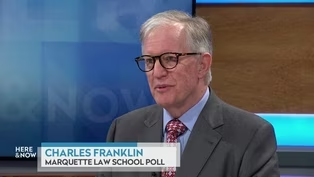
NewCharles Franklin on Polling Wisconsin's Budget Surplus Deal
Video has Closed Captions
Clip: S2400 Ep2446 | 6m 14s | Charles Franklin on voter support for a bipartisan spending bill was defeated. (6m 14s)
 New
NewHere & Now opening for May 29, 2026
Video has Closed Captions
Clip: S2400 Ep2446 | 1m 6s | The introduction to the May 29, 2026 episode of Here & Now. (1m 6s)
 New
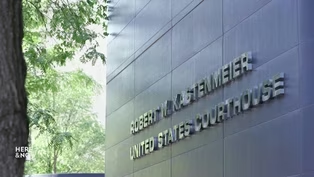
NewLac Du Flambeau Tribe Fights State Lawsuit On Fishing Access
Video has Closed Captions
Clip: S2400 Ep2446 | 1m 22s | A federal court heard a state of Wisconsin lawsuit over tribal fishing limits on 19 lakes. (1m 22s)
 New
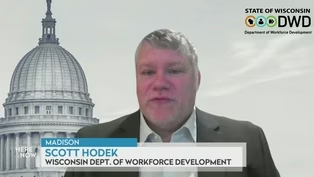
NewScott Hodek on Wisconsin's Job Market, Layoffs and AI's Role
Video has Closed Captions
Clip: S2400 Ep2446 | 7m 22s | Scott Hodek on shifts in the job market and impacts of artificial intelligence. (7m 22s)
 New
NewWisconsin's 2026 Governor Race and Local Government Funding
Video has Closed Captions
Clip: S2400 Ep2446 | 6m 12s | Candidates in the 2026 race for governor on shared revenue to local government. (6m 12s)
Providing Support for PBS.org
Learn Moreabout PBS online sponsorship
- News and Public Affairs

Top journalists deliver compelling original analysis of the hour's headlines.

- News and Public Affairs

Today's top journalists discuss Washington's current political events and public affairs.











Support for PBS provided by:
Here and Now is a local public television program presented by PBS Wisconsin