
The Big Burn, Chapter 1
Clip: Season 27 Episode 4 | 7m 59sVideo has Closed Captions
In 1910 the largest fire in U.S. history burned over three million acres.
In the summer of 1910, hundreds of wildfires raged across the Northern Rockies. By the time it was all over, more than three million acres had burned and at least 78 firefighters were dead. It was the largest fire in American history, and it assured the future of the still-new United States Forest Service. The Big Burn premieres February 3 on American Experience PBS.
Problems playing video? | Closed Captioning Feedback
Problems playing video? | Closed Captioning Feedback
Corporate sponsorship for American Experience is provided by Liberty Mutual Insurance and Carlisle Companies. Major funding by the Alfred P. Sloan Foundation.
Support provided by:


The Big Burn, Chapter 1
Clip: Season 27 Episode 4 | 7m 59sVideo has Closed Captions
In the summer of 1910, hundreds of wildfires raged across the Northern Rockies. By the time it was all over, more than three million acres had burned and at least 78 firefighters were dead. It was the largest fire in American history, and it assured the future of the still-new United States Forest Service. The Big Burn premieres February 3 on American Experience PBS.
Problems playing video? | Closed Captioning Feedback
Where to Watch American Experience
American Experience is available to stream on pbs.org and the PBS app.
Buy Now
Related to This Clip
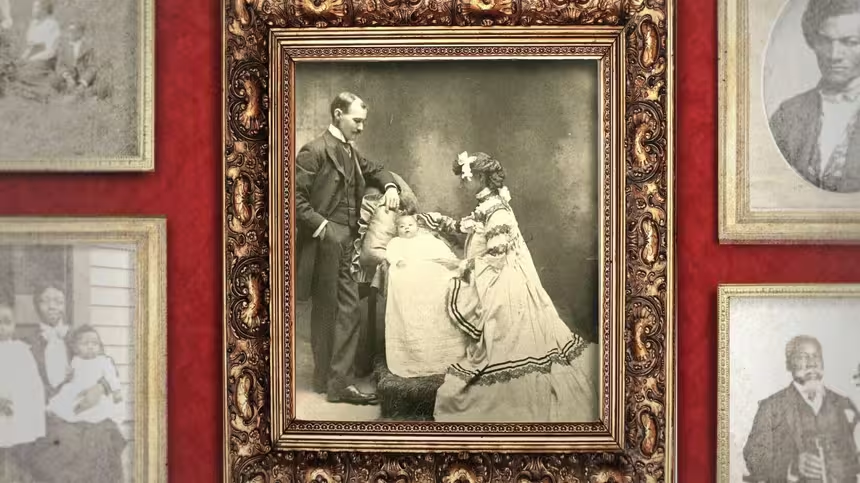
When is a photo an act of resistance?
For families that just decades earlier were torn apart by chattel slavery, being photographed together was proof of their resilience.Providing Support for PBS.org
Learn Moreabout PBS online sponsorship[Narrator:] On August 19th, 1910, an assistant Forest Ranger named Ed Pulaski rode out of the smoke-filled Bitterroot Mountains that loomed over the town of Wallace, Idaho.
For months he and his crew had been fighting wildfires in the Bitterroots, but despite all of their efforts, he was afraid the town was going to burn.
[Timothy Egan:] Ed Pulaski comes down and sees his wife and sees his adopted daughter, Elsie, and says, "Leave.
You've got to get out."
"You've got to leave to save your life," And she says, "No, I'm gonna stay here."
And so he tells her to go up and hide in this reservoir.
If it really gets bad, they can go into the water.
So, the next day they go out to the edge of the trail there, kiss and say goodbye and thinking that would be the last time they ever see each other.
[Narrator:] That afternoon, without warning, the wind began to blow, and flaming embers shot down from the sky, igniting buildings.
Within minutes, Wallace was ablaze.
Desperate residents tried to salvage their belongings.
Women and children were loaded onto the last train out of town.
The roar of the wind and flames was overwhelming, the air so hot it was hard to breathe.
The biggest wildfire to ever hit the Northern Rockies, had begun.
[Egan:] The Big Burn destroys an area the size of Connecticut in 36 hours we've never had anything close to it.
[Narrator:] It was an inferno that not only transformed the landscape of the West, but forever changed the nation's attitudes about its public lands.
[Steve Pyne:] The Great Fires in the Northern Rockies hit the U.S.
Forest Service in ways that rippled through society the army call-out the political fights over strategy.
It's all slammed together in one giant package.
That made them great.
[Narrator:] It was a story of arrogance and pride a belief that nature could be managed and fire brought under control.
[Michael Kodas:] There was an attitude that, if there's something wrong in the forest, we can go in there and fix it.
It was almost as if wildfire was this beast that we can actually hunt down and eradicate.
[Narrator:] The selfless courage of a small group of men would inspire the nation, but questions would linger about whether their sacrifice had all been in vain.
[Pyne:] We can celebrate them as people of their time and era who played out fully the roles that the culture ascribed to them and yet admit that it would have been better if we'd done something else.
[John N. Maclean:] It's a time of catastrophe a time of change, a time of coming up with a new vision.
If you look at the landscape, the scars of 1910 are still there.
[Narrator:] In the flea-bitten collection of ramshackle buildings known as Taft, Montana, college graduates were about as rare as an honest poker game.
So the locals took notice when, in the early Spring of 1907, a group of fresh-faced rangers from the United States Forest Service stepped off the train.
The recent arrivals had come to manage some of the newly-created national reserves in the West, but nothing had prepared them for a place like Taft [gunshot] - - a boisterous, brawling, row of gambling parlors, whore-houses, and saloons.
One reporter called it "the wickedest city in America."
[Pyne:] You've got these temporary communities, particularly along the railroad lots of loose women, lots of loose men, lots of bums, people under assumed names.
There's just this whole throng out there.
How do you impose some kind of order on this process, which had been characterized by almost complete chaos?
[Egan:] Taft had a higher murder rate than Chicago and five prostitutes for every man, they said, and when the rangers showed up, they were horrified.
They cabled back to Forest Service headquarters, saying, "Two undesirable prostitutes setting up business on Forest Service land."
"What should we do?"
And someone cabled back, "Get two desirable ones."
[Narrator:] The newly-minted rangers had been sent West by the founder of the Forest Service, an aloof, hard-driving bureaucrat with an almost missionary zeal for the management of America's public domain.
In less than a decade, Gifford Pinchot had parlayed his family's wealth and social connections, a passionate love of trees, and a deft hand at politics to become America's preeminent forester.
[Egan:] Pinchot is one of the most fascinating characters, not just in American conservation, but in American history.
He was a patrician; he was a very odd duck.
He preferred to sleep on rocks than a soft bed.
He was an ascetic.
But he had a vision.
Even though he was the product of a family that made their money in clear cutting forests; he became, you know, one of the founding figures of saving forests.
[Char Miller:] For Pinchot, nature was really a place of respite.
It's where you went to just forget other things and become whole and become safe and, and in that process come to know yourself.
[Narrator:] Pinchot had forged friendships with some influential men in the growing conservation movement, in particular the famous naturalist, John Muir.
"You are choosing the right way into the woods," Muir told the young man, "You will never regret a single day spent thus."
Pinchot also developed a rapport with the young governor of New York, Theodore Roosevelt, a bond strengthened by their love of the wildness of nature, and a boyish thrill at testing themselves against it.
When Roosevelt ascended to the White House in 1901, he brought Pinchot into the inner circle of his administration.
The two men were determined to seize the mantle of conservation and radically rethink how the nation managed its estate.
Preview: S27 Ep4 | 30s | In 1910 the largest fire in U.S. history burned over 3 million acres. Premiering Feb 3. (30s)
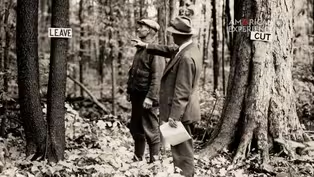
Clip: S27 Ep4 | 2m 58s | In the early 1900s, timber was an essential US product. Premieres Feb. 3 on PBS (2m 58s)
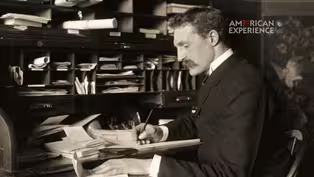
Clip: S27 Ep4 | 2m 54s | Fire was essential to the survival of the new US Forest Service. Premieres Feb. 3 on PBS. (2m 54s)
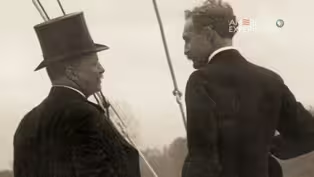
Clip: S27 Ep4 | 2m 35s | Roosevelt and Pinchot make a plan to save America's wilderness. Premieres Feb. 3 on PBS. (2m 35s)
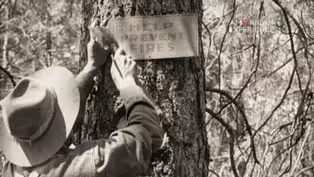
Clip: S27 Ep4 | 2m 19s | Firefighters are regaled as heroes for the first time in America. Premieres Feb. 3 on PBS. (2m 19s)
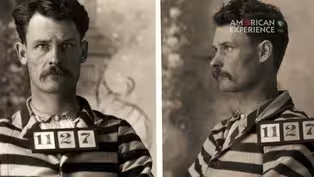
Clip: S27 Ep4 | 1m 45s | In 1910 the U.S. Forest Service was desperately understaffed. Premieres Feb. 3 on PBS. (1m 45s)
Providing Support for PBS.org
Learn Moreabout PBS online sponsorship













Support for PBS provided by:
Corporate sponsorship for American Experience is provided by Liberty Mutual Insurance and Carlisle Companies. Major funding by the Alfred P. Sloan Foundation.